


Having completed one marathon and two extreme marathons within a year, you might think there was nothing more to go for. I don’t know what I thought about that back in 2000. Now I know that there is no upper limit for what people can pull off in the marathon and triathlon. My performances in life are trifles compared to so many others, though nothing can really be described as a trifle when you’re talking about running. We all have our own physical and mental limits. Our individual performances in our sport are unique and do not tolerate comparison with others. My next run would turn out to be one of a calibre I had never expected.
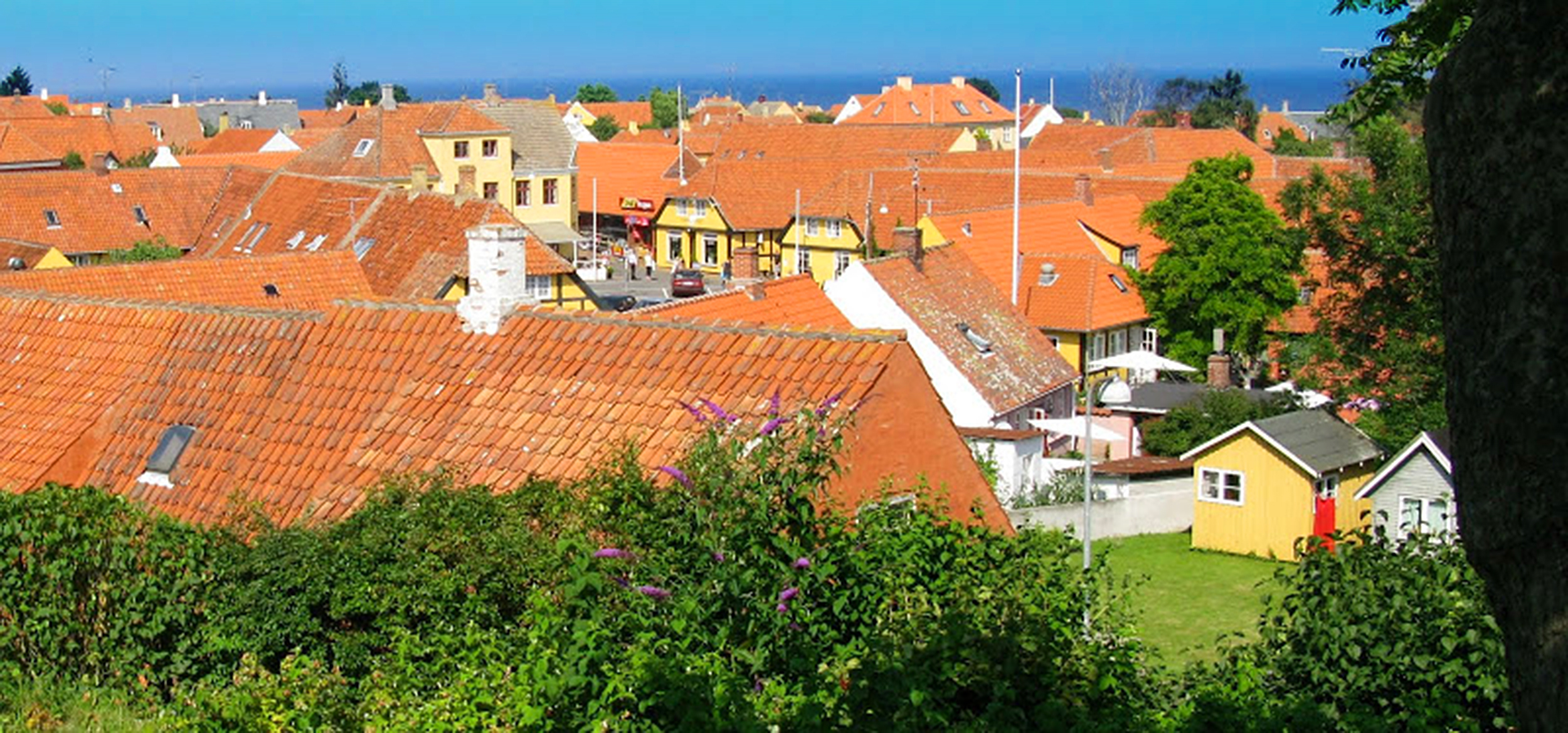
At the gala in China, I had coaxed the Bornholmer Ingvor into giving me a folder, and when I later had the opportunity to read it properly, I found that it was about the Ultra Marathon Bornholm. This was the very same marathon Peter Fredberg had told me about while we were emptying our bladders in the Chinese field. My first reaction was to shake my head, but the seed had been sown and the folder was always lying where I could see it on my desk at home.
I didn’t necessarily have to run the 100 kilometres, because the marathon distance was an alternative. But I gradually became more and more enthusiastic, and there was no way I could “make do” with the marathon. If I were going to participate, I had to “go” the whole way.
I told my sister about the run and my intention to run it. She had lived on Bornholm for a few years but had moved back to Zealand 14 years previously. She thought it sounded like an exciting run though she was not a runner herself, but she would like to see the rocky island again and offered to come along. That meant that we could make a family trip of it with my boys and my niece. My sister had been in the Air Force and still had colleagues on Bornholm. For a symbolic amount, she managed to rent two rooms at the Air Force base for the weekend of the run.
On Friday 1st September, we left for Bornholm. We were going to take the Sound Link for the first time, two months after it had opened. We drove from Amager south of Copenhagen to Skåne in Sweden through the tunnel and over the bridge and then on to Ystad, where we took the catamaran ferry to Bornholm. It really was a brave new world getting to Bornholm so quickly. The ferry crossing took only an hour and 20 minutes, whereas, in the old days, you sailed all night from Copenhagen to Rønne.
We had Saturday to ourselves and spent the day as tourists on the island, which neither of us had visited for years. We returned to many of the places we used to know, but it was rather odd driving round the sunshine island outside the holiday season. There were practically no people, and we had the roads more or less to ourselves. Naturally enough, lunch consisted of smoked herrings, a Bornholm speciality, from one of the island’s many smokehouses, and we ate supper at a restaurant on the square in Rønne. Here it was even more obvious how deserted the island was at this time of year. The square was empty, and even the kiosk was closed, although it was only 9 p.m. But we couldn’t paint the town red that evening and soon left for the Air Force base at Årsbølle and went to bed in one of the barracks.
The run was on 3rd September and was organised by the SÅN Runners, an amalgamation of clubs from Svaneke, Årsdale and Nexø. I think it must have been the wettest day of the year on Bornholm. I awoke in the middle of the night to the sound of thunder so loud it seemed impossible. Through the window, I could see the horizon almost completely illuminated by the lightning flashing away out there in the distance. I just hoped things would calm down by the morning. I managed to get a bit more sleep, but the thunder reminded me constantly what the weather was like.
The run was to start from the square in Nexø at 8 a.m., and we drove off to get there in good time. Now the rain was only very light, and I had faith in the worst now being over. When we arrived, it had stopped raining, but it was a bit chilly because of the wind. Windproof clothing made it bearable, but as it turned out this was silence before the storm because, by the time the starting gun was due to go off, Our Lord had reopened the sluice gates. The run was started officially by the town’s mayor, though it was unlikely that anyone heard him through all the rain and wind, which completely drowned out anything coming from the loudspeakers. We were soaked through even before we set off. Fortunately, things cleared up from time to time, and it didn’t rain all day.
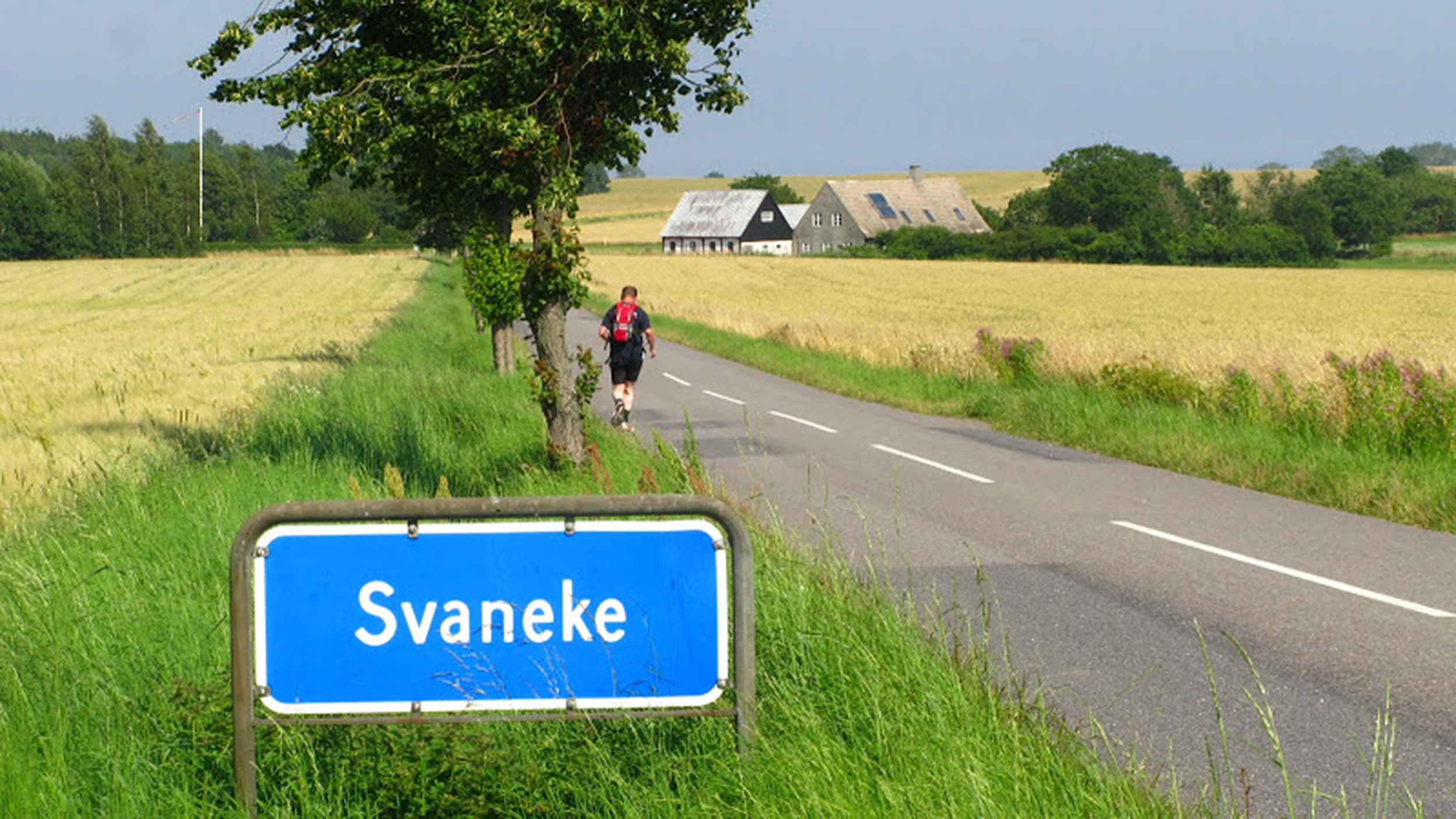
The rocky island is quite hilly, so my strategy was to walk up the worst ascents and try to run on the other sections. I wasn’t able to stick to this strategy throughout the day but generally managed to do so.
For the first part of the race, I ran with Peter Fredberg, but gradually he was too fast for me. He told me I shouldn’t take the 13-hour time limit too seriously. He was sure the organisers would wait for the last arrivals and recognise their performance even if they came in after the marathon was officially over. But this bit of information was no use to me whatsoever! My stubbornness and sense of fairness didn’t permit me to finish on dispensation and be recognised on the basis of leniency and grace. All that counted for me was to finish within the official time limit.
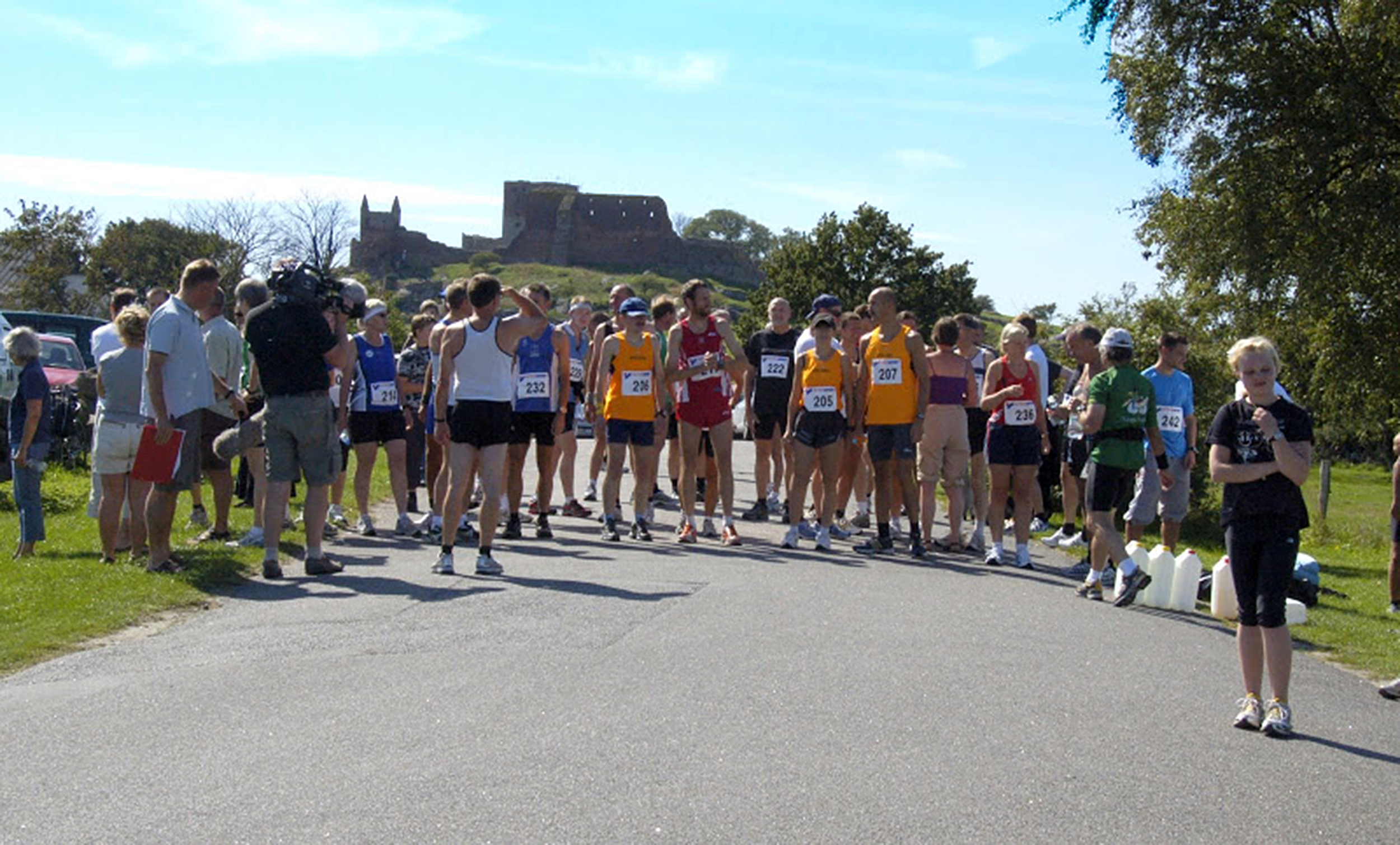
At around midday, there was a proper downpour, so I was thoroughly soaked when I arrived at Hammershus, which is Northern Europe’s largest medieval castle ruin and the finish for the marathon runners. It was here it occurred to me that what Peter had said was perfectly true when he told me a few months earlier that it wasn’t your legs that counted but your mind. It would be quite wrong to say that I wasn’t tired, but despite the hilly terrain and the rain I felt surprisingly fresh. My brain was programmed to run 100 kilometres that day, so for me, this was a subsidiary goal, and I wasn’t even half way. So I couldn’t really be tired yet! I have since become very much aware of this mechanism. Whether it’s ten kilometres or a full marathon I’m running, it’s the final stretch that “pulls your teeth out”.
The family was waiting for me at Hammershus, so I ate a few slices of rye bread and changed my sopping wet clothes and running shoes so that I could run on dry. At that point, the weather was good; it was dry and the sun was shining, so the change was welcome. Nothing lasts forever, though, and it didn’t stay dry for long. When I later reached Hasle there was another heavy downpour, although that was more or less the last one.
When I passed the 70 kilometre mark, I was pretty tired and could feel that I had not spent a day at the office. They were kilometre signs and water stations every five kilometres and at kilometre 75, I accepted the offer of a leg and calf massage. At that point, I was accompanied by a cyclist from the club organising the run whose job it was to keep tabs on the rear guard. He gave me some good moral support by telling me that I wasn’t last. Behind me was a racing walker. The racing walker had walked the 100 kilometres many times and always made it within the time limit. This gave me confidence and faith in myself. As long as I had him behind me I would get through. However, despite this conviction my inner “computer” was running all the time. I was very aware of my time and how much I had left before the deadline. I had to keep on checking that I was in a position to achieve my goal.
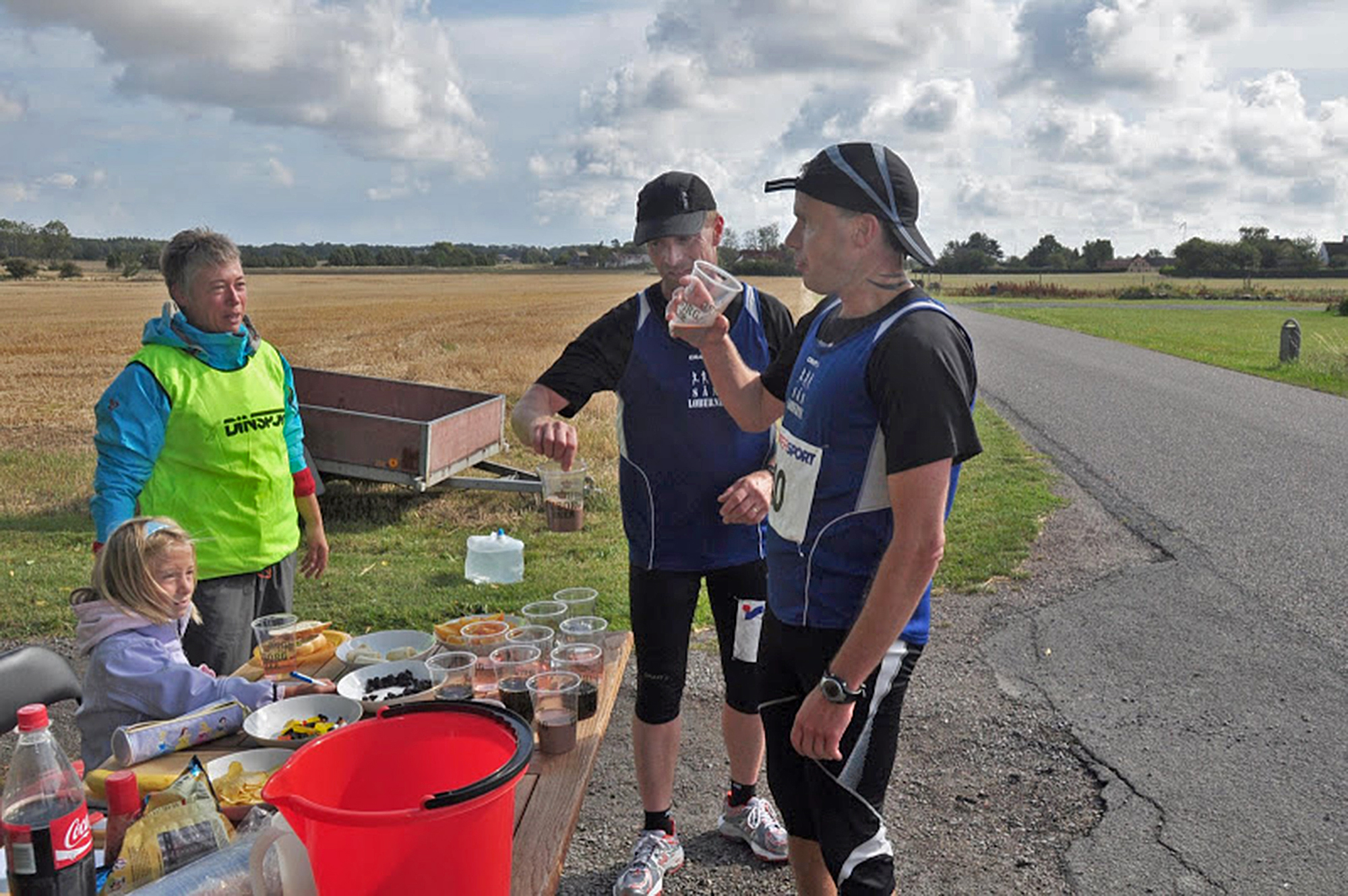
When I arrived at kilometre 80, I was again offered a massage. I accepted the offer this time as well, but at kilometre 85 I declined. Not because I didn’t need it but out of respect for the time limits I needed to maintain.
After 90 kilometres, I experienced a terrible downer. While I was standing there drinking water I saw the racing walker pass me by at a rate of knots. He simply kept walking without a break, his wife following him on a bike making sure he had enough to eat and drink along the way. It was quite a snack to be passed by and thus take up the rear. My collateral had vanished, and I felt abandoned and had to fight extra hard after this. Having run 90 kilometres in just over half a day, I didn’t have that many mental resources left. I felt tempted to break down and cry as I saw my “lifeline” fading out of sight on the horizon.
When I arrived at the next water station, I had got over being overtaken, although I was very aware of my timing and aware that there was not much to spare. As I stood there I suddenly felt dizzy, as though I was swaying back and forth. It was one thing that I didn’t feel right, but something else entirely that I didn’t want that to be discovered by the people around me. It would have been almost unbearable to have been running for half a day and reach 95 kilometres only to be taken out of the race. I hastened to drink up and continue and when I got going I no longer felt dizzy.
Before long I would be back in Nexø, where it had all begun. It was now completely dark, but it hadn’t rained for some time. I was full of optimism and realised that my mission was about to be a success.
It goes without saying that I have no idea how the winner was received. But I was received as though I had been the winner of the day. And that’s the way it also felt to me. It really was a great victory to get through this extreme day and complete the run within the set time limit. My time was 12:51:17, which was just nine minutes from the time limit. At the finish stood my family and a group of people that must’ve been from the organising club. Everybody cheered, clapped and shouted my name as I used up what strength I had left to struggle over the finishing line.
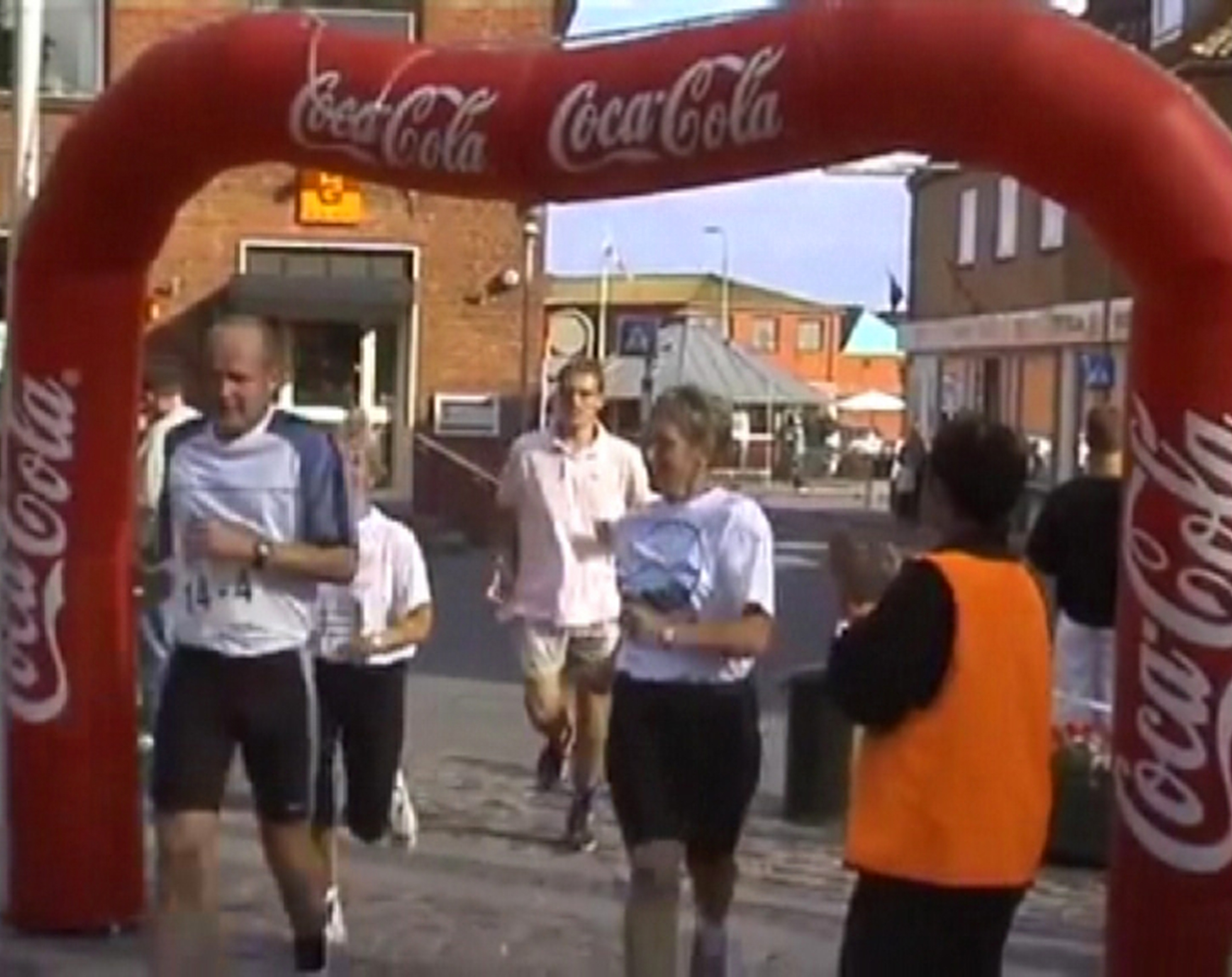
I had absolutely no energy after that. When I stopped, I began to feel the cold as though it was the coldest winter day in a Polar region. And I was wrapped in blankets, but that didn’t help a bit; I just stood there, my teeth chattering like mad.
By the time we had picked up our things at the Air Force base it was too late to catch the last ferry to Ystad, so we decided to take the good old route between Rønne and Copenhagen with the ferry M/F Poul Anker. As we sat at the ferry terminal in the car, my sister pulled out a bottle of whisky and asked if I needed a pick-me-up. I quite honestly thought I deserved it and said yes please. She poured me a very small amount in a shot glass. I swilled down the golden drops, which had an immediate effect. I remember nothing about it myself but the family has never refrained from telling people about it. It is said that I immediately lost the power of speech and that my gait on the ship’s deck was even crazier than on the square in Nexø.
You might think that I slept really well that night. But that was not the case. I was restless throughout my body and went to the lavatory several times, each of which was a struggle for my tender, aching body.
Buy the book here.
