


It wasn´t sport I was interested in
The words above my cradle certainly didn’t say that I was to become a long-distance runner and would be taken round the world by this passion. I never was much good at sport, and nor am I now. But my running has meant so very much to me. I have been driven, not by victory and records, but by the desire and the will time and time again to run those 42.195 kilometres – sometimes longer distances.
I began playing football at Roskilde Ball Club of 1906 at the age of 12, and already after the first day of training they were short of a goalkeeper and asked me to play a training match with boys a year older than myself. I guarded the goalposts, and we lost 9-0. I was a member of the club for about a year, and because I wasn’t exactly a shining talent, I was never selected to play in competitions. Since it was all boring training and ill-matched training matches, I lost interest and ended up leaving.
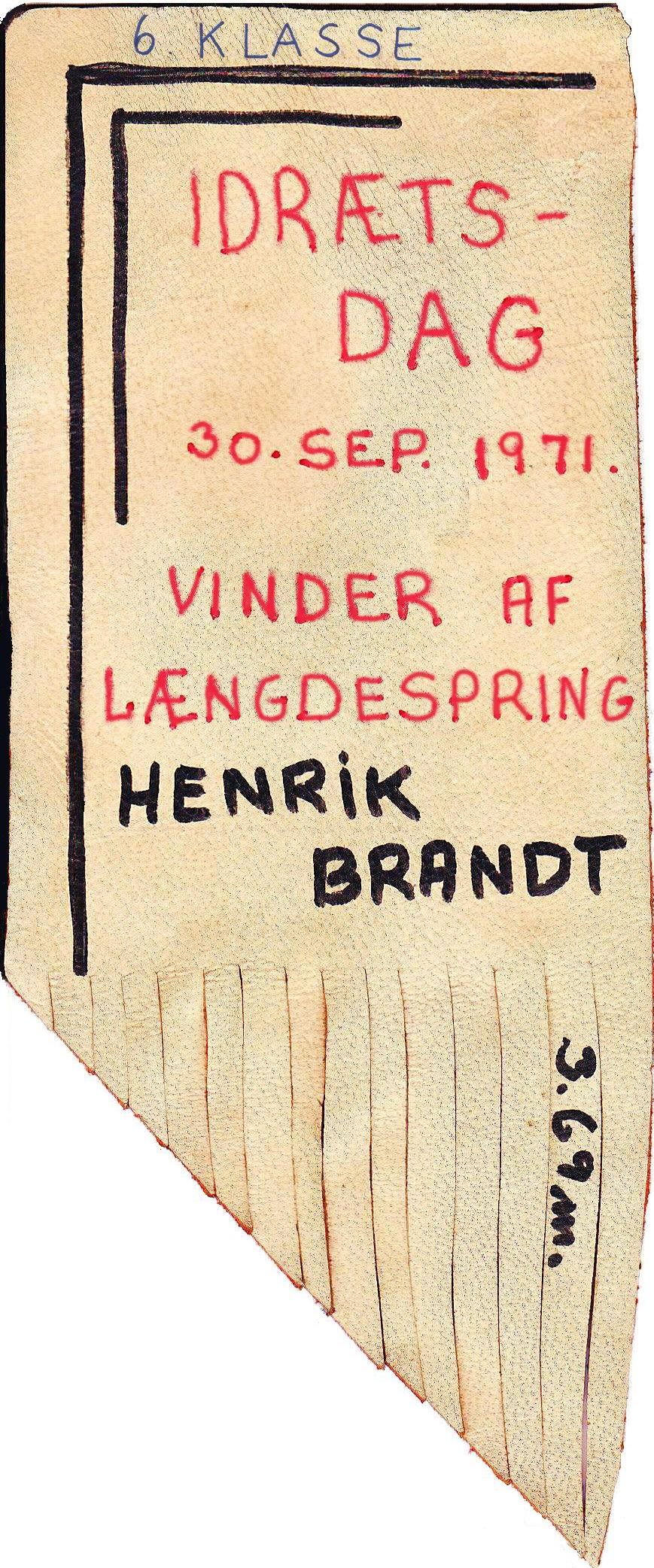
The same pattern manifested itself at the annual sports days when the town’s schools competed against each other. I was never selected for anything there either. But in this case, too, they were short of a long jumper when I was 12. I’ve never jumped the long jump, but I immediately volunteered just to be involved in something. We were to do three jumps and at my first attempt I managed 3.69 metres, finally showing some promise. I became the hero of the day in my class, and I was happy. A year later I was again selected for the long jump and this time also for the high jump, but neither went particularly well.
At the age of 17, I joined the Royal Danish Air Force as a trainee and enjoyed seven good years that helped make a man of me. All servicemen were required to do regular 12-minute running tests, during which time they had to run at least 2,400 metres. This was no problem for me because I could run 3,200 metres, making me one of the fastest in the squadron – although that is probably because there weren’t that many fleet-footed men where I was serving!
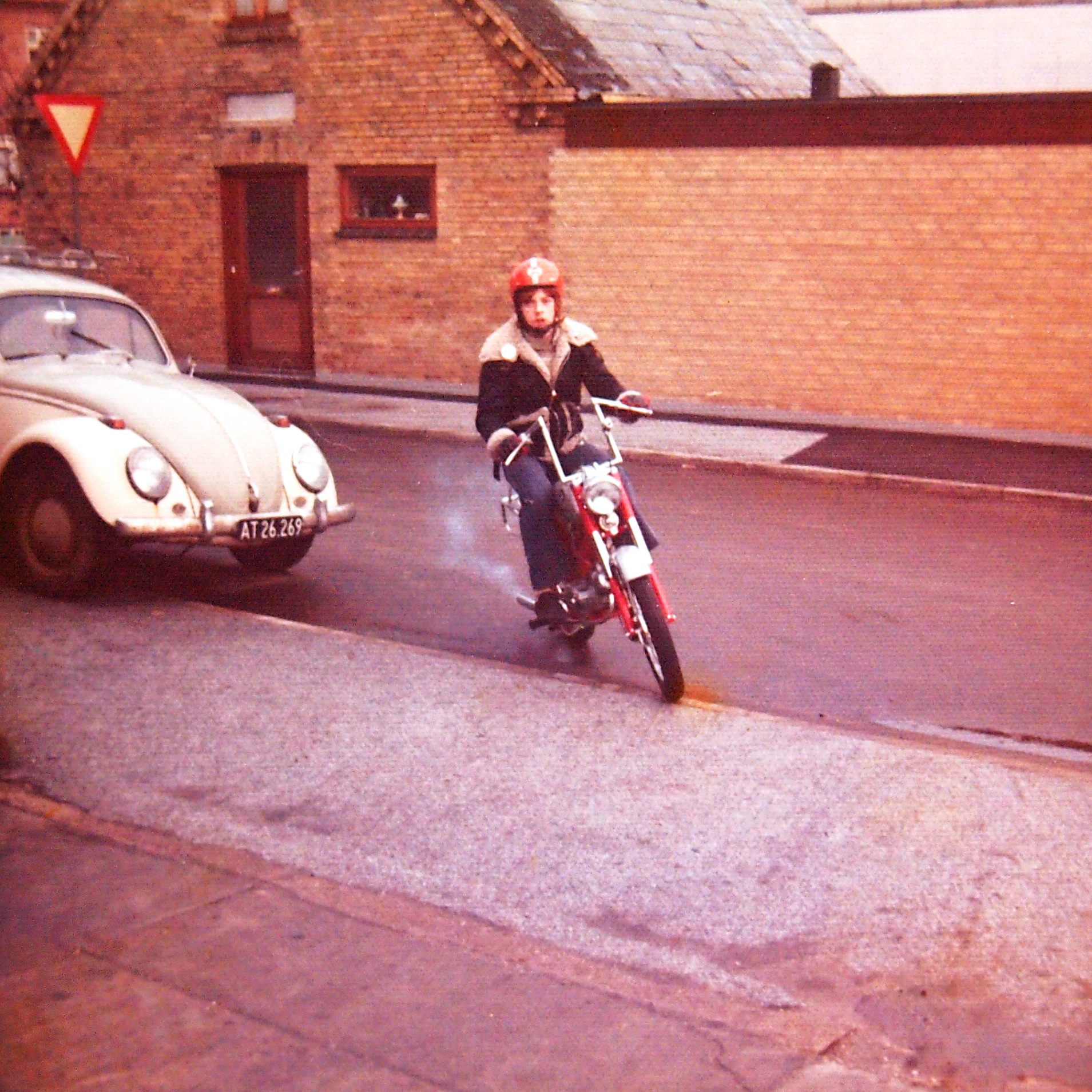
Sport was generally of no particular importance to me during my youth. I spent my time with games, boring out the cylinders of my mopeds, smoking cigarettes, spending time on girls and generally messing about. Since my relatively inglorious footballing career, sport had never really meant anything to me. But after the success of Roskilde’s division team in 1978, I became interested. As a spectator, that is. I would drink beer with my friends, shouting foolish things when the team was playing at home as well as a few away games in my part of Denmark, Zealand. Pools football and cold beers on Saturday afternoons became routine, and European Cup matches brought us together, as well. Once in a while we went to international matches and cup finals at Copenhagen Stadium.
So I was interested in football but was not active
myself, though I did play for the squadron team in competitions if they had
difficulty getting a team together. All the same, I chose to train as a
football referee and passed my exam in 1979. This meant that, for the next five
years, I was driving about in Zealand refereeing minor league matches. I can,
however, boast of reffing an actual international match. Well… as the only
trained football referee in my Air Force group, I refereed most of the matches
between the various squadrons. In the light of this status, I was also asked to
referee a match against some British colleagues who were on exercises in
Denmark. As I remember it, Denmark won 4-1. I hope I didn’t take sides – I’m
pretty sure I didn’t – and the Danish victory was well earned.
Running – heaven forbid
After I had left the Air Force, I bought a house in Himmelev, a suburb of Roskilde, with Hanne, whom I had known since we were teenagers. Søren who lived next door was an incarnate cyclist and runner. He soon got Hanne and I out running with him. When we left the house to run as far as three kilometres, I was despondent before, and especially during, the run! In the end, we stopped running with Søren, and I was greatly relieved.
Hanne, on the other hand, started training with the local athletics club, Hellas, in the early 90s. After a while, she got the idea that she wanted to run a marathon, which to me was incomprehensible. She started on training programmes I found absolutely absurd and could spend all day Saturday training. I missed those cosy early mornings with freshly baked bread rolls, soft boiled eggs and Gammel Dansk bitters, though spending quality time with our son, Steffen, was certainly fine by me.
Hanne ran her first marathon in May 1993 in Copenhagen, though I must admit I didn’t give her much support. Her mother went with her to the capital, whereas I chose to stay at home with Steffen and do our own things. When Hanne returned happy and proud later in the day with her medal from the Copenhagen Marathon I showed no enthusiasm, just spouted a few platitudes. She never forgave me for that, and today I would wish that my attitude had been different.
It wasn’t until 1998 that Hanne had the urge to run another marathon. The relatively long break had nothing to do with my poor behaviour. Our second son, Emil, was born in 1994, which rather put Hanne’s marathon ambitions on standby for a while, but now she decided to run the Berlin Marathon in September.
I was a bit more attentive this time, and we made it a family trip, spending the day before the run sightseeing in Berlin. On the Sunday morning, we went to watch Hanne at the start. Then we set off sightseeing again, returning to the finish later in the day to await Hanne’s arrival. When she appeared on the last straight, Steffen asked if he could run with her and it was moving indeed to see that ten-year-old kid crossing the line hand-in-hand with his Mum.
Amazing what a T–shirt can lead to
Just a month after Berlin, Hanne and I were off on our travels again, this time for a week in Cairo without children to celebrate our up-coming copper wedding anniversary. On one of the first days down there, we received a phone call and fax from my sister, who had read in the tabloid BT that the Danish Athletics Association, Albatros Travel and BT intended to arrange the world’s first marathon with part of the run along the Great Wall of China. My sister had booked two tickets for us, though we did have a 24-hour right to cancel. However, it was not sure that Hanne could take part because of her job, or could get into good enough shape for a marathon by May 1999. We, therefore, decided to abandon the idea.
But being among the first to run a marathon on the Great Wall of China would be fantastic, and Hanne could not stop thinking about participating. This time she had my support because I really wanted to see China, visit the Forbidden City and Chairman Mao’s mausoleum, the pandas, the Wall and all the other things I’d heard of. I envisaged how I would be sitting at the finish, cold beer in my hand, clapping as Hanne crossed the finishing line. That was not how it was to be.
Hanne had to get used to the idea of competing again, so it took time, and in the end it turned out that we’d waited too long. When I called Albatros Travel, all the tickets had been taken. The number of places was extremely limited for safety reasons, and it was difficult to secure enough plane tickets. So we were added to the waiting list and hoped somebody would cancel. We called again after a few weeks, but nothing changed until some way into 1999.
On 9th March 1999, Hanne called me at work. She had gone to the office of Albatros Travel to hear if we even had a chance, or whether we should drop the idea altogether. To her huge surprise, she was able to pick and choose as she wished. I never did discover why we were kept on tenterhooks for months, but now we agreed that we should call and make our final booking. We could choose from 21 different groups with different lengths of stay, travel dates and arrangements, and I subsequently had to answer several additional questions regarding seating, insurance, etc. Last, however, came the question that changed my life: “What T-shirt size does the runner wear?” I answered medium and shortly afterwards the conversation was over. But then the devil rose within me. I called back to ask whether there was a price difference between a runner and a companion. I was told that the price was the same.
“Does that mean to say that I have to pay the same as my wife but don’t get a T-shirt?” The answer was: “Yes, you’ve got to earn that”. Purely as a provocation I then said: “So put me down as a runner, I don’t intend to get cheated out of a T-shirt”. Now the last question became: “What size T-shirt do you want, then?”
When I got back home, I was able to tell Hanne that I had now secured our trip to The Great Wall Marathon in a group of 14, and that I had registered as a runner. She was gobsmacked and stared at me in disbelief. “Are you thinking of competing in that race?” she asked. “No, of course not,” came my answer!
My well-developed sense of fairness and desire to please the organisers thus got me mixed up in a project I at that time had no intention of completing. But that was to change quite quickly.
From words to action
Later that same day, Hanne was getting ready for a six-kilometre training run. I thought for sure that it was a bit far, but I wanted to run with her anyway. Hanne asked once again in amazement, if I really did intend to run in China, and once again I denied it. But to my considerable surprise, the six kilometres didn’t seem that hard and I had no trouble keeping pace with Hanne. My unconscious mind was headed for a new goal. A few days later, Hanne was about to set off on a slightly longer run, and I joined her. Once again, she was quizzical, but I still maintained that I had no intention of running in China. It went on like that for a while.
I eventually braced myself and “came out” as a marathon runner. I had become confident in myself and couldn’t carry on being a “closet runner” with furtive excuses. I had decided to take the leap from being a “couch jogger” to completing the world’s toughest marathon after two and a half months of training. I don’t think that is the usual way of going about it.
Now, after all these years, I might as well admit that I already made the decision to run as I was sitting talking on the phone to Albatros Travel. But since I detest losing face I didn’t want to say that loud until I was sure that I could deliver the goods. I had registered as a runner out of pure provocation and the desire to tease. After a few training runs, I admitted publicly that I intended to run in The Great Wall Marathon, thus making my debut as a runner on the world’s most difficult distance. And for me it has to be that when I have said A, then I also have to say press B. So there was no going back. My decision had been made.
I spent the next couple of months in regular training. I had no idea what I had let myself in for. Okay, I was now running almost 30 kilometres during one training session. But that wasn’t 42 kilometres, and it wasn’t in China, running as I was in the woods outside Roskilde. I did, however, run in one organised race, when, in April, I turned out for the Hedeland Mountain Marathon, a half marathon in pretty hilly terrain which runs up one steep hill, used by skiers in winter. This was a small taste of the rigours to come.
Not just a old race
There was a lot of interest in the world’s first marathon on the Great Wall of China. The tabloid BT was on its toes, but other media were also interested, including one of the world’s largest TV stations, CCTV in China.
The Great Wall Marathon wasn’t just any old race. I was never in any doubt about that. A month before the event, we received two sheets of A4 paper with “Special Reservations and Conditions”, in which it was made abundantly clear what it was we had let ourselves in for, and it was pointed out that participation was voluntary and at our own risk. All runners were recommended to subject themselves to a health examination before departure, and it was driven home that we would be attending a running event that was not about coming in first. The organisers made it very clear that our participation in this challenge was not without dangers. Out of regard for sponsors we were not allowed to wear or promote prominent slogans or logos larger than 2 x 5 cm, unless we had prior written permission from the organisers. The starting number bearing the name of the organisers and sponsors was to be worn on top of all the other clothing throughout the race. Any runners who did not respect this could face being turned away from the race or prevented from starting, without compensation, nor would they get a diploma or running time.
Special rules also applied to photography and video recordings, and it was emphasised that the Chinese authorities had extensive powers. We were all asked to comply with requests from the local police in the running area and in no way to seek confrontation with the Chinese authorities. It was emphasised that in China problems are seldom resolved through direct confrontation, and that seeking such confrontation could result in the loss of the running licence and massive financial compensation.
Finally, force majeure rules were listed in the event of the race being cancelled because of the political situation, the weather or other conditions. All runners were to confirm in writing that they had read and agreed with the “Special Reservations and Conditions”.
But apart from the above, the organisers also sent us extremely comprehensive information material, so that we could prepare ourselves properly for the upcoming trip. We got an overview of all the travel groups and a detailed map of the route, complete with water stations and first aid stations. A 14-page document (“Nice to know”) provided us with all sorts of practical information about the trip, the flight, hotels, meals, training, daily timetables, luggage, climate, washing and clothing, footwear, the run, hygiene, health, photography, finance and shopping. Everyting was thoroughly prepared and nothing was left to chance.
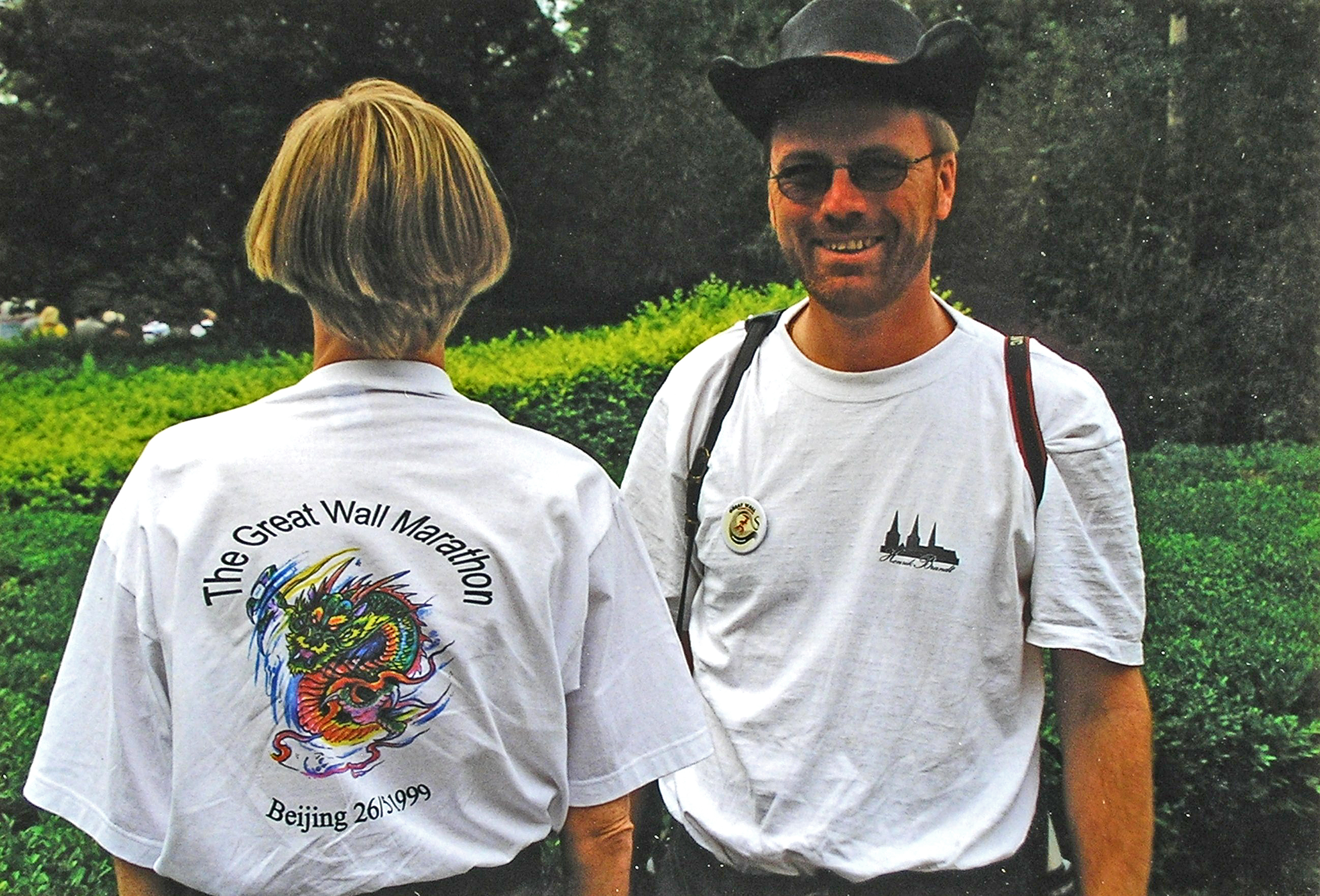
I felt that something exceptional should be made
for this very special trip, which I thought would be a one-time experience of a
lifetime. I, therefore, wanted to print T-shirts and sweatshirts, but had
difficulty finding the right motif. Using the official logo of The Great Wall
Marathon was an obvious choice, but at that time I didn’t even know one
existed. The Internet wasn’t so widely used in those days, and Google was still
in its youth and unknown to most people. I tried to find a fitting motif at the
local library but couldn’t be satisfied. Then it occurred to me that the motif
from a tattoo might not be a bad idea, so I visited a tattoo artist in my
hometown. He allowed me to peruse a large book of designs, and I found one I
thought I could use. He wouldn’t let me take it home with me, so I got hold of
a photocopying machine and copied the design at the tattoo artist’s premises.
It’s obvious that I have a thing about China and T-shirts.
Buy the book here.
