


My first actual marathon in Denmark turned out to be an odd sort of race. But this wasn’t so odd, in fact, because up to that time I had only run extreme marathons, apart from Berlin, of course. I can no longer remember how it came about that my Danish debut was on the west coast of Jutland.
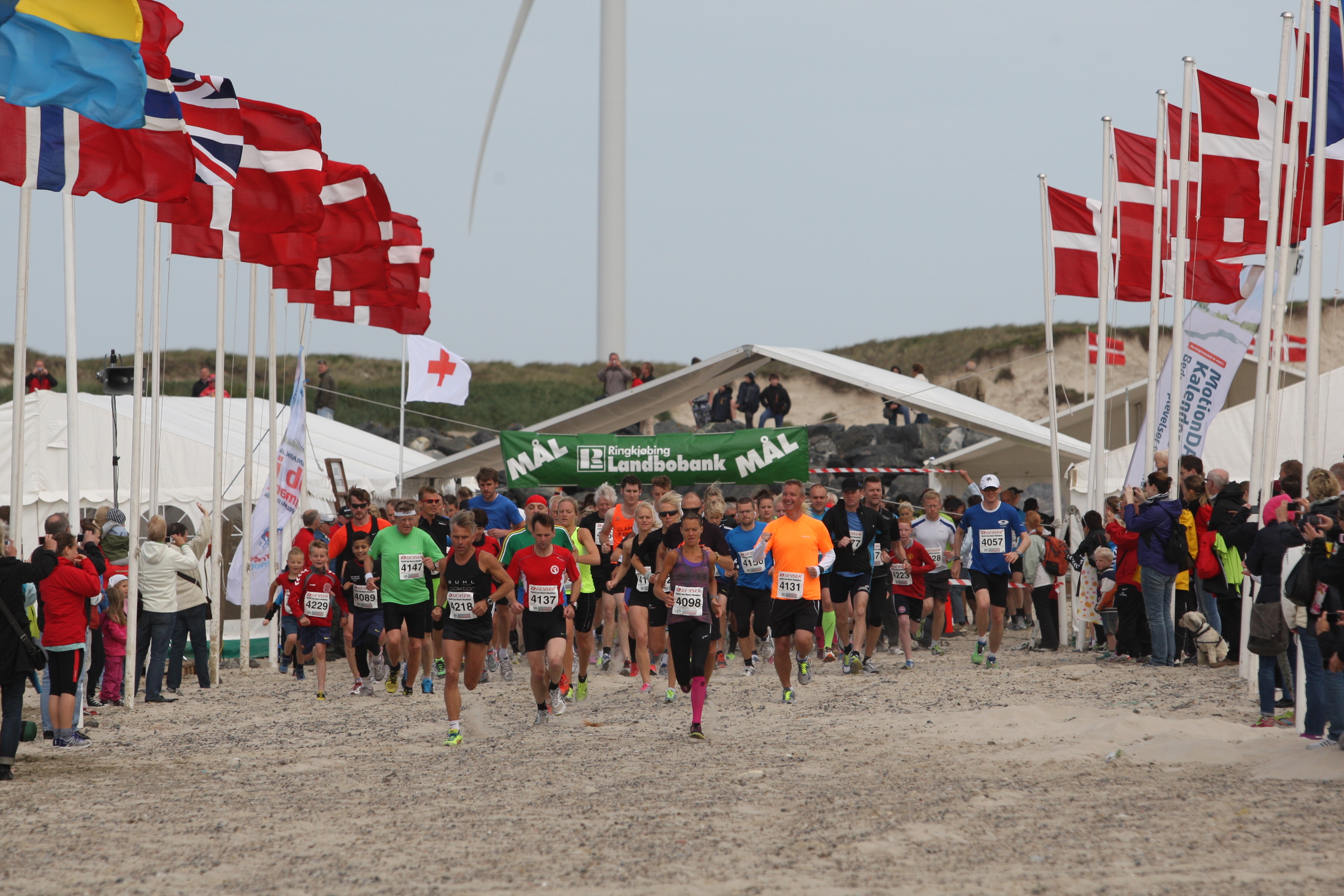
The North Sea Beach Marathon was run for the first time in 2000, so I ran in the second run. This race is probably the only running event in the world, which takes place only on sand. In addition to the classic marathon distance of 42.195 kilometres, there is also a half-marathon and distances of ten and five kilometres. The year I participated, the run began in Vejers and ended at Hvide Sande, as in the first year. Over the years, the start and finish areas have alternated between these two places. Some years you run northwards and in others southwards. The half-marathon starts every year in Nymindegab and has the same finish as the marathon. The shorter runs now start and finish in the same place, so you run in one direction, then turn and run back. That was not the way it was in 2001, however. That year, the ten-kilometre race started at Skodbjerge Strand and the five-kilometre run at Hvide Sande South Beach.
The run usually takes place around the change of the month June/July. In 2001, it was held on Sunday 1 July.
It had now become a tradition for both the boys to come along. The race started at 11 a.m., so we had to leave home early to get to the west coast of Jutland in time. Vejers Strand is in southwest Jutland, in Varde Municipality between Blåvand and Grærup. The start was in the middle of the beach where there wasn’t usually very much going on. But there was no doubt that something was going on that day. Flags, toilet wagons, cars and people in running gear made their marks at the beach.
Just like other runs I have taken part in this was also quite special and had its own charms. Until then, I had run marathons in very hilly territory, including both mountains and steps, and I had also negotiated curves and turns where signposts and guides had been vital to the run. Here, the track was as flat as a pancake and all you had to do was run straight ahead. There were no mistakes to be made.
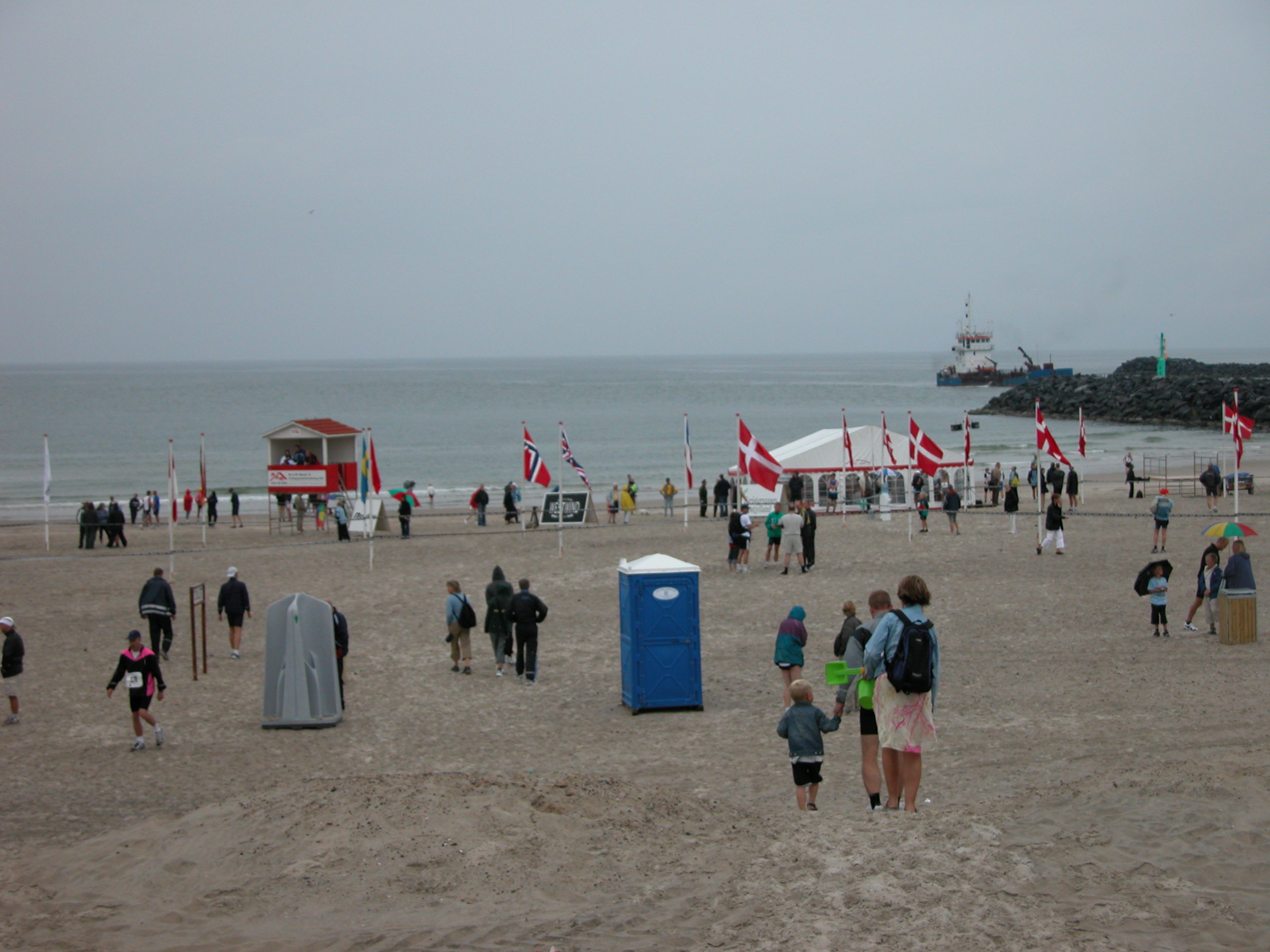
Running in sand was entirely new to me. In some places, it wasn’t much of a challenge, in areas with moist, hard sand that was easy to run on. In other places, we ran on stones close to the water’s edge, which made it worthwhile to run right at the water’s edge in certain places, despite the risk of getting wet feet. The worst places were those with dry, soft sand. Here, it felt almost as though you were running in slow motion. Apart from the ground conditions we also had to battle against a stiff oncoming wind from the northwest, and one unpredictable factor was that you never knew where you might sink in. You couldn’t see if there was air trapped beneath the sand. At the start of the race, the sky was full of heavy clouds, although it didn’t rain.
Not every runner gets the opportunity to jump over a dead cod in the middle of the route, and it is seldom indeed that the first-aiders at a marathon drive around in tracked military vehicles. But such are the conditions when you set out to conquer nature and run a marathon along a never-ending sandy beach in wet socks and with the wind whistling in one ear most of the time.
As at most marathons, there were signs every kilometre, although the countdown was rather unusual because it had to be adapted to four different distances.
The run might immediately sound rather boring, but on the contrary it was quite unique. Its setting along the outermost edge of western Denmark, and the sometimes blustery wind helped to make for a sensual experience in which you tasted both salt and sea.
This time, Steffen was to run the ten kilometres and therefore started at the point where I had already run 32.195 kilometres. This distance was to start at the water’s edge, but because the sea had “eaten” its way up to the flagpoles they had to hurry to move the start a little further back. He was not due to start until 14.30, so, as I approached Skodbjerge Strand, I got the idea that I would arrive in time to give him a hug and wish him a good run. I was perfectly aware of the fact that I would not have the necessary energy to keep up with his strong young legs on my final stretch. But my idea turned out to be pretty stupid. I battled away to reach Steffen and in so doing used more energy than I actually had. As a result, the ten-kilometre run started less than 100 metres before I got there. I saw the start but couldn’t catch sight of Steffen sprinting off in the crowd. After this, I was both physically and morally shattered and had to walk most of the last ten kilometres, which thus took me more than an hour and a half.
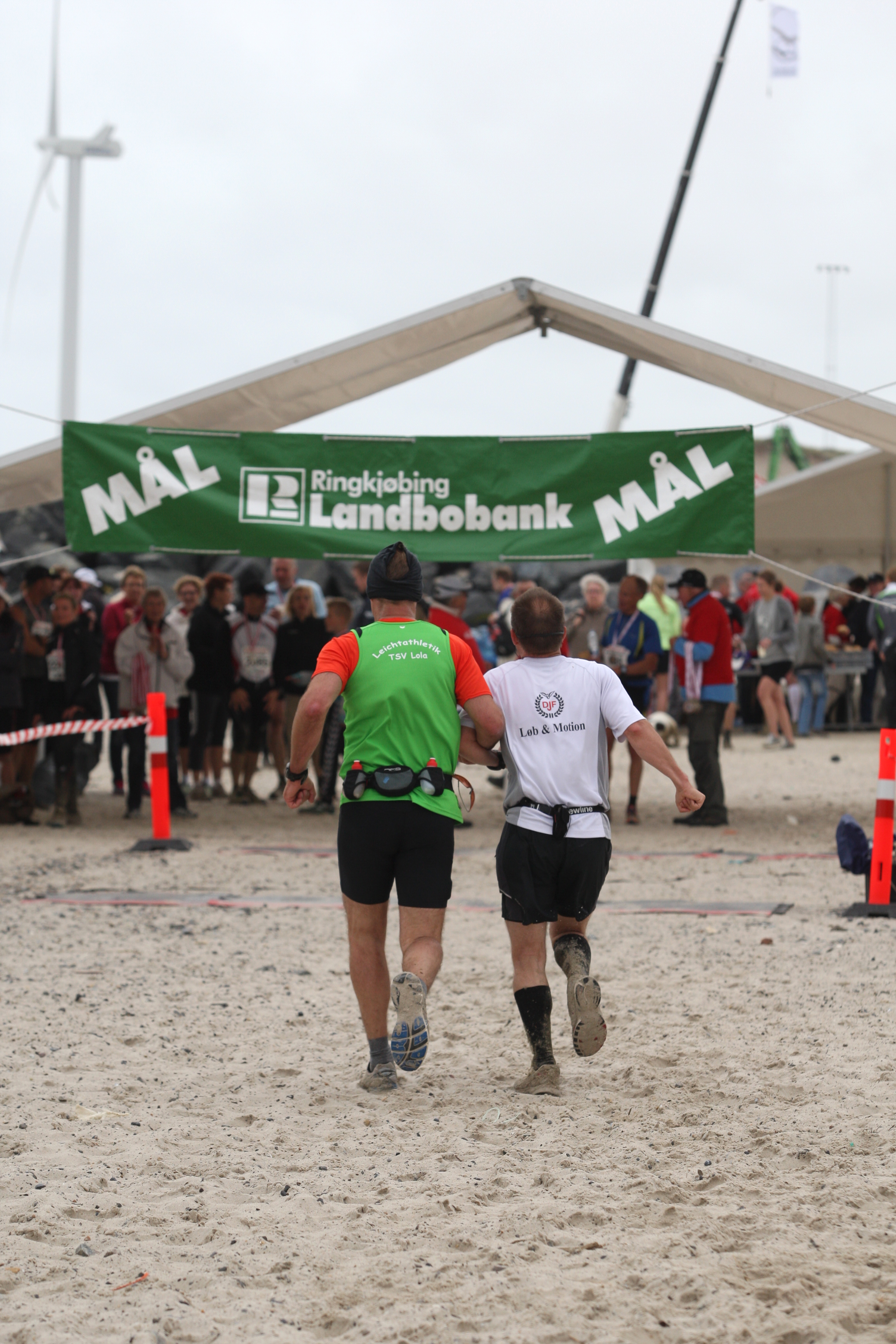
But there was no way I could get myself to walk across the line even though running was not easy. At the finish, the three shorter distances and a lot of marathon runners had passed this point before me; and the sand was now so soft that it was just like running in deep snow. So putting the last few metres behind me was quite an ordeal.
Although I was tired and exhausted, it was simply great to cross the finishing line in the cosy little fishing town in the parish of Holmsland Klit. The atmosphere was pure party here. The baker on the pedestrian street was selling beach runner cakes, and a few local women stood there concerned in the wind talking about how all those runners had far too few clothes on. It was also wonderful to be received by my two sons at the finish. Steffen had managed his ten kilometres in 1:16:10, while it took me 5:01:37 to complete my marathon. After a cooling shower, we drove back to Zealand.
A total of 1821 runners from 11 nations had signed up for the four distances before the day of the race. Of these, 1623 completed the run, 426 of them marathon runners. The winning man was Torben Nielsen with a time of 3:10:30, while Polish Janina Malaska was the first woman to cross the line with a time of 3:29:44.
Buy the book here.
