


Not so straightforward
My first city marathon in Berlin in 1999 had given me a taste for big, famous marathons, and I wanted to try another one. Elisabeth was living in central London at the time, just a stone’s throw from Hyde Park, and during the Christmas holidays of 1999, I ran in the park several times and got the idea of running the marathon in the city. This would turn out not to be so easy.
My intention was to take a cheap flight to England and stay with Elisabeth. All I needed now was a running number, but this was to be quite a challenge.
It would have been possible for me to run the London Marathon, if I simply bought an expensive package solution from a travel agent with a flight and hotel room. I could also have raised money for charity, but for me, neither of these options was possible, or what I wanted.
Limited number of runners
Run for the first time in 1981, the London Marathon has since developed into one of the biggest and most famous of its kind. Interest in the run is huge. If the city could accommodate them, 100,000 people would gladly turn out, but there simply isn’t enough space. Some 40,000 start numbers are issued, and many apply in vain. A very limited number of running numbers are sold by the piece, and a ballot is held among the runners. Getting through is down to a lot of luck.
Draw
In 2000, I decided to try and buy a running number and investigated the possibilities. It turned out that there were two ballots. One of them was for UK residents, the other for those who lived elsewhere, but I made use of both. Because I was able to use Elisabeth’s abode as a c/o address I could put my name on both lists – we shared the same surname at the time. The London system required that you should send them a cheque, and there was a box you could tick to indicate that you would donate the amount to charity if your name was not drawn. If that happened, your name would go into a fresh ballot. I decided to make use of that possibility and was thus potentially included in three ballots. As I had expected, however, I didn’t get a running number in 2000. On the other hand, I did receive a polo-necked jersey with the marathon logo for the amount I had donated.
This repeated itself over the following years, 2001, 2002 and 2003. I was starting to get hopeful though, because I had heard that if you didn’t get through the eye of the ballot needle five years in succession you were certain of getting a running number the following year. But it didn’t take that long.
From glee to frustration to relief
Early in 2004, Elisabeth called to say that I had received a letter at her address, and I immediately asked her to open it. The letter congratulated me on having won a running number for the London Marathon on 18th April 2004. This made me very happy, of course, but frustration soon took over. On that very weekend, I was supposed to be on a course in connection with my NLP-training. Failure to attend would mean that my qualification would be delayed by a whole year. In actual fact, it was not really very much of a dilemma because I was fully aware of the significance of this training. All the same, not being able to go to London was very disappointing. When I later received the letter itself I was greatly relieved. I could see from the small print that it was possible to send in a coupon and have your running number transferred to the following year. That would be no problem, so I immediately sent off the coupon to England.
Delicious food and great hospitality
Friday, 15th April 2005 in the evening, Karin and I flew with Maersk Air to London Gatwick, where Elisabeth met us. She had in the meantime moved to St Michael’s in Surrey, just south of London. We were entertained with good food and a drink or two in her new, beautiful surroundings before it was time to retire to bed.
A day in central London
Saturday, Karin and I went to London to pick up my race number and go exploring. Elisabeth drove us to the train station after breakfast, and we took the train into London and the ExCel Exhibition and Convention Centre at Royal Victoria Docks in London’s East End. After I had picked up my race number, we gave ourselves plenty of time to see the huge exhibition that included everything a relic hunter could wish for. We spent the rest of the day sightseeing and shopping in central London before Elisabeth joined us in the evening. We then went out to eat before returning to St Michael’s to get some well-deserved sleep.
City positively oozes marathon
On Sunday 17th April, it was time for the jubilee run, the 25th London Marathon. Elisabeth drove us to the station after breakfast, and we took the train up to town for the big race. There was no need to buy a ticket for the Underground because travel was free on the occasion of the marathon. This was probably more of a practical measure than a gesture to the runners. Not surprisingly, the place was teeming with people in running gear. The train and Underground were packed, and roads had been closed to make room for the marathon.
The start was near Blackheath station. The runners would not all be starting at the same time and place, but would soon join the same route. My running number was 22244, and I was in the blue start group starting from Shooters Hill Road. Here we divided up into smaller start groups according to our expected finishing times. It goes without saying that I wasn’t in the fastest group, so I found my way to group 8, where I belonged.
Imaginative runners
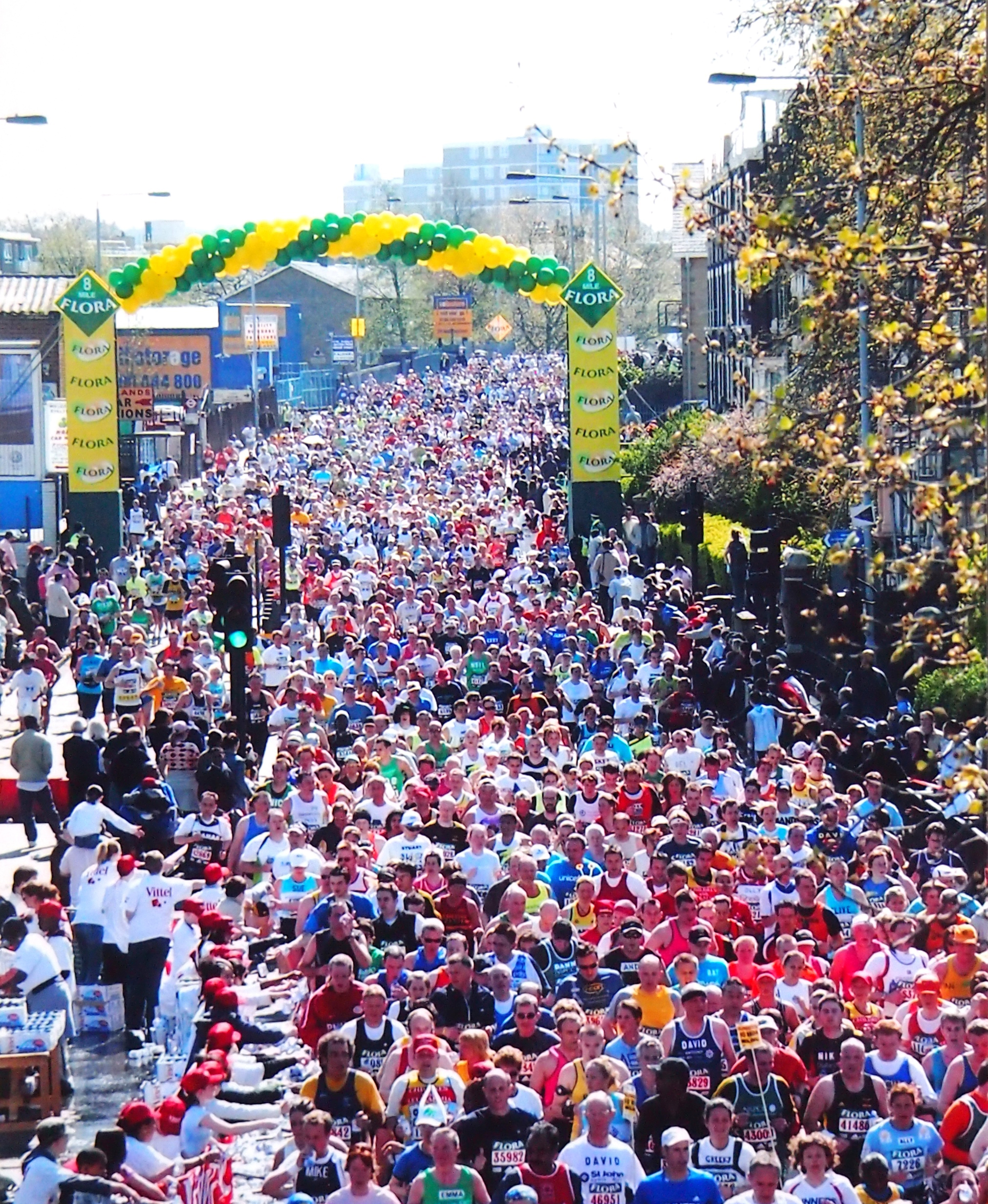
It was a pleasant spring morning with cheerful people all over the place. There was plenty of opportunity to get something to drink and use the lavatories if necessary, so all the runners were fully prepared for the start. It was fun and rather interesting to see all the festive, imaginative runners who had turned out. As I had previously experienced in Berlin, people were demonstrating the most fantastic creativity, particularly the runners raising money for charity who were wearing the weirdest costumes.
The marathon
My group set off at 9.25. Starting at the back of such a large group means that you don’t start running immediately, but that didn’t matter. It was fine for me to save my strength; there would be plenty of need for it later.
After about five kilometres, we were on the proper route, all the runners having filtered in from the three start areas. There was a lively atmosphere throughout the day. The route began east of Greenwich on the south bank of the Thames, and basically followed the river, first on the south bank, then on the north. We crossed the Thames at London’s famous Tower Bridge, almost halfway through the race. The finish was on the Mall with our backs to Buckingham Palace.
There was plenty to drink throughout. Towards the end of the run, a spectator made me a tempting offer by reaching out a can of beer to me. Although I’d drunk enough water by that time, I made the wise decision not to touch alcohol until later.
Hello – where are you?
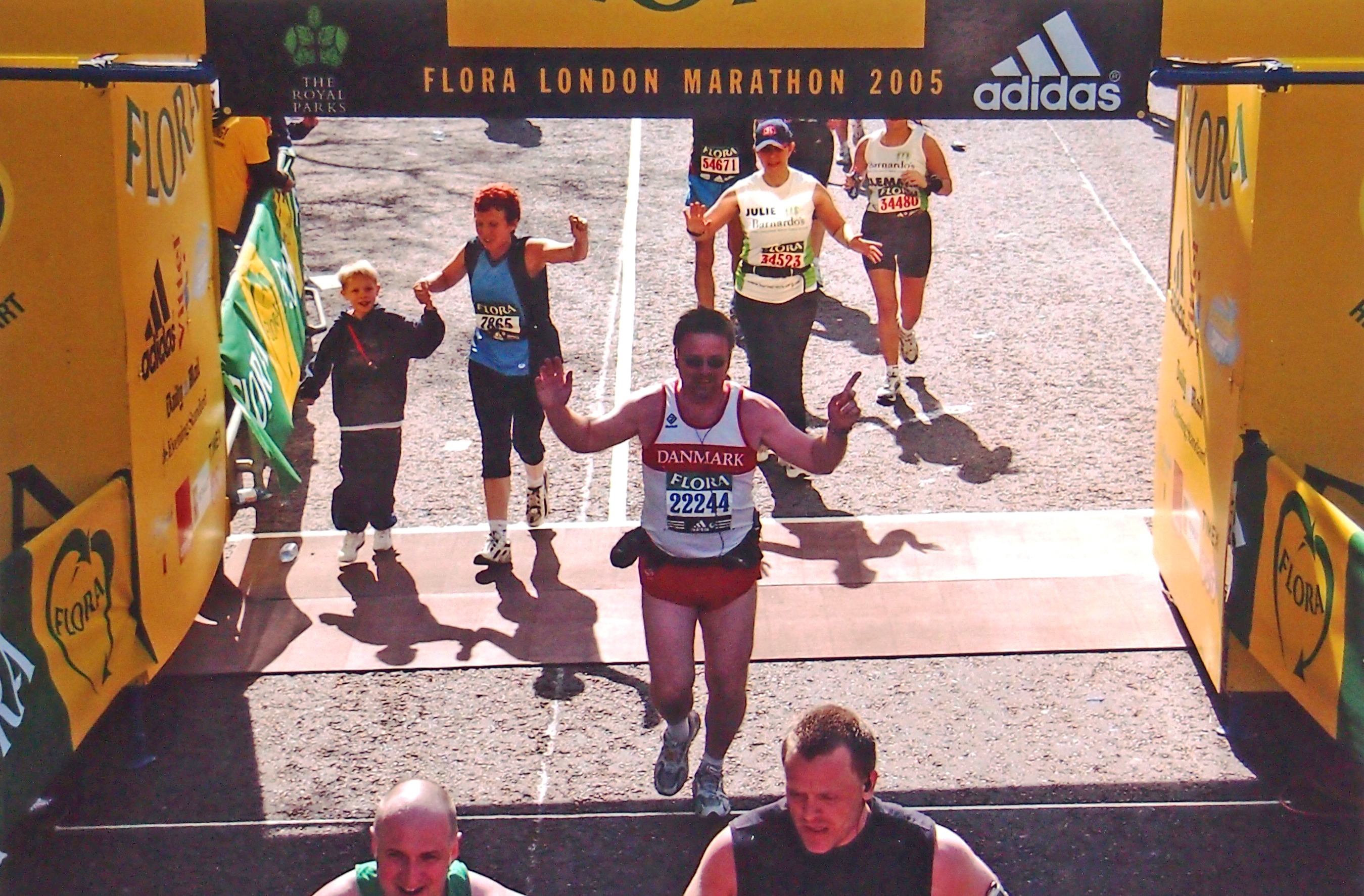
I crossed the line happy and in a good state of health with a time of 5:22:37, three and quarter hours after the winner. My next job was to find Karin, which wasn’t that easy given that the mobile phone network was overloaded. And then there was the explaining, where each of us was in relation to each other. But we succeeded, and Elisabeth, who also came to town during the afternoon, met up with us later.
On the way to the railway station, I suddenly felt really cold. It was probably because I had been drained of all energy, but it was a good thing we were in London with all its pubs. We found one and sat down to enjoy something a bit stronger than energy drink. I got my strength back, and we could head for home. This, however, caused us unforeseen problems.
Journey home with obstacles
We were to take the East Grinstead train from London Victoria. The station was packed, and everything was rather chaotic, but we did find the right train, which was clearly indicated by signs on the platform.
Not long into the journey, however, Elisabeth began to have her doubts about the route the train was taking. We ended up getting off at the station of a sleepy little town way off the beaten track, and we hadn’t a clue what to do. We found the phone number of a train company on the platform, but when we called, we found they had nothing to do with our train. It wasn’t the poor representative’s fault that we had ended up in some mysterious place, and he told us so.
There was a lady on the platform who was in the same boat as us. She had been taking the train from Victoria for 20 years and was quite certain that neither she nor we had done anything wrong and that the train company must have screwed up.
After a while, we walked down to what might resemble a town. There were almost no shops, and it seemed pretty deserted. But there was a gym, so we went inside. It turned out to be a very big gym, which seemed a bit odd for such a small, almost uninhabited town. But with the help of one of the staff we managed to find a taxi, which we shared with the stranded lady. We drove past her house first to drop her off before finally heading for St Michael’s. It was an expensive taxi ride, but it did give us a few stories to tell.
Five-year struggle finally over
It was wonderful to finally get home again and take a long bath and something to eat after a long, albeit experience-rich day. Next morning we took the plane home, arriving in Copenhagen around lunchtime. A five-year struggle to participate in one of the world’s largest, most popular marathons had come to a successful end.
Buy the book here.
