


Ironman
In 2001, I had the idea of completing an Ironman before I reached 50. An Ironman consists of swimming 3.8 kilometres, cycling 180 kilometres, and then running a marathon. The first Ironman was held in Hawaii on 18th February 1978 after a group of Navy SEALs had been discussing, who was in the best shape. To decide the matter once and for all, their commander, John Collins, proposed that they combine three existing long-distance competitions on Hawaii into a single competition. And the winner? Well, he would be called an Ironman.
My new goal in mind, I bought an old racing bike and began to take swimming lessons. I had found swimming difficult and after a few years I had decided to stick to running marathons.
Distances for everyone
The triathlon fortunately accommodates more than just the ultimate Ironman, and there are many different distances, giving athletes at different levels the opportunity to take part.
After running the Helvede i Nord (Hell in North) half marathon, in the spring of 2010, there lay a folder behind the windscreen wiper of my car. I put the folder in the car intending to throw it away when I got home, but it didn’t suffer that cruel fate. I had a look at it, and it caught my interest. Hillerød Running and Triatlon Club (Langgarverne) was inviting participants for a triathlon meeting.
The meeting had two distances on offer, designated gold and silver. I know that a bronze route has since been added. The route was identical for both categories, the difference being that gold participants would run it twice. I had no idea how good I would be at swimming and cycling. I knew that I would have to swim breaststroke, but had no inkling as to how long it would take. The time requirement for gold was eight hours. I reckoned this had to be possible, so I signed up for the long distant.
Dog in a game of skittles
The meeting began on Sunday 22nd August at 8 a.m., at the public swimming pool in Hillerød. I arrived in good time and signed in. I had come alone and knew nothing about the procedure. I had to ask about the most banal things and felt rather like a dog in a game of skittles.
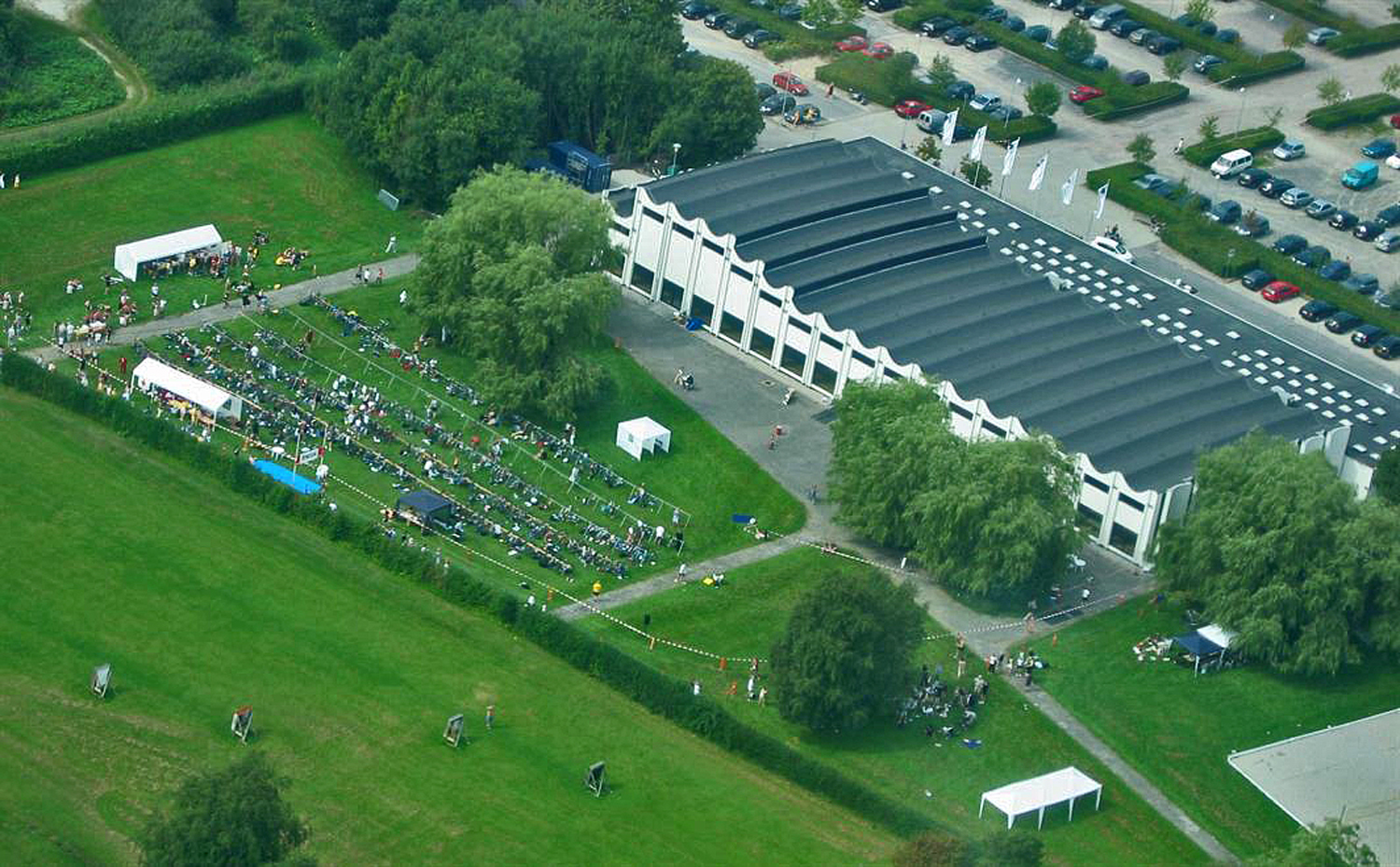
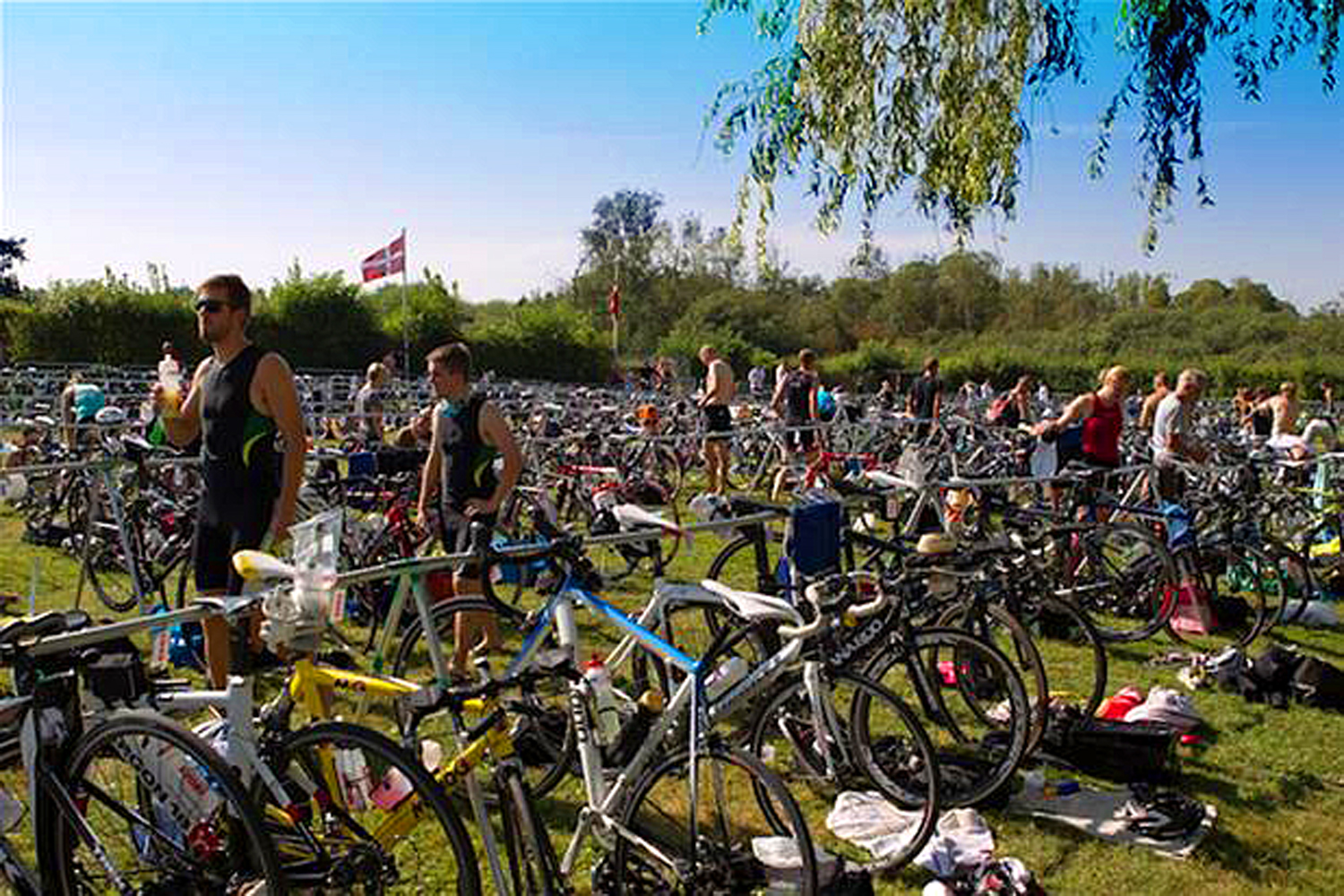
First I had to find the stands in which competitors would hang their bikes by their saddles. This was in the transition area between the disciplines, so you left your sports clothing and other equipment next to your bike. In the changing rooms, I met seasoned athletes putting on wetsuits and bathing hats. All I had with me was a pair of old bathing trunks. I fell into conversation with an experienced Ironman, who talked a lot and had everything under control. I didn’t even know which door to leave the room by. He was talking about how irritating he found breaststroke swimmers, who got in the way of everyone else. I decided to keep quiet.
Swimming
Your race number was written in waterproof marker on the back of one hand, and your chip was supposed to be attached to a strip of Velcro wrapped around your ankle. In the swimming pool, we lined up in order, and entered the water by the steps at intervals of 20 seconds. The first athlete entered the water at 8 a.m.
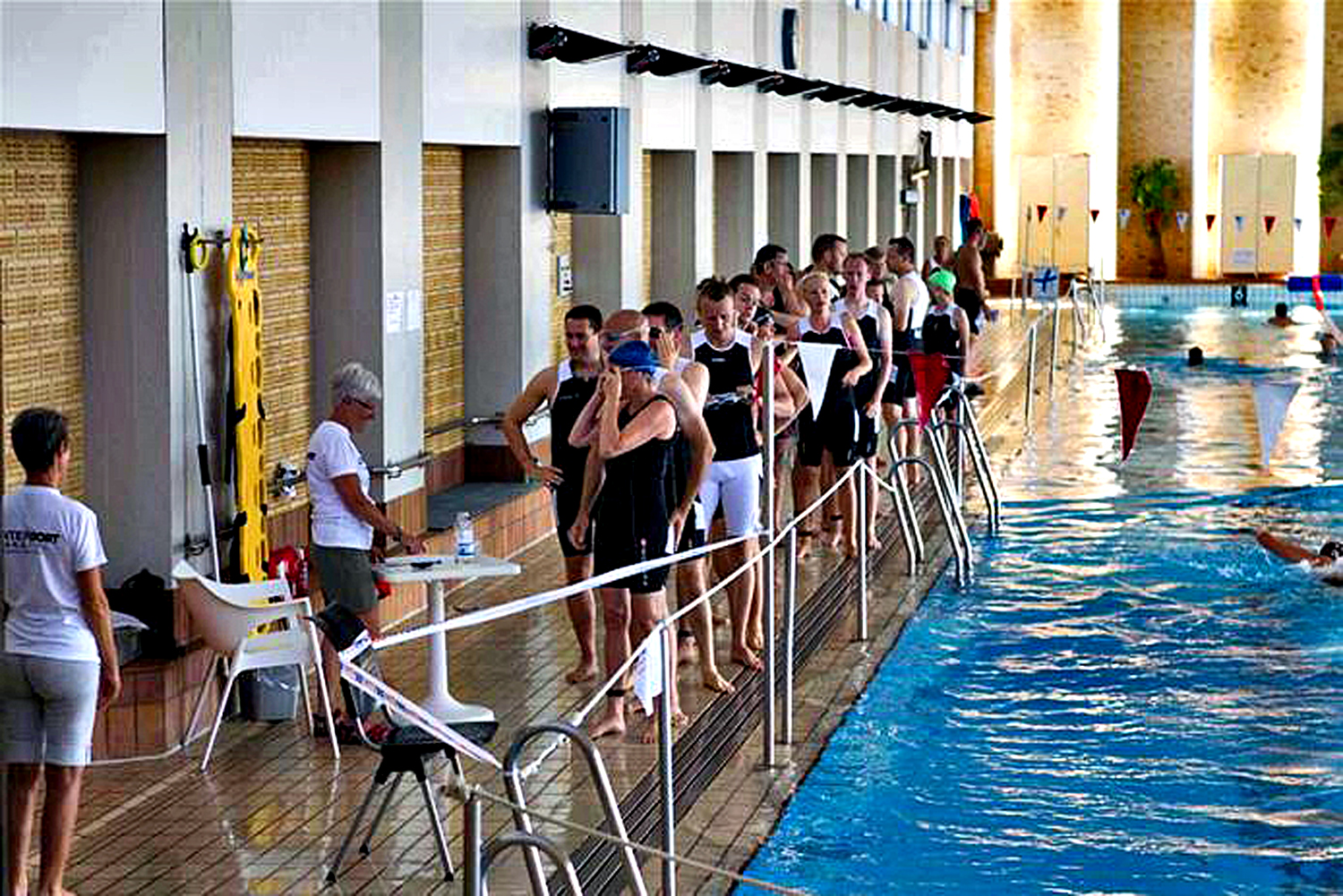
We swam in a spiral lane, that is to say that we swam the 50-metres length of the pool in lanes. The pool was divided into six lanes using lane makers which allowed free passage between the lanes. Five lane makers made six lanes, the first and the last being half width. After the first 50 metres, we swam under the lane maker to lane two, which we swam in both directions. This continued until we had swum 500 metres. As gold swimmers we then got out of the water to walk over to the start and do another round.
I can well understand the super athletes not regarding our presence as conducive to their own performance. But then again, one could always argue that if they felt that way they could stick to elite meetings, at which I can guarantee them I would not turn out. I swam breaststroke, although I did briefly try the crawl a few times. While I lay there splashing, one swimmer after another charged past me. My overall time for the 1000 metres was 36:42 minutes.
Transition area
After the swimming leg, we left the pool in the opposite direction of the start side with direct access to the transition area where my bike was. Here it was just a question of getting out of your swimming trunks and into cycling gear and cycling shoes and putting on your heart rate monitor. We had to have left the transition area before we started cycling and the place was clearly marked. After that it was on your bike and off.
Back and forth
The route took us to Skævinge first, from where we continued to the main road, Amtsvejen, where we turned right and headed back to Hillerød before taking another right to take us back in the direction of Skævinge. After 20 kilometres, there was a much needed water station, where I filled up my bottle, got back on my bike and rode straight for Hillerød. A kilometre before the venue of the meeting, I came to a turnaround at the roundabout on Peder Oxes Allé – Trollesminde Allé. From here, the whole route repeated itself.
Dehydrated
I had thought there would be water at the turnaround and had therefore emptied my bottle with a clear conscience. But there was no water station here, which was irritating although the fault was entirely mine. I could have checked or taken an extra water bottle with me. That sort of thing comes under the heading of dearly bought experience. I had to wait another 20 kilometres for water.
Puncture-free
Fortunately, my tyres didn’t puncture, but a lot of other people weren’t so lucky. I spoke to one woman who had changed an inner tube twice, and on numerous occasions, I saw bicycle inner tubes lying on the road, abandoned by athletes, who didn’t have the courtesy to take them to the nearest rubbish bin.
Wasted time
After the second round and 76 kilometres on the bike, I was back at the transition area. Because I didn’t have a tri suit, I had to change clothes again. My running number had been on my back while I was cycling, and for this discipline it needed to be on the front. Before I set off to run, however, I needed a drink of water, so I asked one of the officials where I could get some. He had no idea, so I had to search transition and found some in the end. As a result, I spent quite a lot of time there whereas others had simply changed shoes and continued. What was more, it turned out that there was a water station just outside the transition area, so I could have spared myself the time I had spent looking.
Difficult transition
It was really odd starting to run after riding such a long distance on a bike. It felt as though my legs didn’t work properly.
The run was an out-and-then-home affair with a little of it on asphalt and the rest along woodland roads and paths with plenty of cool shadowing. We crossed a major asphalt road twice along the route. I had been short of water on the cycle ride, but here there was plenty to drink, with three water stations. When I had done ten kilometres and was back at the start, it was just a question of setting off once again, to make up what was almost a half marathon.
My first triathlon secure
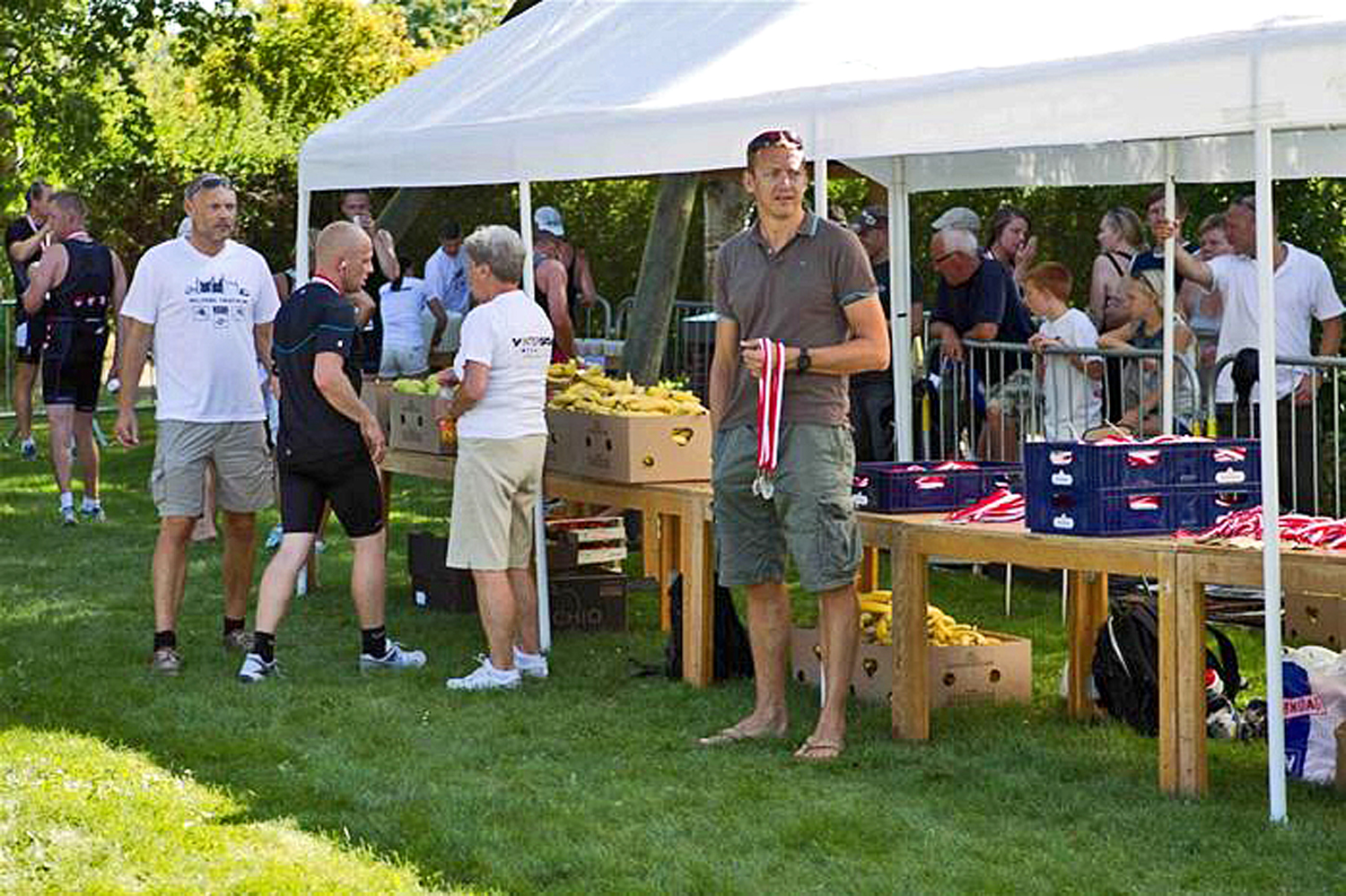
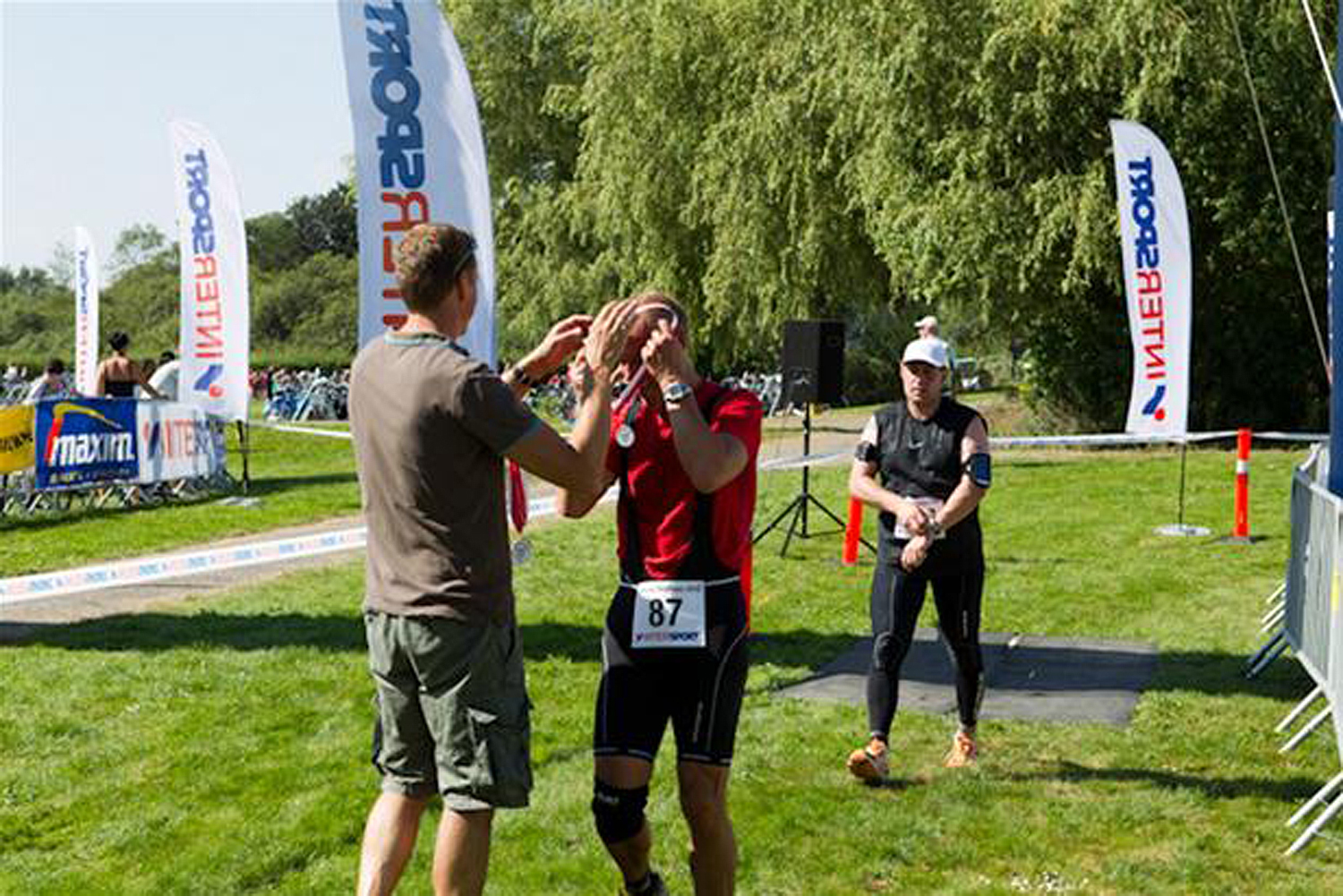
Having covered 97 kilometres altogether, I crossed the line with a time of 6:43:11, which was more than an hour and a quarter from the time limit. The fact that I was the last to cross the line took nothing from my pleasure at having completed my first triathlon.
Buy the book here.
