


New date
All The Great Wall Marathons have been run in May. The first two years, they were on the fourth Wednesday of the month, and the next three years on the fourth Saturday. From 2005, The Great Wall Marathon was run on the third Saturday of May. That was the way it was to be in the future. The sixth marathon of the series was run on Saturday 21st May.
The structure of the trips starts to get a bit monotonous and predictable when, like me, you have run each and every one of them. But in saying monotonous and predictable I don’t mean boring, not by any means. I enjoy all my trips to China and look forward every year to returning.
Group 5 consisting of 21 guests and a guide met at Copenhagen Airport on Tuesday evening 17th May. There was a familiar face from 2000 in the group. It was Hans, who got lost on inspection day together with my son Steffen and Lars Bom. This time, Hans was in the company of a runner by the name of Ole. They had met when Hans’ daughter and Ole’s son started going out together, so this was a father-in-law trip.
A city under development
This year, we were to stay at the Dong Fang Hotel, a fine establishment, where I have since stayed on several occasions. Having checked in, several members of the group got together to go to the Silk Market by taxi. When the driver wanted to drop us off next to a large building, I protested. This was not the Silk Market, which was usually outdoors, spreading up and down several streets. The driver stuck to his guns while I showed him a piece of paper with the name of the Silk Market written in Chinese. In the end, however, we had to get out and take a look at the place.
It turned out that the driver was right and that the Silk Market had moved indoors into a new building. A short distance away, I recognised the Jianguo Hotel, where I had stayed the previous year. After a while, I also recollected seeing a building site there in 2004 just next to one of the market streets. Now the small charming stalls in the winding streets had been moved indoors and turned into streamlined shops in straight lines on storeys separated by escalators and lifts. Another piece of China had become a modern city.
And it was not just the Silk Market that showed how the capital was in a state of rapid development. In 2001, Beijing had been selected to host the Olympic Games in 2008, and over the years that followed, one noticed pronounced developments. Many of the old hutongs and poor quarters had been demolished, and the narrow, local trading streets had been done away with in an effort to turn Beijing into a modern city on a footing with other world metropolises.
Guide for a morning
On Thursday morning, we got up very early to drive to the traditional information meeting on Yin and Yang Square. In the bus, I was appointed assistant guide. Louise had asked me to tell the others what would happen on the day as well as a bit about the day of the race, catering, showering and storing our bags.
The village developing too
When we arrived at the car park, I could see that quite a lot had been changed. Yin and Yang Square had been fenced in, and you had to go through a passage to get in. Otherwise, everything was as it was in the old days. The postcard, T-shirt and film salesmen were there to do a deal, as always.
After the classic walk across the Wall and some lunch, it was time to inspect the rest of the route. I was tired, so I decided to go back on board the bus and sleep instead. I was not the only one, as another runner came along, who also needed a nap, the gold medallist rower Eskild Ebbesen, a highly versatile sportsman. That same year he had danced his way to a second place in the Danish commercial television’s “Strictly Ballroom”. I was lying most uncomfortably in the bus, but was so tired that I barely noticed.
Average standard
I had slept for a couple of hours by the time the group returned, and it was now time to drive to Jixian and check in at the Yuyang Hotel. We were given some really unattractive rooms. The first thing I did was to take a bath, and when I pulled out the plug all the water ran out onto the floor. It was so funny that I screamed with laughter. But after I made them aware of the problem, a plumber quickly arrived on the scene and fixed it.
We had supper in the hotel restaurant. It was nowhere near as delicious as the food served the previous day in Beijing, although it did satisfy our hunger. A few of us from the group went out to have a look at the town, but we returned to go to bed before it got very late.
Friday, I was already awake at 4.30 a.m., which fitted in well with my daily rhythm because I would also have to get up early for the race. I now had a couple of hours where I could sit and write, take care of some practicalities and take a bath before breakfast.
The hotel breakfast wasn’t in any way interesting. Boring toast, nondescript fried egg, a little fruit and some dry sponge cake. Along with it were warm lemonade and something that was supposed to be coffee. The staff only spoke Chinese, but that’s the way it is when you get out of the city. The Yuyang Hotel in Jixian neither can nor should be compared with the Dong Fang Hotel in Beijing.
Liberating commerce
After breakfast, I went for a walk on my own in town. By Chinese standards, Jixian is a small and rather “sleepy” provincial town with 7-800,000 inhabitants. That is about the same as Copenhagen, which definitely puts the relative sizes of Denmark and China into perspective.
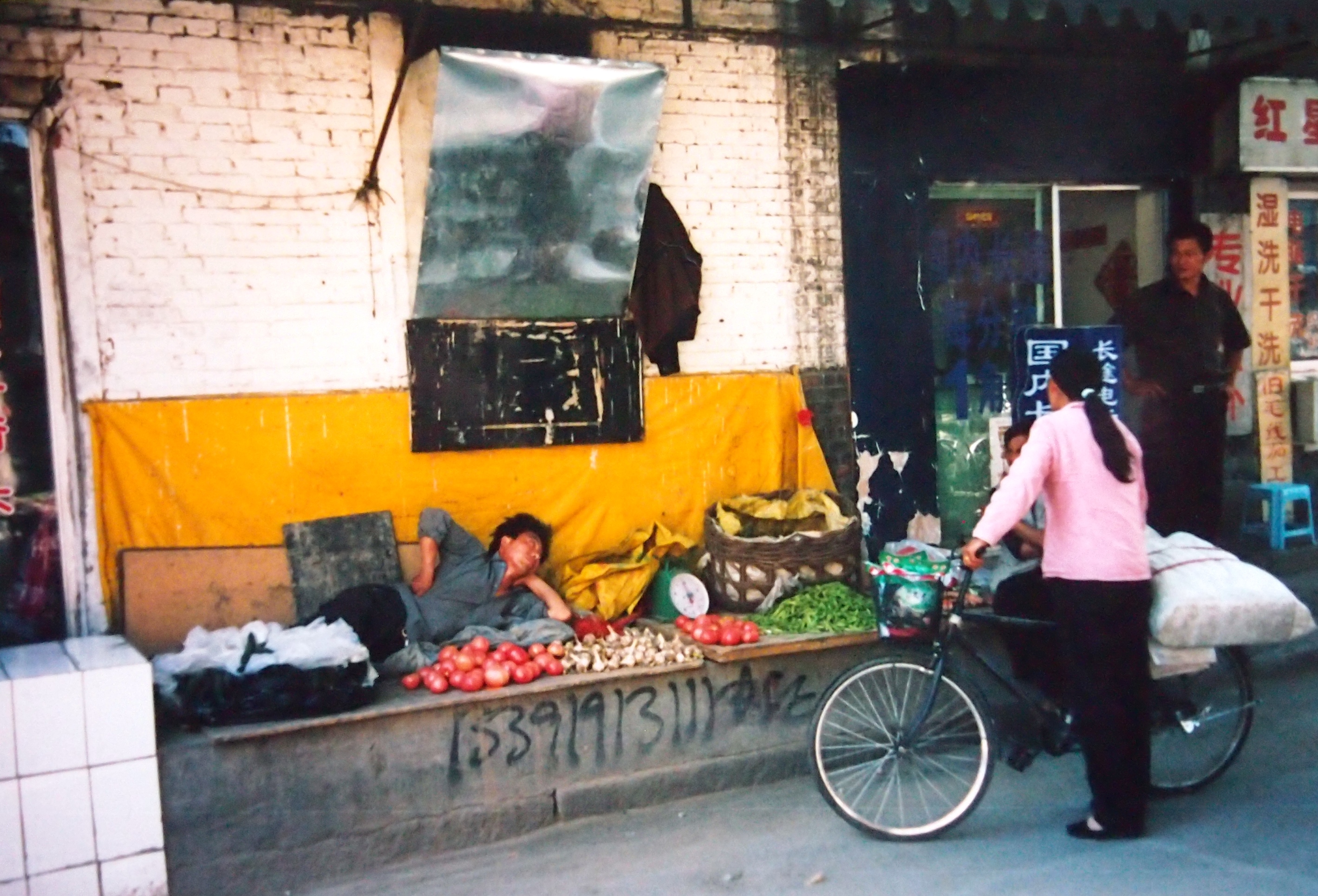
I spent several hours walking round forming an impression of life in the town and bought what I otherwise would have shopped for in Beijing. Things were markedly different here, and I was able to go about my business without being harassed by insistent sellers. I didn’t have to haggle over prices, either, because they were reasonable to begin with.
Stomach ache
At that evening’s traditional pasta party, I had a stomach ache and had to visit the lavatory several times. This was unlikely to have been due to the pasta, but I feared that I was getting a badly upset stomach. This fear was exacerbated during the night, when I slept restlessly and made several visits to the lavatory.
On the day of the run, 21st May, I put on my running clothes and went to have breakfast, which, like the previous day, was boring and in no way an optimal diet for athletes who, just a few hours later, would be running the world’s toughest marathon.
At five o’clock, we left the hotel by bus, arriving at Yin and Yang Square just after six. My stomach was still upset, so I had to visit the lavatory, and all the water I had consumed that morning came back up again. I spoke to one of the medics about the state of my health and asked if I could have a pill. This she could not advise, but said I should let her know during the run if things got worse.
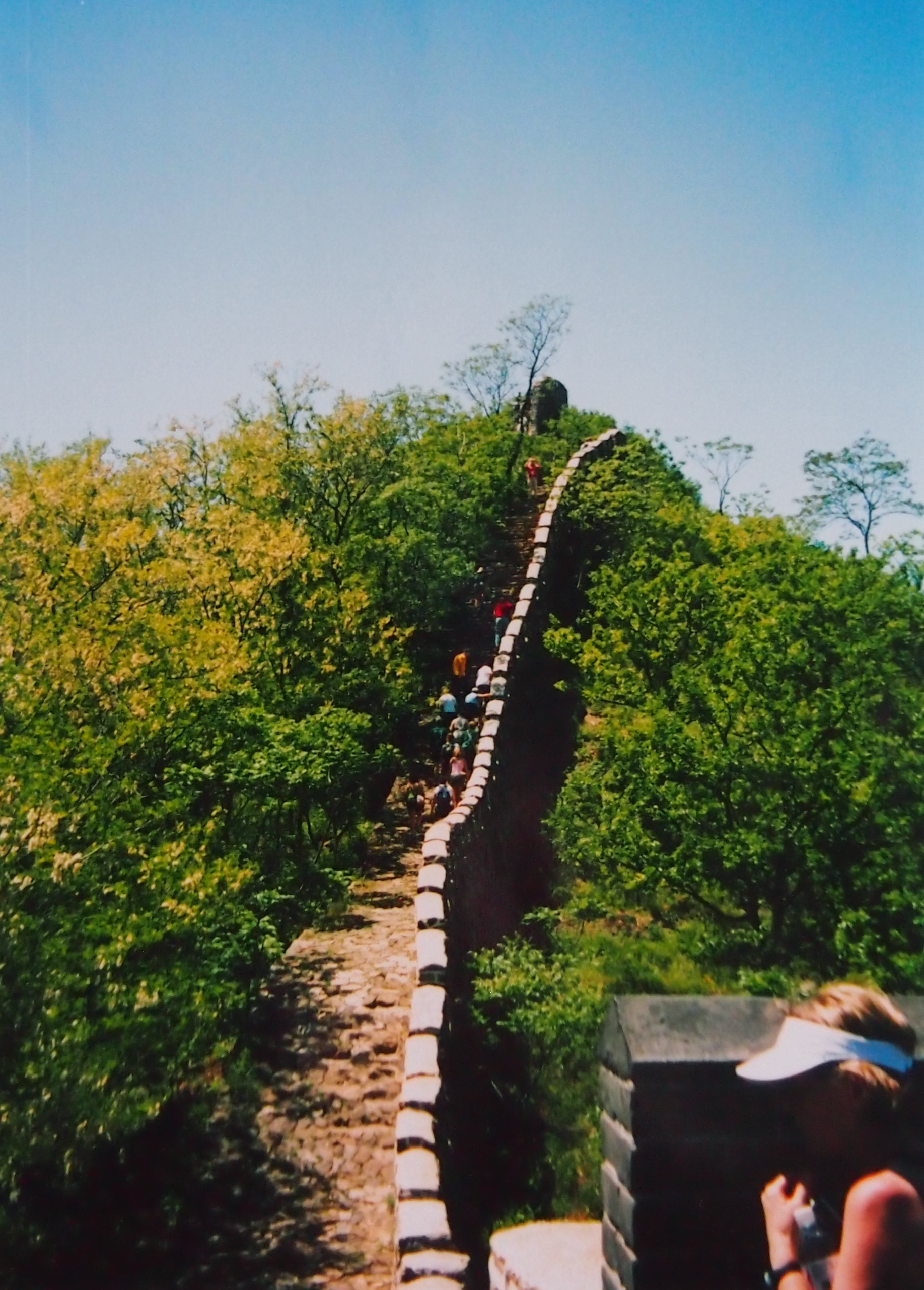
After various speeches, the run started at 7.30 a.m. I took things easy for the first five kilometres up the mountain and did the same over the Wall. After more than an hour and a half, I was back at Yin and Yan Square, with 26 kilometres ahead of me into the landscape. This first half of the run went very well. In actual fact, I was pleasantly surprised by the kilometre signs on two occasions because I had run farther than I had expected. It was a bit like Christmas!
Aching legs
A good half way through the marathon, my left buttock and thigh started to ache. Although I was able to continue, I did have to walk a lot of the way. It was overcast, so we didn’t get thoroughly baked, as in earlier years, which was rather nice, although I regretted having run in sunglasses.
Shortly before I arrived at Yin and Yang Square, it started raining. It wasn’t much, and it was quite agreeable, but I was concerned that it might rain so much that I would have trouble on the stones on the Wall and that the goat track would be slippery. Fortunately, this was not the case.
I had intended to be at Yin and Yang Square again at 1 p.m. and actually arrived there ten minutes early.
Psychological first-aid
A short way up the Wall, I met a woman in her sixties from Hawaii called Suk. She was in tears and at the point of giving up and going back down. It was her 33rd marathon, and she had never dropped out before, but she felt awful, and her legs were failing her. I took her by the hand and made a lot of encouraging remarks as I helped her across the Wall. She was about to give up on several occasions, but we managed to get across.
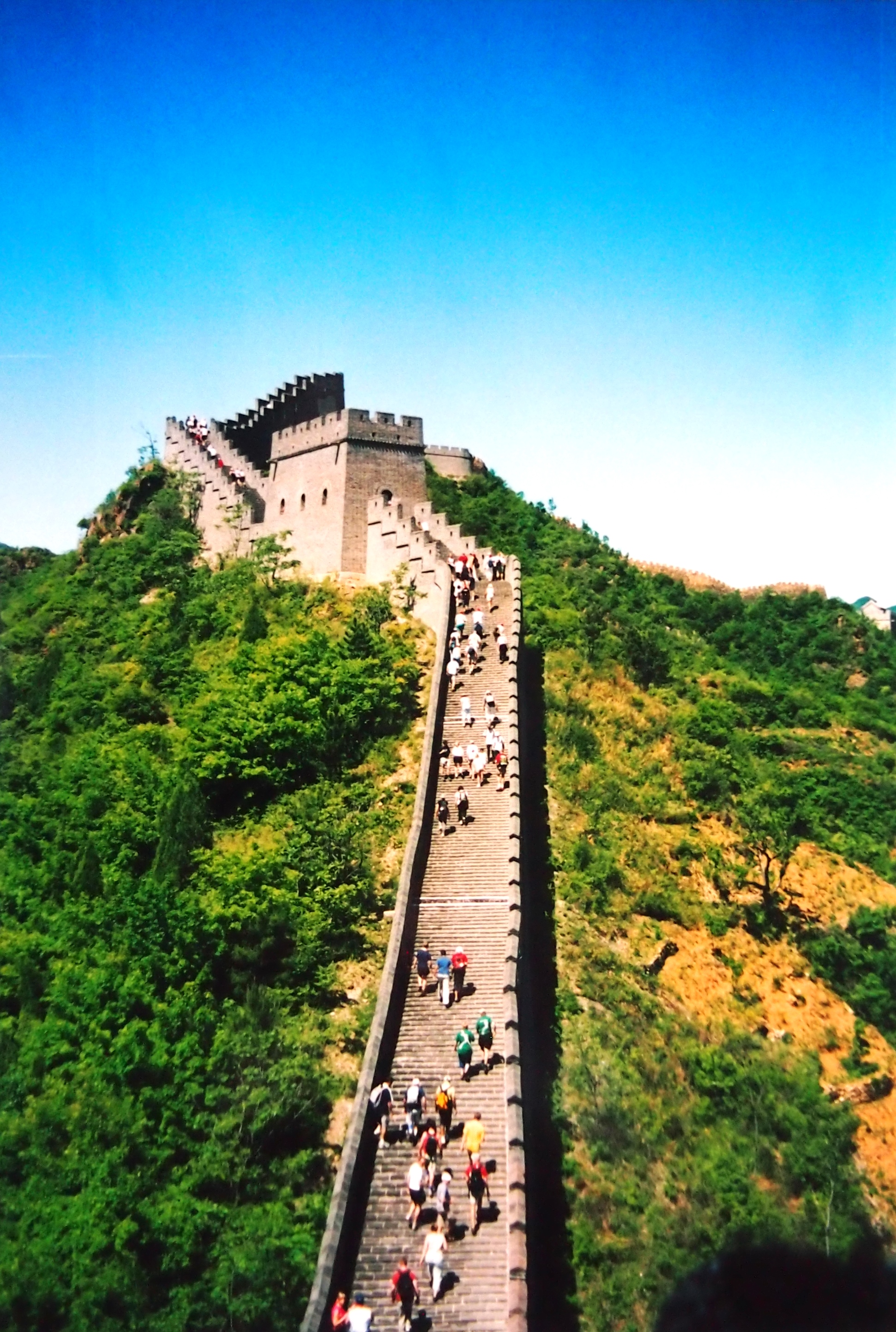
By the time we had crossed the Wall and were about to set off down the mountainside, Suk was herself again. She was a little elf of a woman, who could easily run at that stage. For me, it was a bit more difficult, what with my buttock and my thigh. I walked quite a lot of the way and trotted once in a while. I, therefore, urged her to run her own race, but she didn’t want to. She didn’t want to leave me because I had helped her get that far. Suk kept on trotting, and I felt pressured when she called after me. After 40 kilometres, however, I didn’t allow myself to be pressured by Suk anymore. I thought Suk would be there when I crossed the finishing line, but she was not, and I never saw her again.
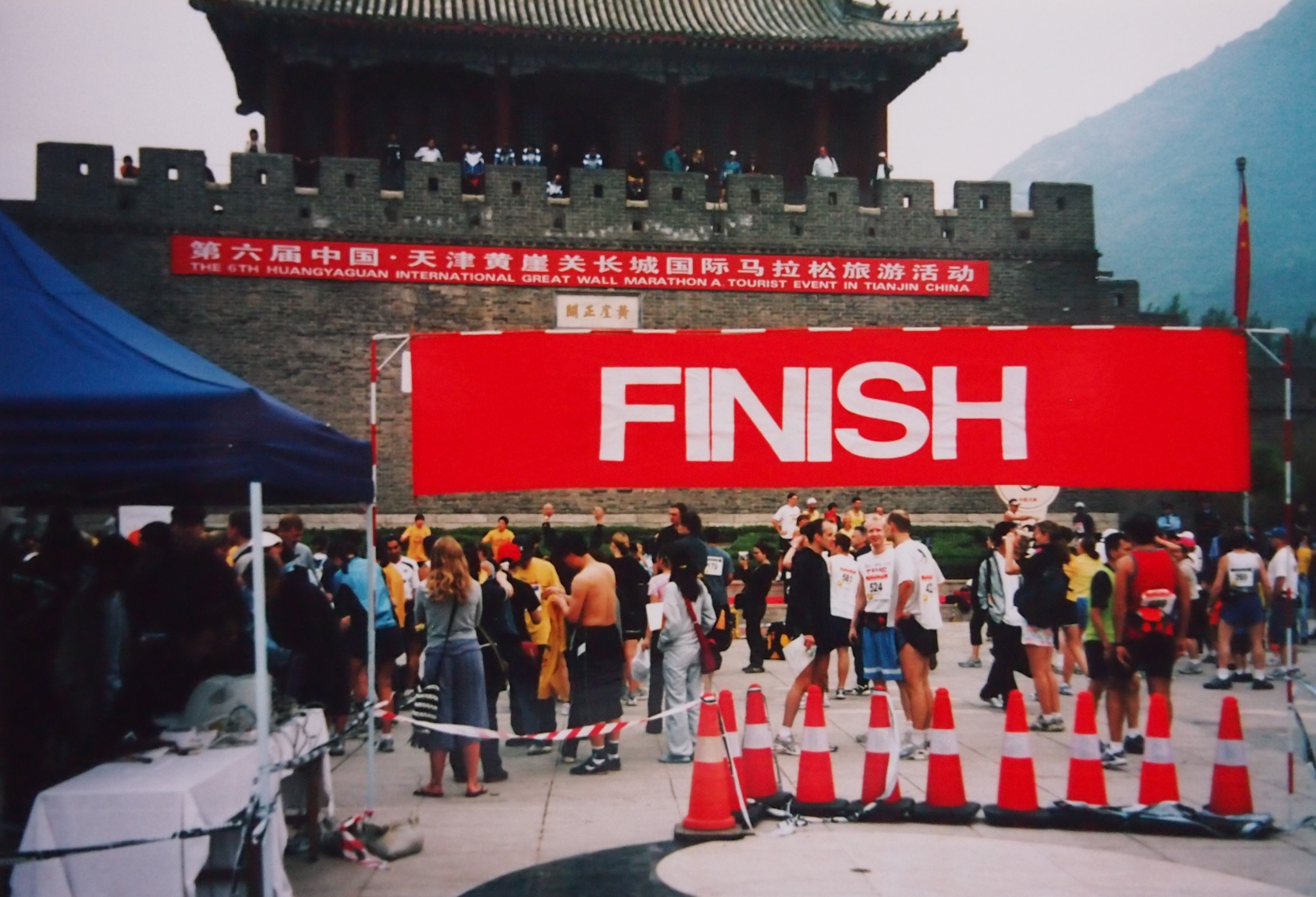
At the line, I got an indescribable reception, with tributes paid by a lot of people, not least Thomas, who, apart from my medal presented me with a little rose.
Proposal at the finishing line
Among the 761 runners divided into four distances was an American couple who ran together from start to finish. A few metres from the finish, the man fell to his knees before his “maiden”, pulled a diamond ring out of his pocket and proposed to her. Seven TV stations immortalised the proposal as she said “yes”. It has to be said that it was a rather unusual proposal, but it was by no means unique. It has happened several times, both in China and at other runs.
Exchange with great difficulty
When I got back to Beijing, I decided to buy a massage for my aching legs before I checked back into the Dong Fang Hotel. Communicating with the masseur was a bit difficult, so I got the works. Face, arms, chest, legs – well, everywhere. It was very pleasant and lasted an hour and a half, much longer than expected.
It cost 100 Yuan, and I didn’t have much more on me. Because I needed to get a quick bite to eat at McDonald’s, I was in a bit of a fix. I asked the masseur if there was anywhere nearby, where I could change some dollars. He was very kind and went with me, but this turned out to be a “disservice”. We started by going to McDonald’s to ask if I could pay with a credit card or dollars. I couldn’t. After that, we went to a couple of hotels but had no luck. Then we found two ATMs, but I couldn’t use them. By now I was really aching and just needed my bed, so I ended up just going back to the Dong Fang. I checked in and was allowed to exchange some dollars, so I was able to go to McDonald’s after a delay of almost two hours.
Noble craftsmanship
On the Sunday, I went for a walk in the narrow streets near the hotel and came across a lady sitting on a stool next to her small trolley filled with a variety of tools, etc. She was a shoemaker. I had a pair of shoes with me on the trip that I had considered throwing out because they were on their last legs. In fact, I had already bought a new pair at the Pearl Market. But I decided now to give my old shoes a last chance and went home to get them.
Her craftsmanship was excellent. Unfortunately, she wouldn’t let me photograph her. The whole operation took an hour, and I was enthralled by her work. First she glued the soles, and I thought: that will never hold. She thought so, too, obviously, because she then cut a small groove under the sole and started to sew it onto the shoe. It was just like a crochet needle, and she stuck it in from the outside and caught the thread inside the shoe. The thread was laid into the groove she had cut. It was hard work, and she winced several times as she pushed the needle through. There were some cracks in the side of the sole, but she had a solution to that, too. She filed some rubber into a fine powder, which she inserted into the cracks mixed with glue. When the glue had dried, she cut the sole to shape and polished it smooth. The shoes weren’t like new, but for about six dollars, I could use them for a while, and the experience had been worth every penny.
TV interview
The evening’s traditional gala party was held at the Sheraton Hotel, and during the champagne welcome I was interviewed by an American TV station. I never got to see the result, though.
The gala party was entirely traditional, just as it should be. The same applied to the after dinner party elsewhere in the city. I didn’t get back to my hotel until the small hours.
Gambei – what a buzz
I spent the last whole day of the trip shopping, and I bought quite a lot of stuff at the Silk Market, which meant yet another homeward journey with full suitcases and bulging bags, plus some excess kilos.
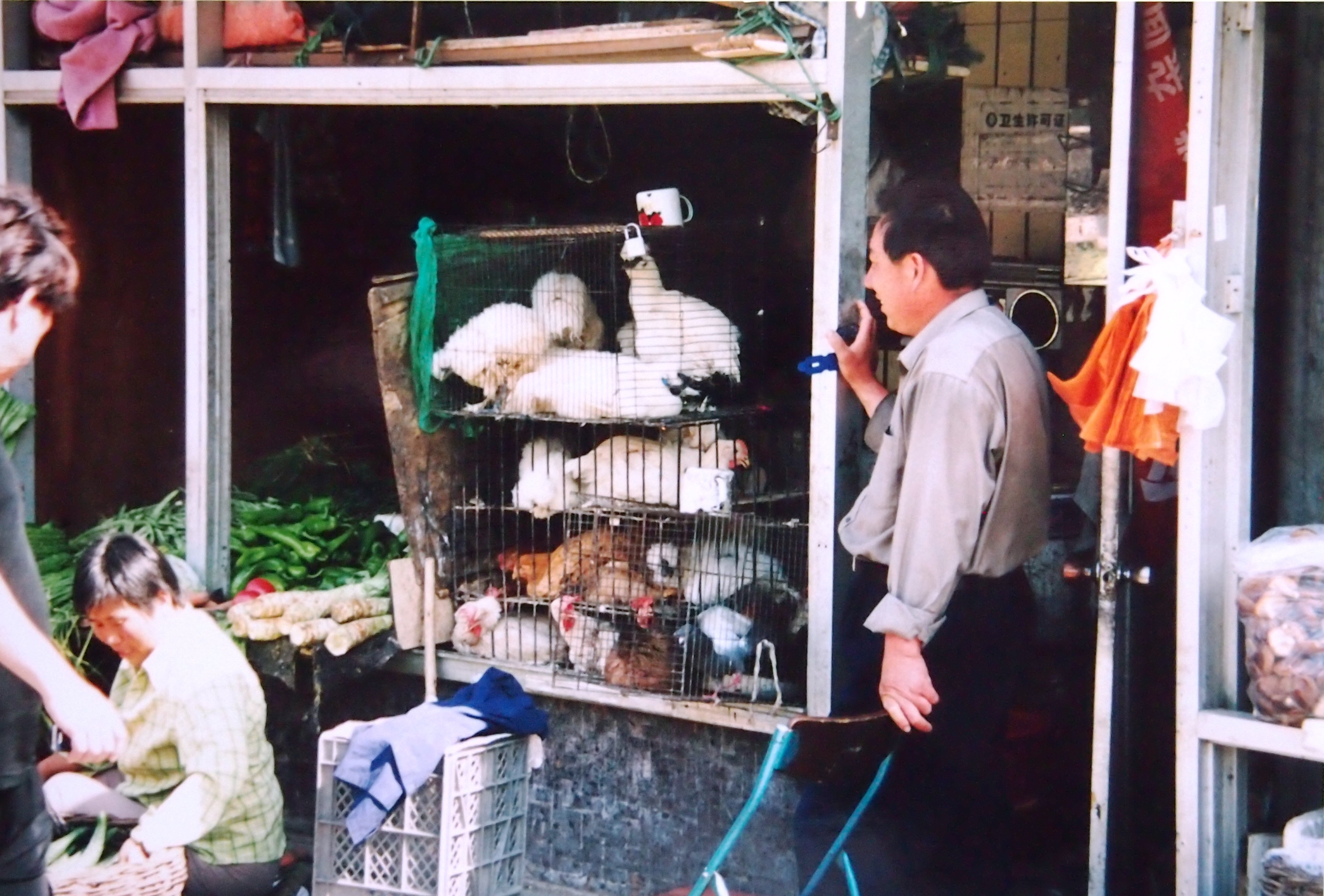
Later in the day, I went for a walk in the locality, where I got really close to life on the streets of Beijing. I was the only foreigner around, and people were busy in their tiny shops, selling ironmongery, fruit, fish and live hens. This was my tourist experience of the day, and I was probably the experience of the day for them.
That evening, I got a call from our guide, Louise, who wanted to hear if I and the rest of the group would join her for a farewell dinner at a nearby restaurant. Here we spent a few cosy hours with delicious food. Several members of the group made speeches, and one of them gave me a present in the form of a Chinese drink.
As the evening wore on, Louise thought it would be a good idea to try some Chinese rice brandy. We were each given a small glass of the brandy, and on the command “gambei” we were supposed to knock it back in one go. And so we did, after which the glass was immediately refilled. I was told the day after that the brandy had been 56 % alcohol, which probably explained the effect it had had on me.
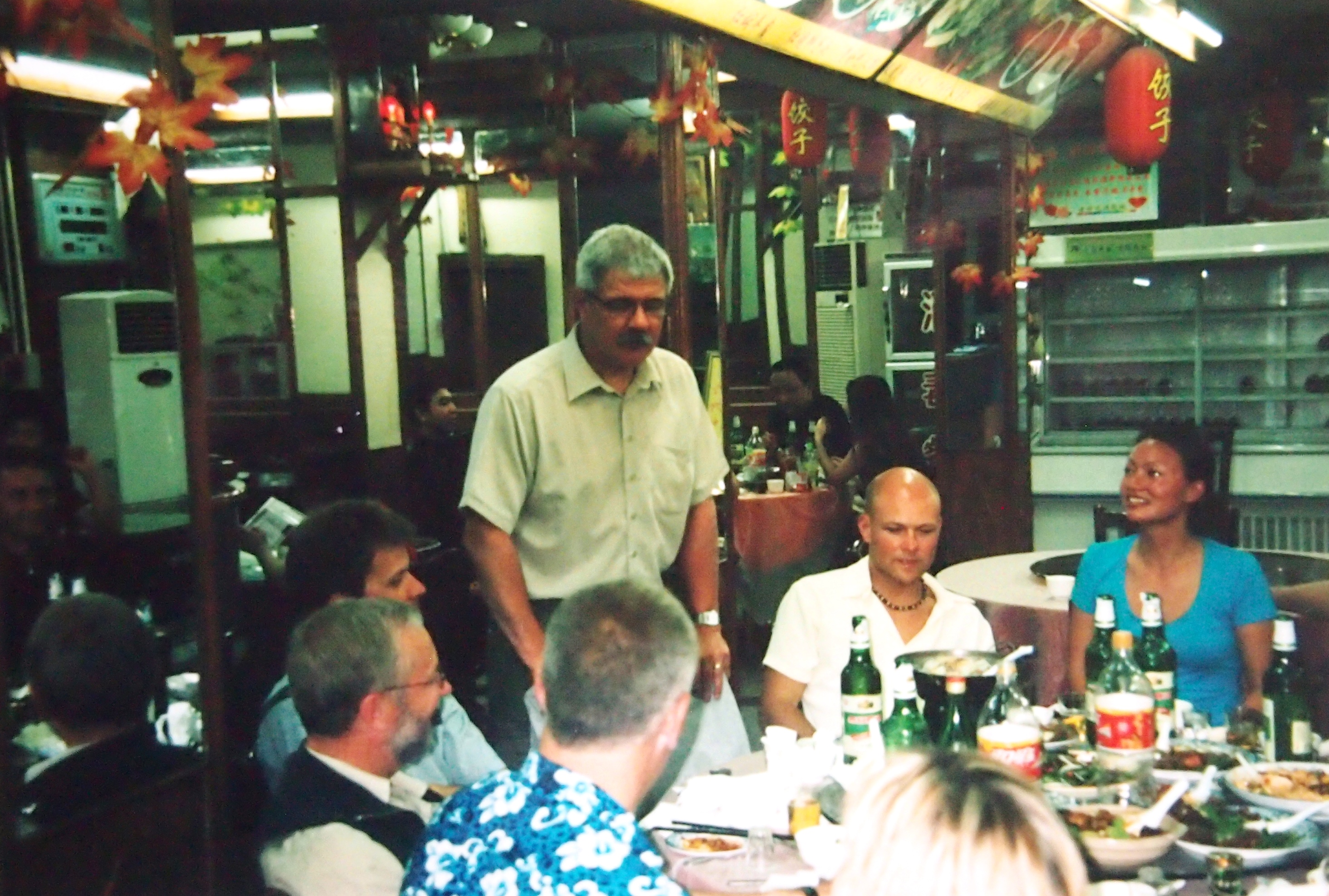
For the first time in many years, I got thoroughly drunk and had to leave the restaurant several times to find somewhere to be sick. This was not at all pleasant, and I had soon had enough. So after my last “sacrifice”, I went back into the restaurant and said, “I want to go home, but I don’t know the way to the hotel”. A man called Bjarne could, although he said “But you’ll have to support me because I can’t walk straight”. Together we staggered arm in arm back to the Dong Fang Hotel. We must have been a sight for sore eyes
Time trouble for a tie
Tuesday 24th May was home-going day, and my son Steffen sent me a text message asking me to buy a tie for a friend of his. But this was not far off delaying a busload of people getting to the airport.
I was convinced that the Pearl Market was within walking distance, but this was not the case. I had started walking, but realised before long that there was further to go than I had thought. In the end, I had to trot, and got blisters because I was wearing sandals without socks on. It took me more than 20 minutes to get there. I was bathed in sweat, and we were to meet at the hotel in 22 minutes’ time. I bought the tie and took a taxi back to the hotel, where I just managed to grab my hand luggage and splash water in my face before we were due to meet for departure to the airport.
At the airport, I had a few problems with my hand luggage. It was inspected and scanned several times. Fortunately, as it turned out, the only “mysterious” thing about my luggage was my medals. Otherwise the homeward journey went very well, and yet another trip to the world’s best marathon was at an end.
Buy the book here.
