


Third time lucky
For me, there was no doubt that I was going to join the third trip to the Wall. I felt that I needed to take revenge after the run with the blisters, and my promise to Søren Rasmussen was also etched in my mind. It is less clear to me now why I chose to take both boys with me again. It was the third long trip they were to take with me within a year. The first two could be explained by what they could learn and the new experiences they would have, but this repetition was not quite as logical. Basically, it was perhaps my own egotism that made me take them out of school again, but looking back many years later I can see that the trip was defensible all the same, despite the school hours lost.
The trip that almost never happened
In 2001, the departure date was 21st May, which would turn out to confuse me so much that it almost cost us the trip. We arrived at the airport in really good time – or at least I thought we did, and after checking in, we did a bit of shopping. After that, we took a seat at a bistro to have a meal and something to drink. The boys went exploring while I gave myself time to make a phone call.
However, just before 8 p.m., I heard a voice over the loudspeakers saying that the family Brandt should proceed immediately to gate C 33. I got into a bit of a sweat, and we really had to put our skates on. At the gate, we were told that we had arrived at the very last moment and that they had already called us four times over the loudspeakers. In fact, it was only because they had to change planes that the flight had not left yet. When I got on board, I checked our boarding cards. It turned out that we were not supposed to fly at 21.05 but at 19.45. The number 21.05 was our date of departure! How stupid can you be?
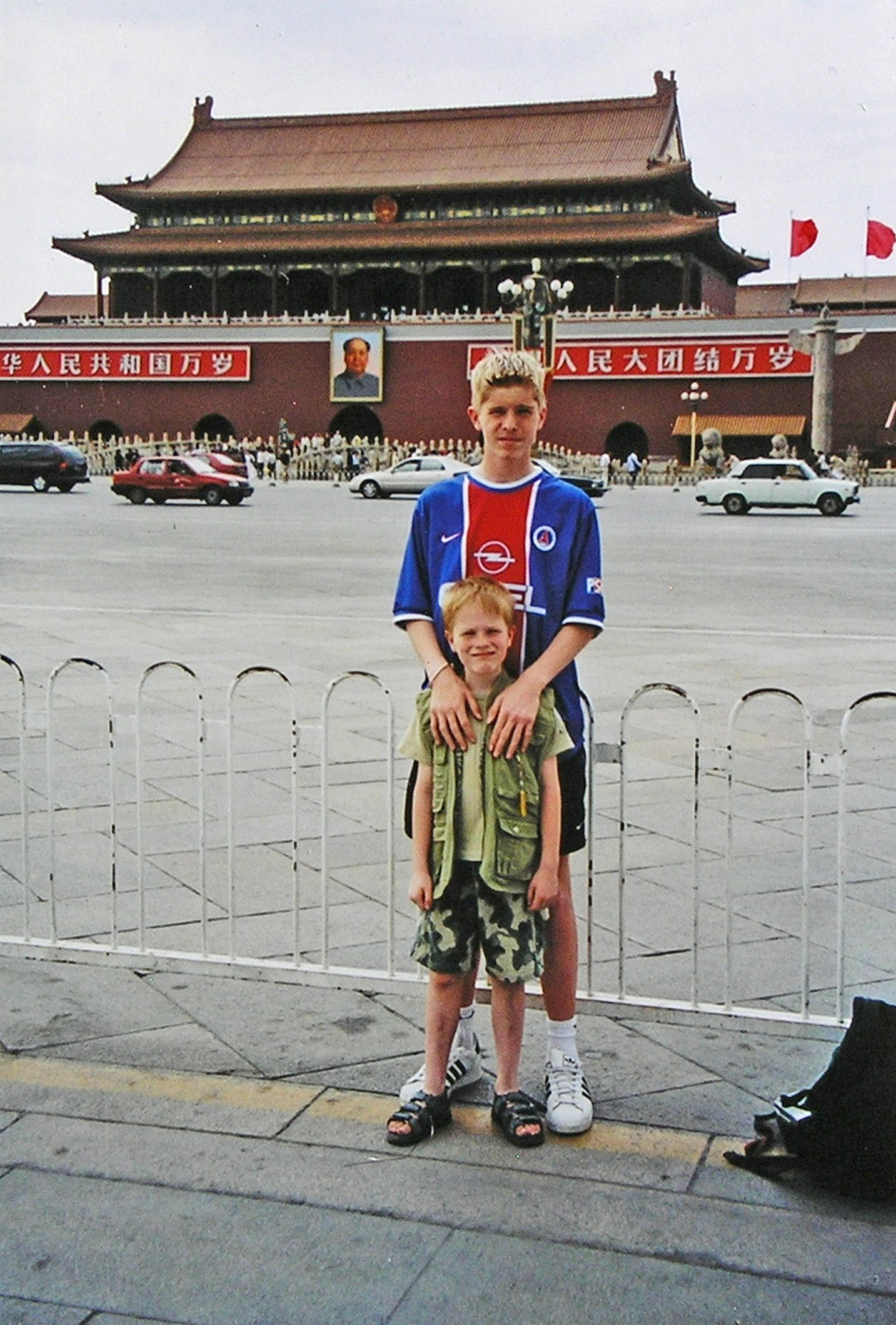
This year we arrived in Beijing well into the morning and went straight to our place of residence. The Olympic Hotel, according to the number of stars, should have been the same standard as previously. The hotel was certainly acceptable, but the standard was not nearly as good as what we had previously experienced. The biggest disadvantage was that it was so far away from central Beijing that we had to ride three quarters of an hour in a taxi when we wanted to go to the markets. In addition, the hotel was not geared to international visitors. They spoke very good Chinese, but we did not.
Looking about the hotel, it was difficult to imagine that there could be any unemployment in China. Two women stood at the entrance to the hotel restaurant greeting arriving guests. Two more waited inside the restaurant, and out on the street stood men in uniform who apparently did nothing but watch life going by.
It was like that in many places. One of the country’s lowest ranking jobs was to stand at bus stops and wave buses in to waiting passengers.
There were 21 groups on offer this year, but too few people signed up, and several of them retracted. We had originally signed up for group 14, but ended up travelling with group 21, 17 people in all. Because we didn’t feel the need to see the tourist attractions again, we chose a group without guided tours. This gave us plenty of time to go exploring on our own, which was very nice.
Linguistic challenges
Communication can be difficult at times. I was already aware of that, but this year I came across more examples of how problematic it can be when people from different parts of the world with different cultures and languages need to communicate with each other.
It is said that the spoken word only has 7% significance for communication, whereas intonation accounts for 38% and body language all of 55%. For this reason, I can get on quite well with someone from Poland, even if we are each speaking our own language. Because we live in the same part of the world and have more or less the same cultural background, we have other ways of understanding each other. But my experience in China was completely different, because both intonation and body language are very, very distant from what we know. This happened several times in 2001.
We spent Thursday around town, exploring in-depth the copy markets. We didn’t have much time the previous year because we had to keep up with the group schedule, but now the boys had time to look at T-shirts, mobile phone accessories, CDs and much more. At the Pearl Market, however, Emil suddenly needed to go to the lavatory, and I had to ask the way. This wasn’t easy. I realised quite quickly that we couldn’t express ourselves verbally and had to try other approaches. The result was rather like pantomime, with me standing there with my legs apart with a finger on my fly to let people know what it was we wanted. But nobody understood what I meant. Thankfully, a Swedish tourist came by and told us the way to the gents’ toilet on the second floor.
Later on we needed to withdraw some cash and had to find a bank. This was also tricky. After many attempts at asking the way, we had to wander around until we came across a bank. We succeeded after a while, and the bank had both Visa and MasterCard signs. I sighed with relief and after waiting for ages in a queue it was my turn, but I couldn’t withdraw cash with my card. I pointed to the signs, but nobody understood what I was trying to say. Apart from the two international logos there was also a Chinese logo on the sign. This kind of card could likely be used at that bank, but that didn’t help us.
We spent quite some time looking for somewhere to withdraw cash, finding several other banks where we couldn’t use our card. After a long search, we finally found a bank employee who spoke a little English. She said we would have to go to the Bank of China to take out money, but this didn’t solve our problem either. We were unable to withdraw money inside the bank and were shown to the ATM outside. It had a keypad, but all the information on the screen was in Chinese. I was almost in a state of panic, because I had inserted the card into the ATM but had no idea which button to press. I had to go into the bank again, and one of the staff came out to help me. Everything sorted itself out in the end.
International style
We had to get up early Friday morning, which was the day we were to inspect the course. Unlike the first two years, we wouldn’t return the same day. We were to spend the night near the Wall and therefore had to check out from the Olympic Hotel. Once again, I had a problem with the language when I phoned to book a wake-up call, though I did succeed in the end.
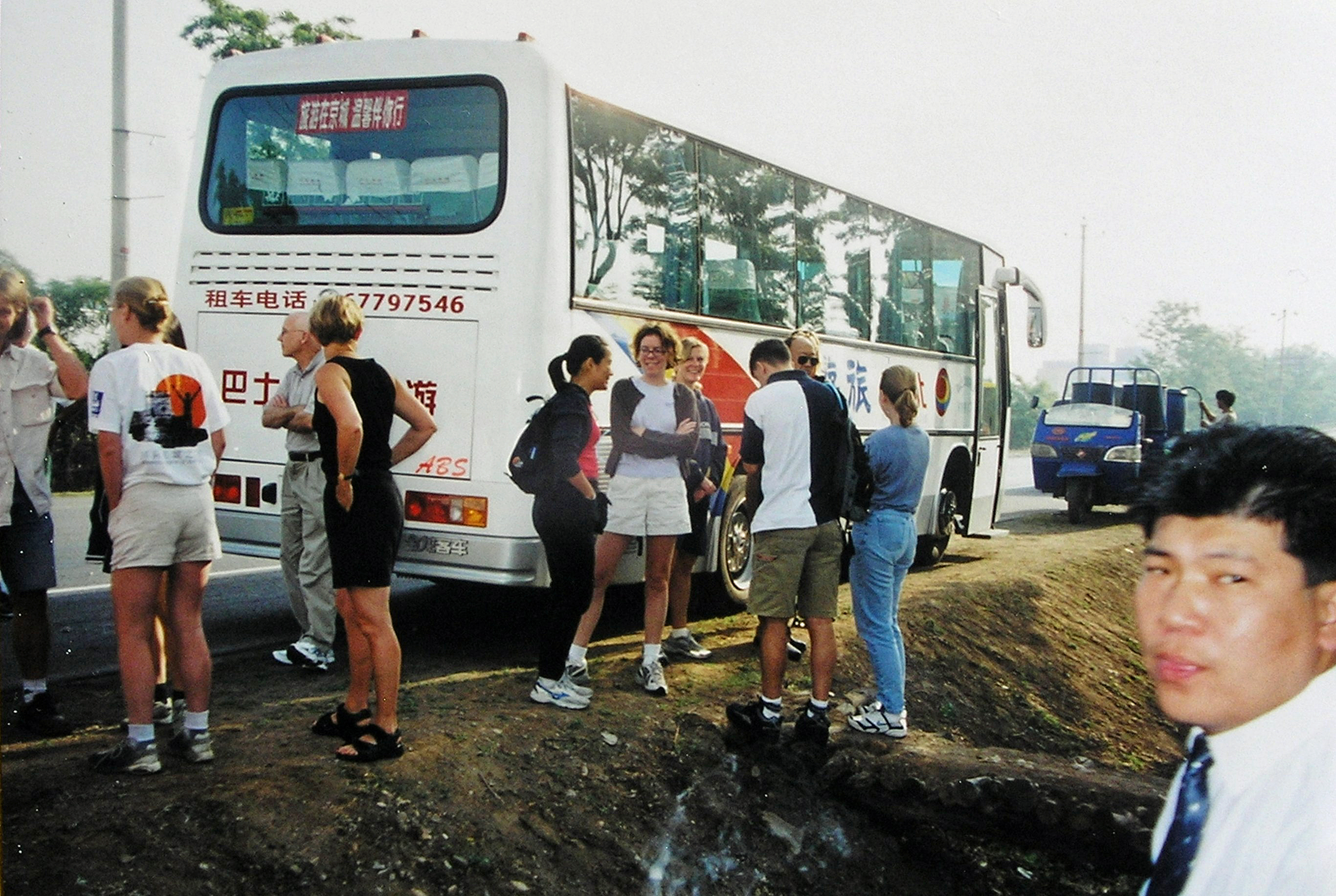
The bus left Beijing at five o’clock in the morning, so there was no time for breakfast. We were given a bag of food to eat in the bus, but not many of us touched it.
Unlike the first two years, the buses didn’t drive in a motorcade. Some 20 buses had made the trip the day before, and many participants were already living in the marathon area.
There had been a limited number of runners in 2000, but the 2001 run was the biggest yet. Until now, the Danes had dominated the field, but those days were over. A total of 511 runners entered, and it was now possible to run a half-marathon. A total of 16 nations were represented, and though there were quite a few Danes, the United States had the most runners, and that is how it has been ever since.
Kathy Loper in particular had done her bit to attract interest in this marathon in the United States. With her travel company Kathy Loper Events, she brought a group of American runners and has done so year after year. Kathy was the woman who collapsed at the finishing line in 2000 and had to be hospitalised. That didn’t put Kathy off, however, and in 2001, she achieved a magnificent seventh place among the female half-marathon runners.
Now that the run had assumed a more international character, the information meeting was held in English. It was led by Rod Dixon, who had previously won the New York Marathon, as well as a bronze in the 1500 metres at the 1972 Olympics in Munich, and who the following day won the half-marathon in convincing style. Otherwise, the inspection tour was more or less the same as the two previous years.
New start time
The route had been changed radically from the first to the second year, and this year the route was the same as the year before. However, the start time was brought forward by 2½ hours in relation to earlier. This meant that a good number of runners would avoid the worst heat during the afternoon, and the whole run could be completed by evening.
As in the first year, the marathon was run on 26th May. We arrived early to watch the opening ceremony involving representatives of the Chinese and Danish athletics federations, as well as the local mayor and other dignitaries.
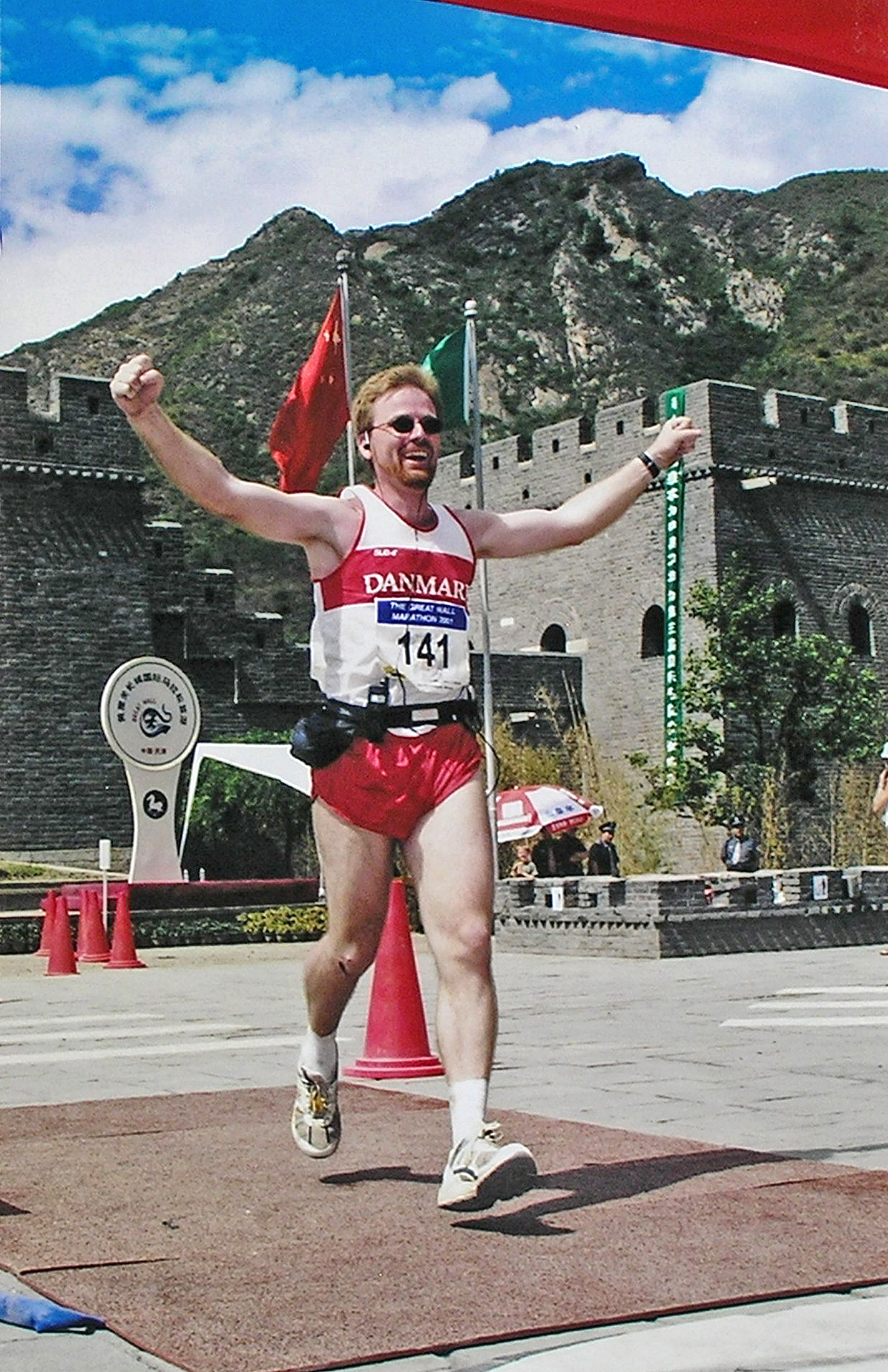
The marathon started at 7.30 whereas the half-marathon runners set off at 8 a.m. Among them was Steffen, who was now to have his debut on the Great Wall. I had a good run, although I fell on the tarmac road about a quarter of the way into the race and grazed my right knee, but it was nothing serious. When I arrived at the Yin and Yang Square I was informed that Steffen had crossed the line with a respectable time, so half my day had already been made.
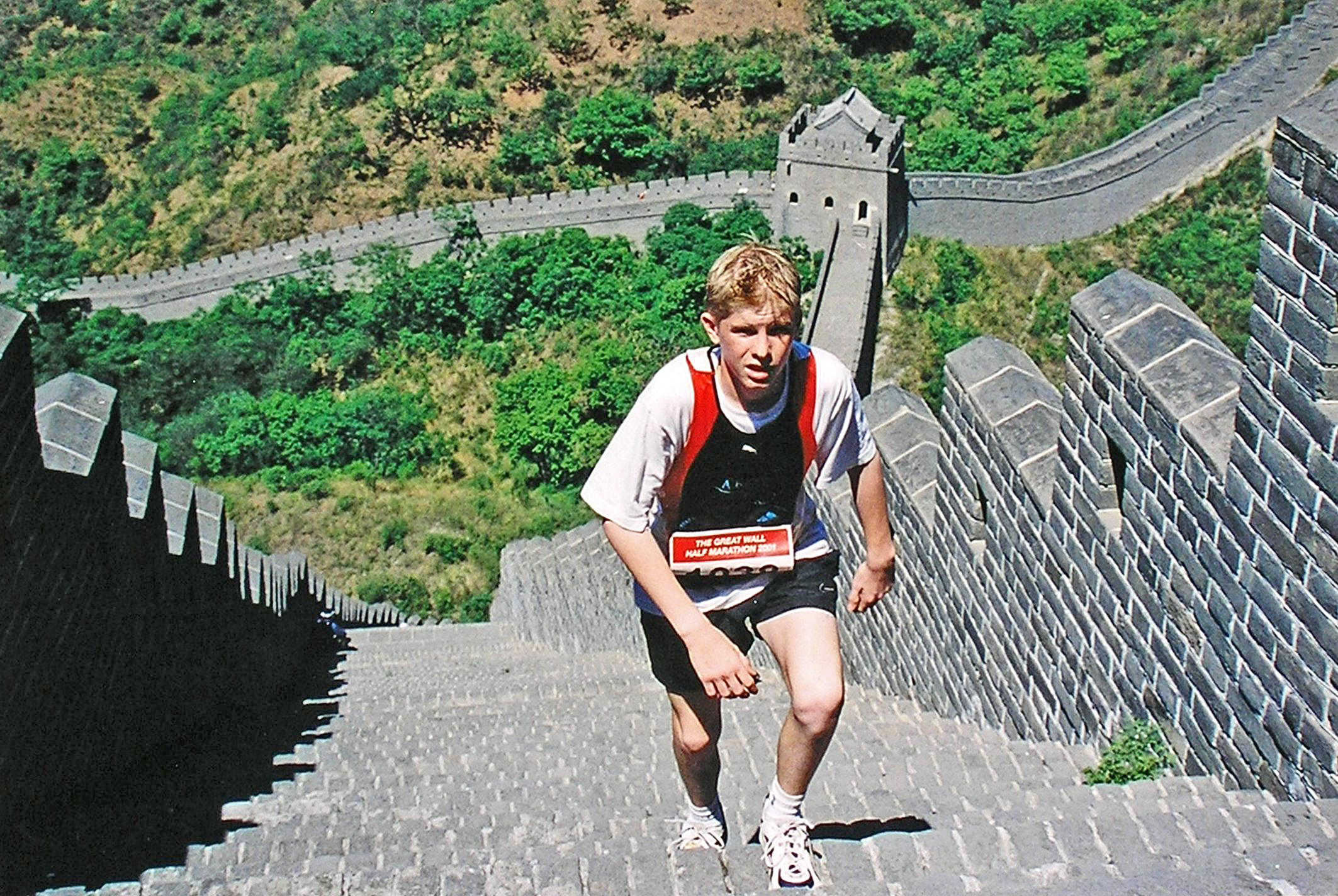
On the level section of the route, I looked forward to reaching the Wall, where I would be able to walk with a clear conscience. The pleasure quickly disappeared when reality caught up with me. I had obviously used more energy on this first part of the course, along which I had walked most of the way the previous year. But now I was quite simply sapped of all energy, which meant that negotiating the Wall was far tougher than before. It was an unparalleled struggle. Time after time I had to sit down on the steps and rest while I stared out across the magnificent countryside and the huge edifice that is the Wall. But at that particular moment I had no surplus energy to enjoy anything. I don’t know how long it took me to get across the 3½ kilometres of wall, but I reckon it must’ve been around an hour and three quarters, equivalent to two kilometres an hour.
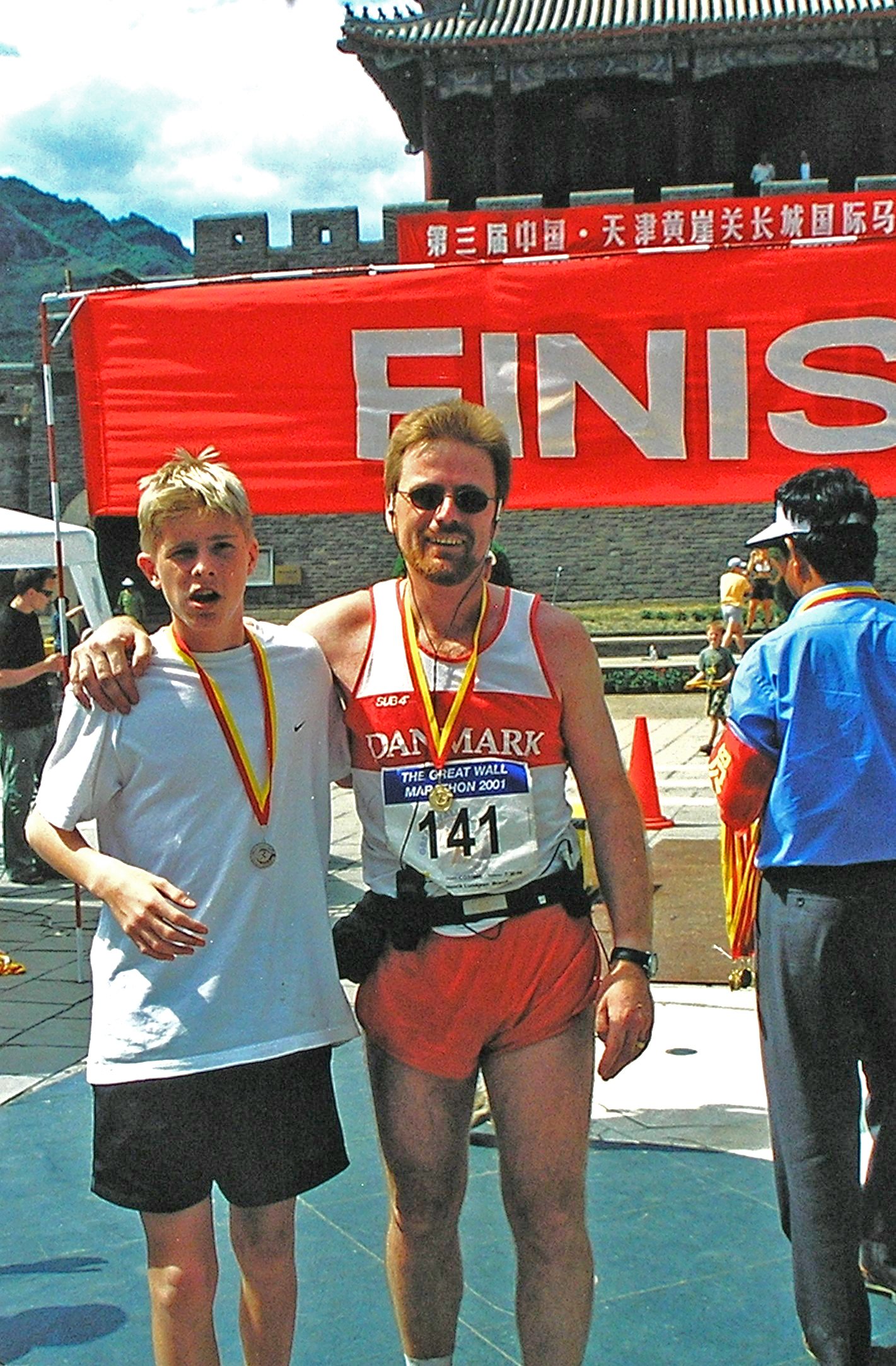
As I set about the Wall for the second time, I envisaged quite a specific finishing time. That all went by the board, however, because this was “torture” and a pure fight for survival. Having got across the Wall, I was actually prepared to run down the mountain. But I got into a conversation with a slow-running American woman who was doing the half-marathon and had got no further. She intended to walk the rest of the way. We had a most enjoyable conversation, and since I had no phantom time in sight, I decided to stay with her for a while.
At the end of the mountain section, however, there was only a kilometre left to the finish, and I had to tell her that I really didn’t want to cross the line walking. Because she had no option but to do just that, I ran on and felt reasonably re-energised.
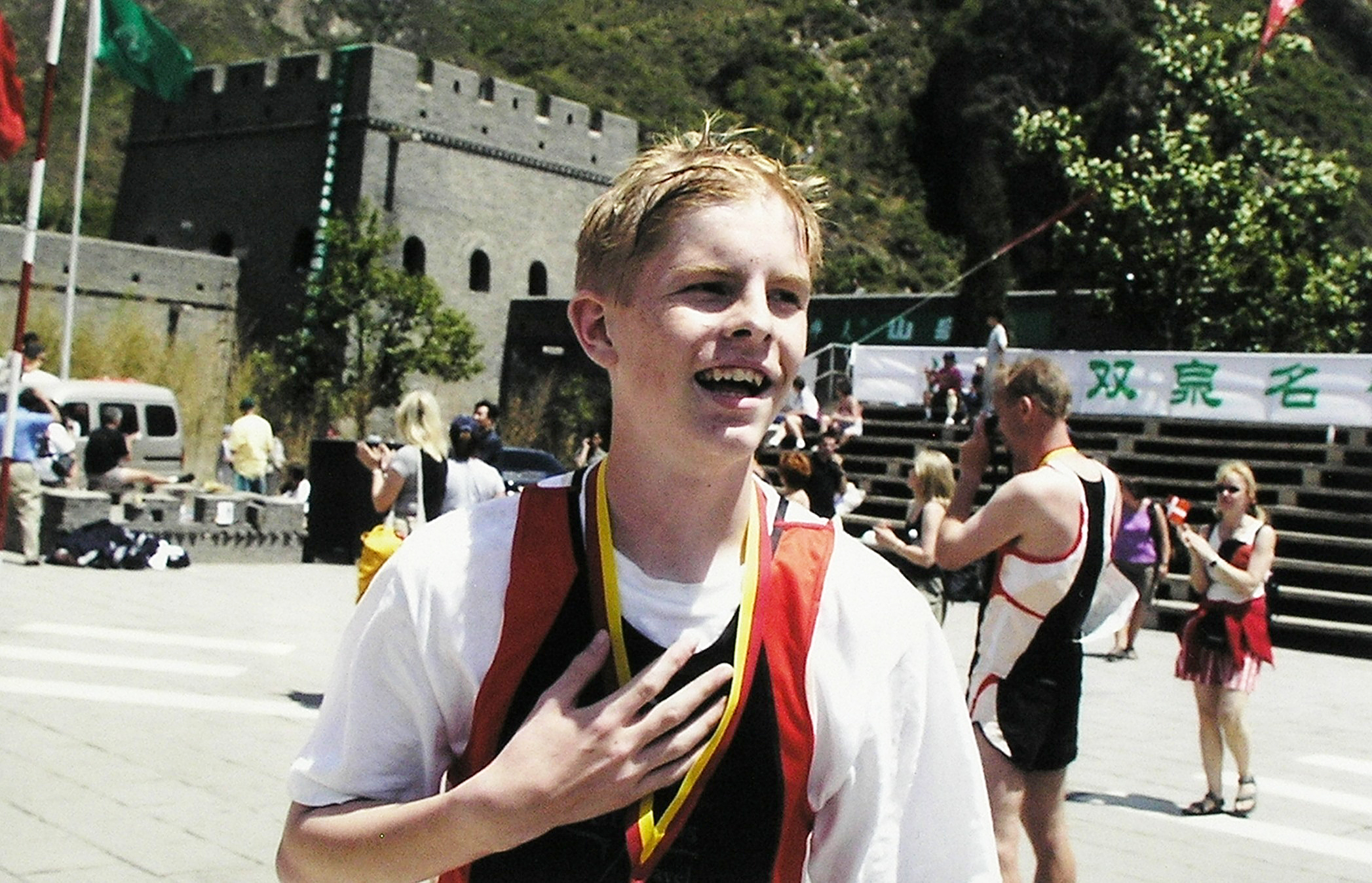
As always, it was a tremendous feeling to cross the line and get a medal round my neck. My time was 6:50:03. Not the best time in the world, perhaps, but since I’d given it more or less all I had, I considered this run to be another great personal victory.
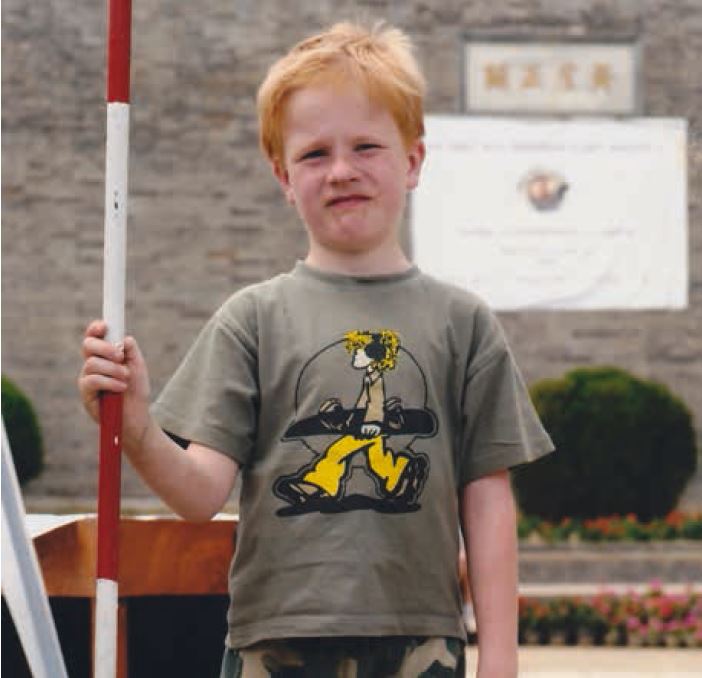
Steffen ran his half-marathon in 3:19:10, and I was impressed that a 13-year-old boy could complete the world’s toughest half-marathon in such an excellent time. As in Kenya, he was the only child in the race.
Søren Rasmussen in crisis
Out of the original 300 plus marathon runners standing at the start two years previously, only three of us were left. One of them was Søren Rasmussen, the managing director of Albatros Travel and one of those who took the initiative for the first Great Wall Marathon. But he got very close indeed to missing this third race.
On Ascension Day, just two days before the race, Søren’s daughter was to be confirmed, and this had presented Søren with quite a dilemma. He had tried to convince the girl to be confirmed on another day, but the independent young lady had insisted on being confirmed together with her classmates. The result was that Søren did not fly out of Copenhagen until the day before the run, arriving in Beijing on the race day itself just after six o’clock in the morning. Added to this, he had not had much of an appetite during the flight. It was of course impossible for him to get to the official start of the full marathon, but a chauffeur was waiting at the airport, and Søren was driven to the start at a rate of knots. The car had to stop along the way for Søren to get out and be sick in the verge. The car arrived just before eight o’clock, and he started at the same time as the half-marathon runners.
These were in no way the optimum conditions for such an arduous run, and they left their mark. When he reached the Wall for the second time, he had to lie down for half an hour and had no idea what to do. In the end, he stuck a finger down his throat and barfed, after which he fought his way to the finish. It is said that Søren was under the strict supervision of a medic on the last section of the run. But his perseverance paid off, and he deservedly crossed the line at the last moment before the absolute deadline.
Victory on the home track
For the first time, The Great Wall Marathon was not won by a Dane. The first man to cross the line was the Chinese newspaper delivery boy Zi Jixiang with a time of 3:50:24. He had run the previous year but came in number 42 with a time that was more than two and a half hours slower. He had only trained for a week leading up to his first marathon. Having never run one before, he pushed himself so hard that he became completely shattered and had actually considered himself dropped out. However, after a very long break he set off again and completed the race.
In the marathon distance, 184 men and 86 women completed the course, while 73 men and 101 women crossed the line in the half-marathon. Some 67 dropped out this year while 11 dehydrated and were put on drips.
Lars Bom got his revenge having dropped out in 2000 and came in a very respectable 14th. Another celebrity ran in 2001, the former Tour de France cyclist Brian Holm, who came in 22nd. After the race, he said that he had ridden the world’s toughest stage on a bicycle seven times and completed ten times in the spring classic Paris-Roubaix but that he had never had to work as hard as he did on the Wall.
Kim Tang Veje, who dropped out of both the first Great Wall Marathons, tried again and this third time he was lucky.
Stubbornness and endurance are rewarded. It is the head, not the legs that decide the result.
Surprisingly fresh
The day after the run, I found to my surprise that I felt really good considering what I had put myself through. I had not expected this as I was struggling across the Wall the previous day. Both my feet and the rest of my body were ready to do another run. But I decided to refrain.
Struggle to find a tie
In keeping with tradition, we were to attend the after-race gala dinner. Although there was no dress code for these dinners, I wanted to be well-dressed. To my dismay I found that I had not brought a tie with me. We had all kinds of other things with us, but a tiny little tie, which took up no space at all in my suitcase, I’d forgotten it. I had brought along a shirt, jackets, trousers, shoes, tie pin and an iron, so it would be anything but elegant to attend a gala dinner with no tie on. I decided to try and find one.
Emil and I went down to a marketplace next to the hotel. There was everything between heaven and earth here, but I couldn’t see a tie anywhere. I found a gentleman’s outfitters, but once again the language barrier raised its ugly head. With a round of charades, I tried to explain to the man that I wanted a tie by taking hold of his shirt collar and “drawing” a tie around his neck and down his chest. See, he thought he had understood – after which he tried to sell me a shirt. I tried again, and a lady came along, but neither one understood anything. No matter what I did, they just wanted to sell me a shirt. So I took a piece of paper and tried to draw a tie for them, but to no avail. They were convinced that I wanted a shirt, and it was not until several attempts later that they understood that I was looking for a tie. But they didn’t have any in their shop.
We went on to a place resembling a Western department store and at the entrance stood a man wearing a tie. I took hold of his tie and looked as though I was searching with a hand above my eyes. He immediately understood and pointed us in the right direction, and here there were so many ties that it wasn’t difficult to find something suitable.
Gala dinner
Ingvor from Bornholm, who had given me the folder about the 100 kilometres run around Bornholm, was with us in China again, and when we were heading for the gala dinner he came along with both his Chinese medals round his neck. He asked me why I was not wearing my three medals because, as he said: “If you’re not going to air them at an event like this, when are you going to?” This gave me an idea that, over the years, would prove to be just a bit over the top.
The gala dinner was held at a large conference centre which could seat up to 1,000 people. We were served with delicious buffet food and drinks ad libitum. During the dinner, the winners were announced, and others were also rewarded for their performances. In between we were entertained by local performers. A band played after the dinner and later there was a disco. Some of us continued to party with beer, wine, crisps and chocolate in one of the hotel rooms.
Take two, pay for one
Three of the runners present had run the first three Great Wall Marathons. Søren Rasmussen from Albatros Travel and Peter Fredberg of the tabloid BT were both members of the organisation behind the run, so I was the only tourist to have run all three times. Søren came over to me during the dinner for a chat. He said we were now an exclusive little club of three who had completed the run three times. “If you run it for a fourth time I’ll give you the fifth,” he said. I looked flabbergasted at Thomas Thomsen, who was standing there with us. “Will you be my witness?” I asked. Thomas answered. “You don’t need a witness. Søren is an honourable man – you can count on his word.”
This was a very nice gesture. Up to then I had not really decided whether to run again, but now I knew that I would be leaving for China again at least twice.
Special offer haircuts
We spent the last day relaxing and buying the last few things. One of our fellow travellers came into the hotel with a new haircut and recommended a hairdresser nearby. We had to try that. Here, too, we experienced language difficulties, but we sorted it out. All three of us had our hair cut. I had my beard trimmed, and Steffen and I had scalp massages. All for a total of less than ten US dollars.
Buy the book here.
