


New Millennium – new times
In late January 2000, a letter arrived from Oriental Tours – a subsidiary of Albatros Travel. They were ready to offer the latest version of The Great Wall Marathon and repeat the success of 1999. This time, the run would be bigger and more international, and they were expecting runners from Japan, Germany, the United States, and in particular the other Scandinavian countries. The 1999 route would be changed, adapted to the larger number of runners.
The Great Wall Marathon 1999 had been very tough. The Millennium was to be celebrated with an even tougher route.
The material I received was just as comprehensive as the previous year, and this time there would be 27 groups and five different airlines to choose from.
Off to China with the family
I was not going alone this time, either. My stepmother, who is only ten years my senior wanted to come with me, and she was more than welcome. As a child, she travelled the globe with her parents, and she also explored many parts of it with my father until he died in 1997. During the years that followed she travelled alone as well as with family and friends. The fact that she had had sclerosis for many years didn’t stop Elisabeth gadding about the world, although she couldn’t run and also had other physical limitations. But now she was coming with us to China.
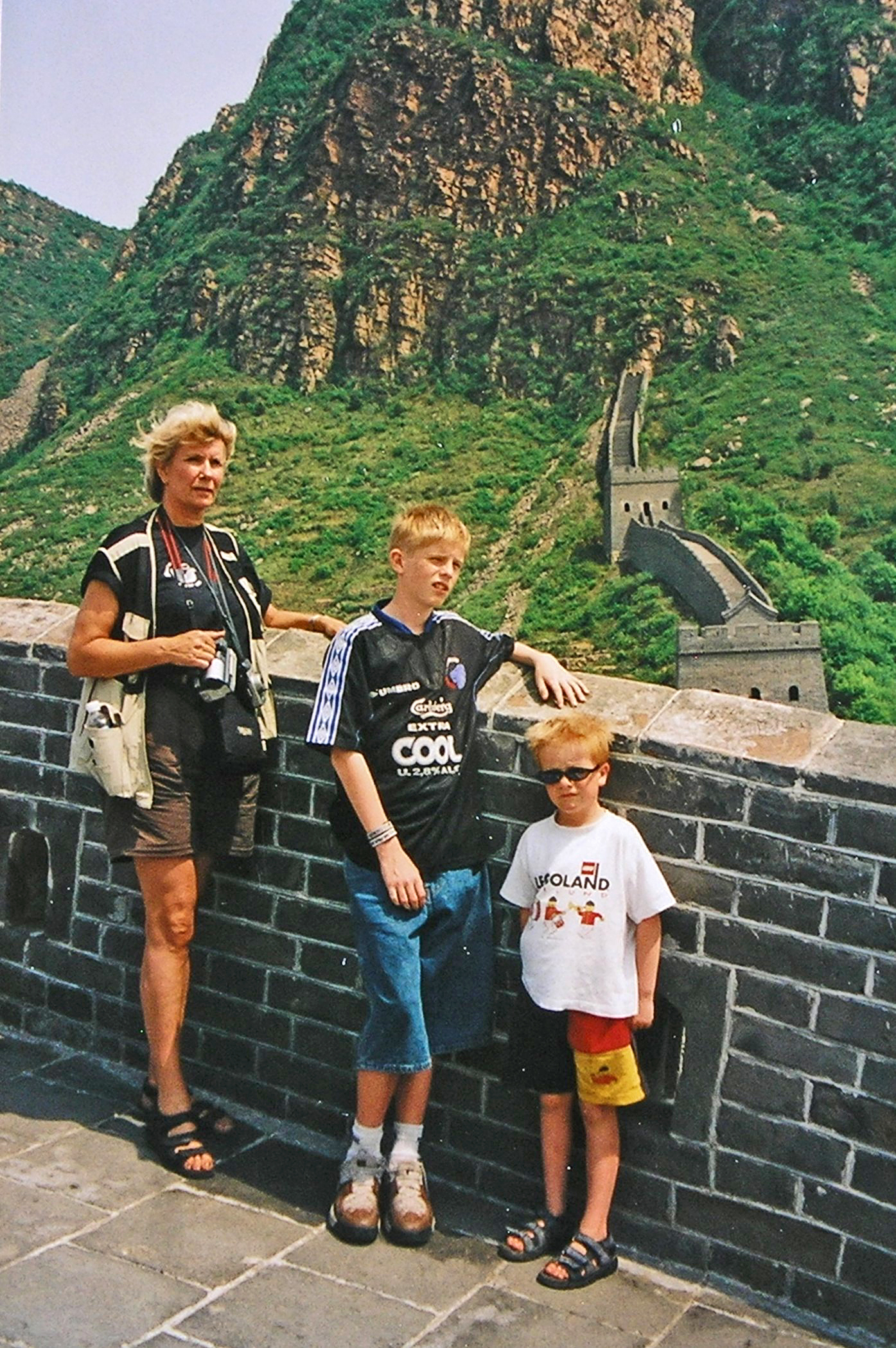
Both my boys were coming along to the great country where people had yellow skins and slanted eyes. Emil went to kindergarten, but Steffen had to be taken out of school because the trip didn’t fit in with any holidays.
Step training
Whereas in 1999, I didn’t do any actual step training for the marathon, I now had the idea of making use of the amphitheatre in my hometown, in Folkeparken (literally: the People’s Park). Here I could zigzag up and down the steps, which I did every time I went training. Since then I have made use of the amphitheatre steps when preparing for The Great Wall Marathon. It can be quite an odd experience on a Friday afternoon, when young people from the high school often gather there with beers and other supplies. My body exercises often give rise to amusement, and once in a while some of the youngsters find cause to put on a small play.
Back in China
As in the debut year, the marathon was run on the fourth Wednesday in May. This year it was on 24th May and just like the year before we set off from Copenhagen the previous Friday so as to have enough time to get accustomed to the new time zone.
We arrived at Copenhagen Airport with group 11 at 5:35 p.m., with the flights due to take off at 7:45. There were not nearly as many groups gathered at the airport as a year earlier, and I imagined this was probably because most of the groups would be leaving at different times. As I later found out, this was not so.
Our guide was Katrine Chang, who, like me, was a repeater. I didn’t know her, but I seemed to remember seeing her in 1999. Like Søren Dehn, she was a sublime guide who was able in every way to make the trip a great experience for us all. Besides Katrine, the group consisted of 30 passengers, though one of us had apparently not turned up. We stood there waiting for him for some time, but then Katrine decided we should check-in. She would then keep in touch with the check-in to hear if the last man turned up.
In the transit hall, I met Peter Fredberg of the tabloid BT with his wife, Mie, who were travelling in the same group as us. I now got an explanation as to why the airport was not as full of runners as the past year. Not many had registered, and there would be fewer than 70 Danish runners. It had obviously not been so attractive to set off for a second time. There were only nine runners from last year, of whom five had completed the course, while the four who had dropped out were now going again to take revenge.
We left Copenhagen without the missing participant, whose fate remained a mystery at that stage.
Beijing revisited
The trip was in many ways a repeat of the previous year, and that’s almost the way it had to be. We had joined a group with organised outings that were more or less the same as the previous year because Elisabeth had not been on this particular trip before, and the boys had never been to China either.
Lars Bom was also going to run again this year and was accompanied by his wife, Birgit. During lunch at the Summer Palace, five-year-old Emil was sitting between Lars and me and I told him that the man next to him used to be the man inside the television teddy bear, Bamse. Emil didn’t believe me and asked Lars, who was able to confirm this and also told him that he had been one of the voices in another children’s TV show, Bananas in Pyjamas.
Oops – weren’t we supposed to fly on Saturday?
On Sunday, it was time to revisit the Forbidden City, Tiananmen Square and other sights. When we got back to our hotel, I was the first to get off the bus and was met by another Dane, who obviously thought I was the group’s guide. He asked if this was group 11, introduced himself as Jens, and told me that he was the missing passenger from our flight. The story was that Jens had been caught napping. He had originally joined a group that was to have flown out of Copenhagen on the Saturday but because this group didn’t have enough participants, Albatros Travel had asked if he would mind travelling with group 11 instead. He agreed to this, and Albatros had sent him his travel documents. But as Jens admitted to me, he had screwed up. He had been a bit stressed out and had, therefore, not taken a good look at his new travel documents, for which reason he thought that the group would leave on the same day as his original group. Standing at the airport on his own on Saturday afternoon, Jens couldn’t understand what was going on. He went to the SAS desk, and they were able to tell him that he should have left 24 hours earlier. Now Jens was in a tight spot. But, as luck would have it, SAS had a spare seat on the Sunday flight and did him the great favour of allowing him to rebook free of charge. The next problem of course was that Jens was on the group 11 visa, but that problem was also solved by contacting the Chinese embassy which with record speed procured a personal visa for him.
Missing Danes
Monday’s inspection day was in many ways reminiscent of the 1999 version. The big difference was that there were so few of us on Yin and Yang Square that it seemed almost empty.
While out walking in the “Gobi Desert” during the inspection trip, Steffen needed to let off some steam, so the 12-year-old lad ran off ahead of us, while I stayed together with Emil and Elisabeth. When we got to the meeting point, Steffen was missing, which concerned me – or rather caused me to panic slightly. My son had gone missing in that huge country, and I had no idea where he was. I was, therefore, somewhat relieved when a woman told me that her husband Hans was also lost, and Birgit Bom said that her Lars had also disappeared. Since three people were missing now, it was very likely that they would be together. And they were. A car was sent off to find them, and it turned out that they had run to the right where they should have taken a left. They had run so far ahead that they had arrived before the people who were supposed to have shown them the way.
Lars Bom had also done a disappearing trick the previous day in front of the Forbidden City. There wasn’t much of a cop in him!
A day with a full schedule
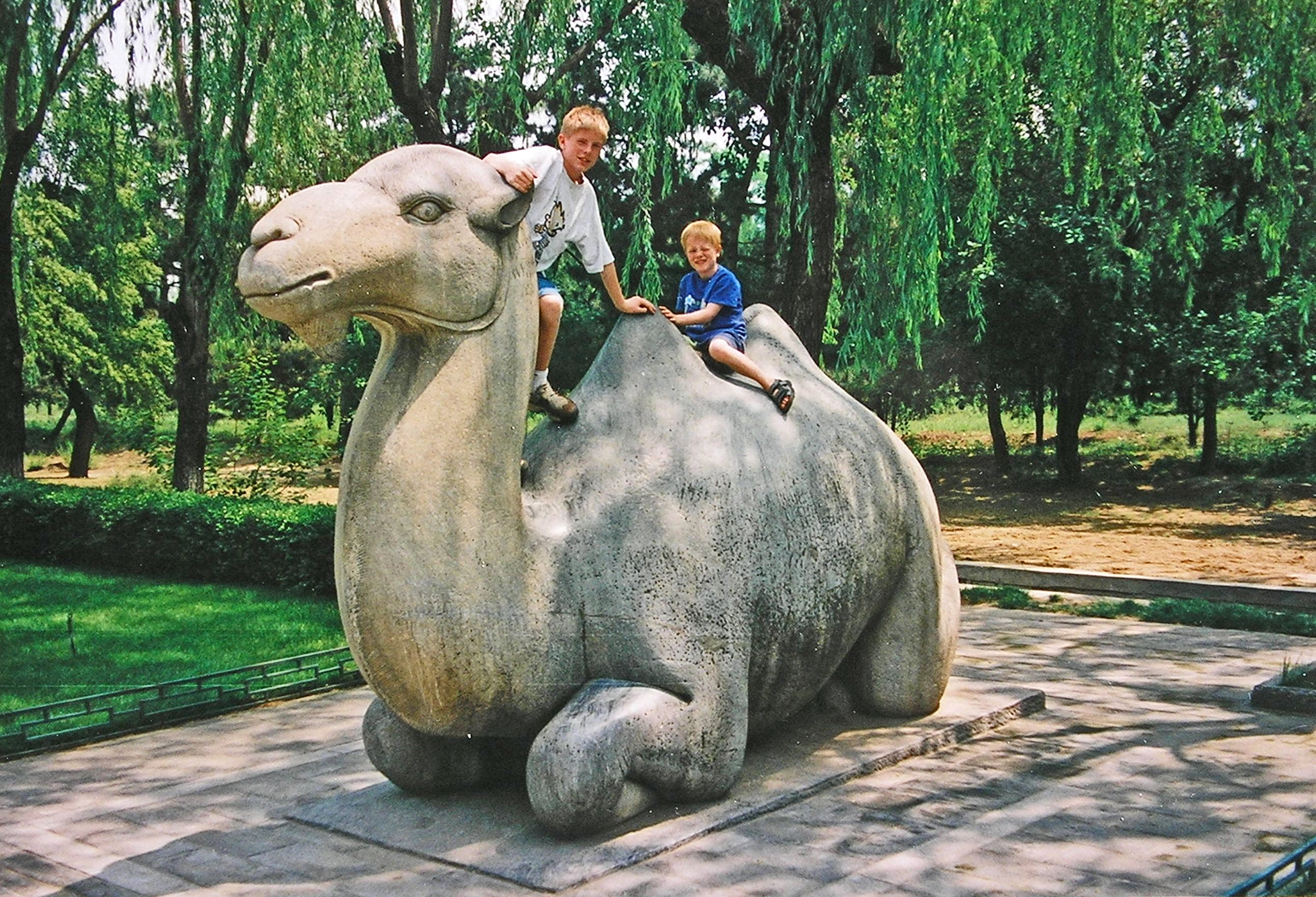
The day before the marathon also had a full schedule. First we visited a cloisonné factory and then the Ming Dynasty Tombs, where we set out for a walk on the “Spirit Way” (Shéndào). Its many impressive stone sculptures were to prevent evil spirits desecrating the graves. However, the statues were unable to fend off the marauding hordes of tourists. After a visit to the tomb of Chang Ling, we went off to look at that of Qing Ling, and here in this quiet and beautiful part of the Ming Emperors’ resting place we were able to feel the presence of history.
On our way back to Beijing, we visited a village in the area. The majority of China’s population is rural. Although economic reforms initially helped the peasants improve their living standards, the economic prospects of the population in the countryside looked pretty grim at that point in time and several million people left every day for the cities in search of work. We got a very real insight into the sparse conditions predominant in rural China.
Tougher version of the marathon route
On Wednesday 24th May, it was time for the second version of the later so legendary marathon. As was the case a year earlier, we got up very early to travel by bus from Beijing to Huangyaguan, where the 2000 race was also to start at 10 a.m.
About halfway to the start we made the obligatory stop off, and Peter Fredberg and I chose to take a leak in the same field. As we stood there, legs apart, Peter told me that, in the autumn, he was going to run the 100 kilometre race around Bornholm, the Danish island in the Baltic. He had previously run the same distance on Zealand. I had become a marathon runner the year before, and now there stood Peter talking about running 100 kilometres. In my innermost thoughts the diagnosis was unambiguous – the man was stark raving bonkers. But my curiosity had been aroused, and I asked Peter if he did training runs 50-70 kilometres at a time. No, he didn’t, he just trained as he would for an ordinary marathon.
“It’s all in the head,” he said, “Not in the legs”. I would later experience just how true this was.
As the bus approached the area of The Great Wall Marathon, I started to feel goose bumps on my arms, and I have had the same experience every year since. In many ways, The Great Wall Marathon is very special to me. Most important perhaps is the fact that it was here I ran my first marathon and was “born” as a marathon runner.
As in 1999, speeches were made by the Danish ambassador, Thomas from the Danish Athletics Association, and several high-standing Chinese officials. Our immediate impression was that more traditions were waiting for us, but things were not as they were last year, as we would soon find out.
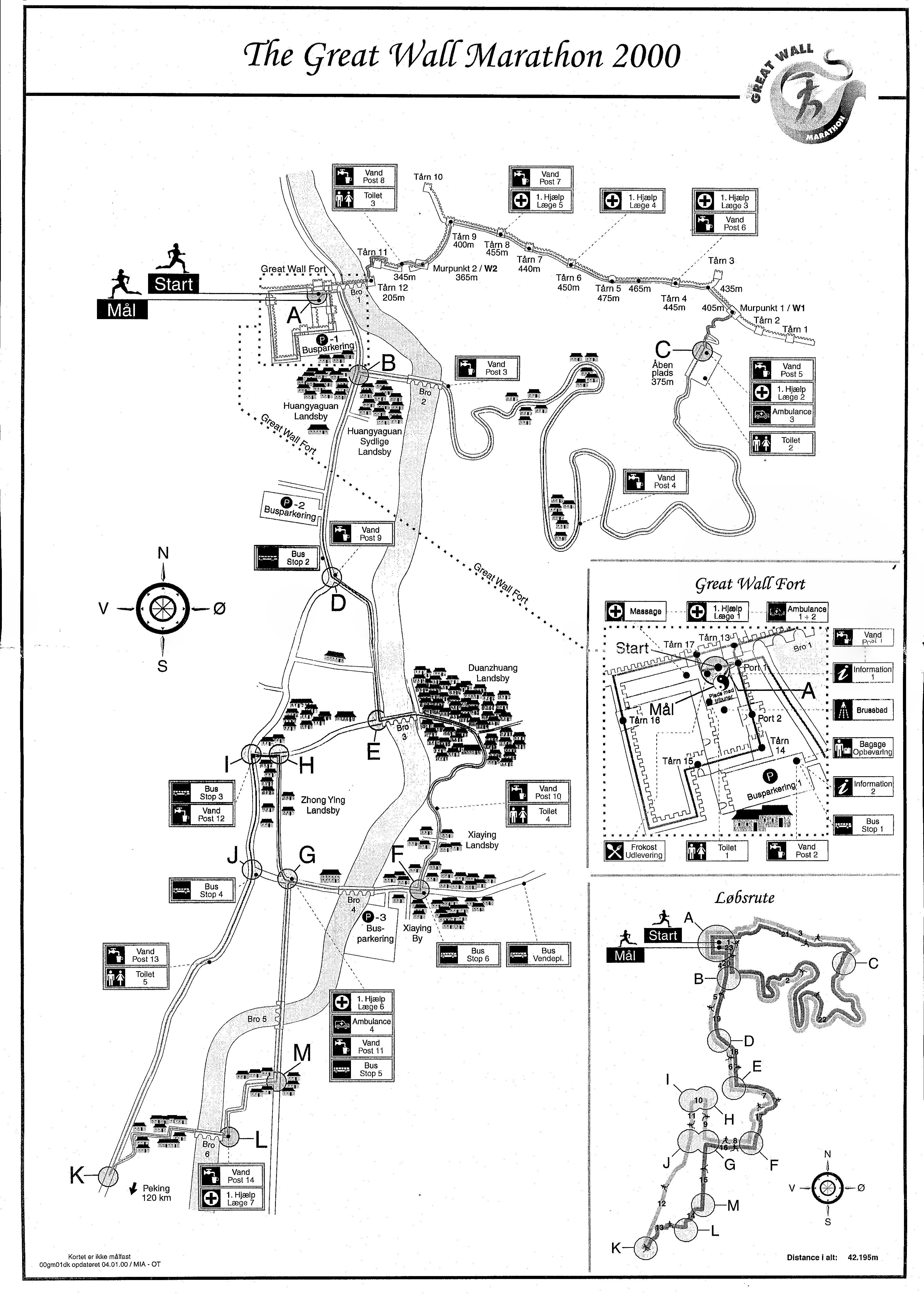
In 2000, the race started on Yin and Yang Square itself and has done so ever since. The starting pistol was fired at 10 a.m., and we ran out through the archway in the foundations of the Great Wall fort. Out on the road we took a right southwards and were now on a stretch of the route we would run four times in all – twice in each direction.
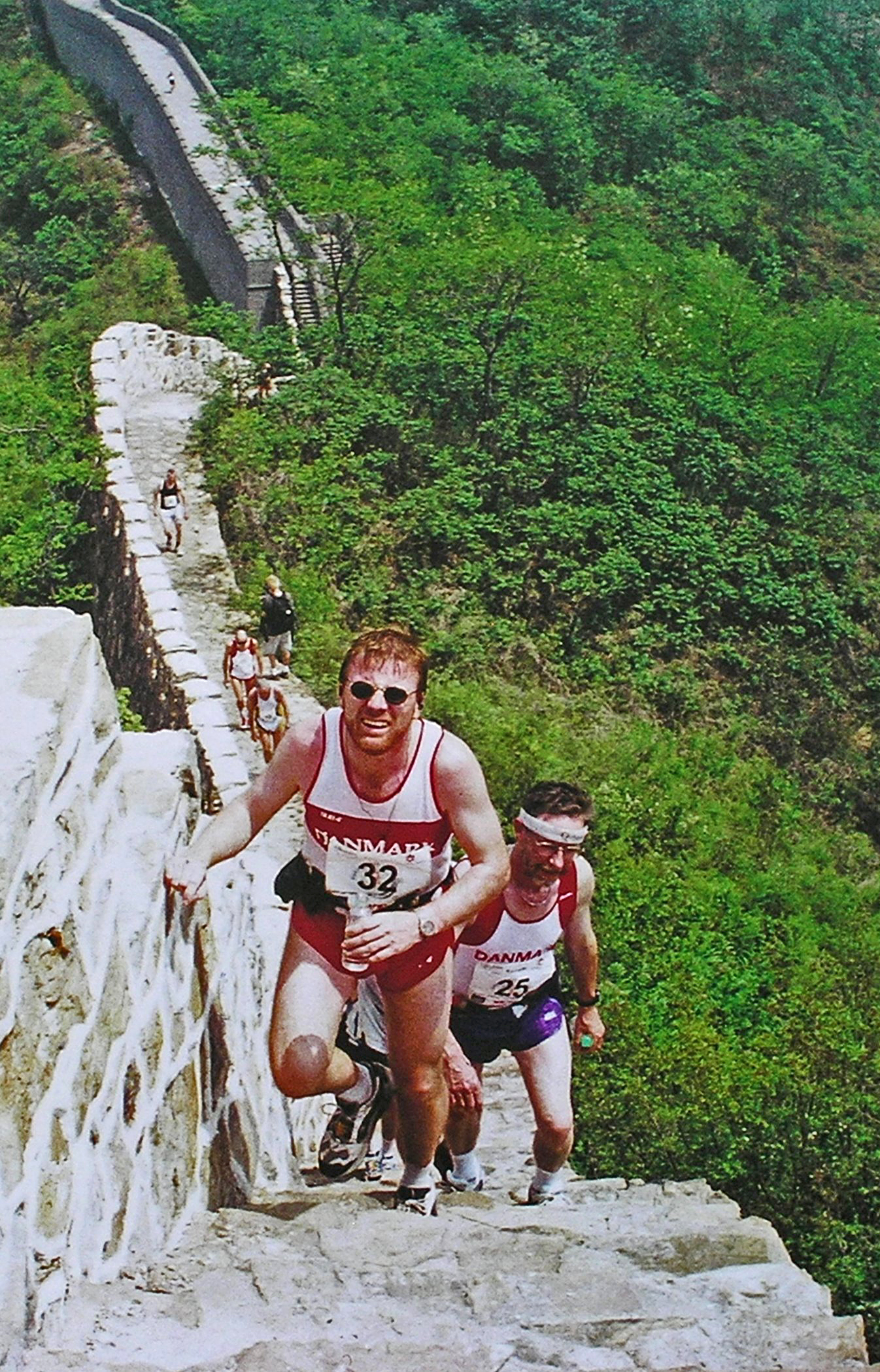
Eight hundred metres down this road we were to turn left and up a very steep tarmac mountain road which I had only tried running down the previous year. I have to admit that it was an entirely different challenge running it in the other direction. We were now confronted with the next-toughest challenge of the race – exceeded only by the Wall itself. It turned out to be a very good idea to save one’s strength during this part of the run, which was what I did. I was well aware of the challenge that faced me just after the top of the mountain.
Obviously, the Wall had not become easier than it was last year, since I had started the race running up a mountain with ascents of up to ten per cent. But I navigated the Wall in fine style.
But it was not just the start on the mountain that made the 2000 run different from the previous year. Many changes had been made, although I won’t go into detail about the route. It was in the same area as the previous year, and many of the sections were also identical. We ran along the main road, through villages and on gravel and dirt paths. Again, there was a great atmosphere everywhere with happy children and smiling adults. Whereas the previous year we had run two short loops, this time we had to go further out before returning to the point of departure.
Wet feet
The day of the run in 1999 had been very hot, and although one might not believe it were possible, 2000 was even hotter. The temperature rose to 34°C in the shade, and I have never since experienced such intense heat in China. In 1999, I had great success dousing my body with water to combat the heat. I repeated the tactic but this time with fatal results. I was so reckless that I soaked both my shoes. Inexperienced and ignorant as I was I thought the sun would quickly dry them out. This was right enough, but that wasn’t all. I got blisters, which as time went on presented more and more problems.
First meeting with Kathy
Over a third of the way into the run I happened to run alongside a middle-aged American lady. We each focused on our own race although we did chat for a while. When I reached 18 kilometres, the blisters on my feet were getting really painful. I had to slow down and walk while my companion continued. Her name was Kathy Loper.
At the mercy of blisters
Although I hadn’t reached the halfway point yet, it was soon obvious to me that I would not be able to run anymore. I did try, but it was too painful. I, therefore, had to walk, which I did at a pace. I was convinced throughout that I would be able to reach the finish within the set time limit.
A difficult situation
Hanne had also decided to run The Great Wall Marathon in 2000 and had come out here with a new boyfriend. I didn’t feel good about it, but I was glad at least that we were not in the same group or at the same hotel. We did, however, meet at the common events, and on those occasions she was able also to spend some time with our children.
As in the first year I was faster than Hanne, and the distance between me and her new boyfriend suited me fine. I could run my own race in peace. But the blisters had put a stop to that and as time went by I noticed they were not far behind me. However much I wanted to, I couldn’t avoid them gradually catching up on me. After 24 kilometres they were alongside, and Hanne asked if she could help in any way. I was obviously rather brusque when I said that I could manage, thank you very much. As they disappeared over the horizon, I walked on with the tears rolling down my cheeks. I think it was at that moment that I decided that I would finish the race however painful it might get. Stubbornness? Willpower? Or fear of losing face? Well, I don’t know but at the end of the day, this episode was perhaps one of the reasons why I succeeded in completing this second run with large open blisters on both feet.
After almost 32 kilometres, I was back on the tarmac road and could discard my running shoes, something which had been impossible on the dirt and gravel tracks in the “Gobi Desert”. I tied the laces of my running shoes together and hung them round my neck, after which I continued on to Yin and Yang Square. Many spectators had noticed how I trudged along downcast and before long a rumour was circulating at the finish that I dropped out.
Sandals as running shoes
But when I got back to Yin and Yang Square I checked out my running shoes and got hold of my sandals. Fortunately, I remembered to take my chip off the shoes and put it in my bum bag. Now I was ready to take the Wall in highly alternative footwear.
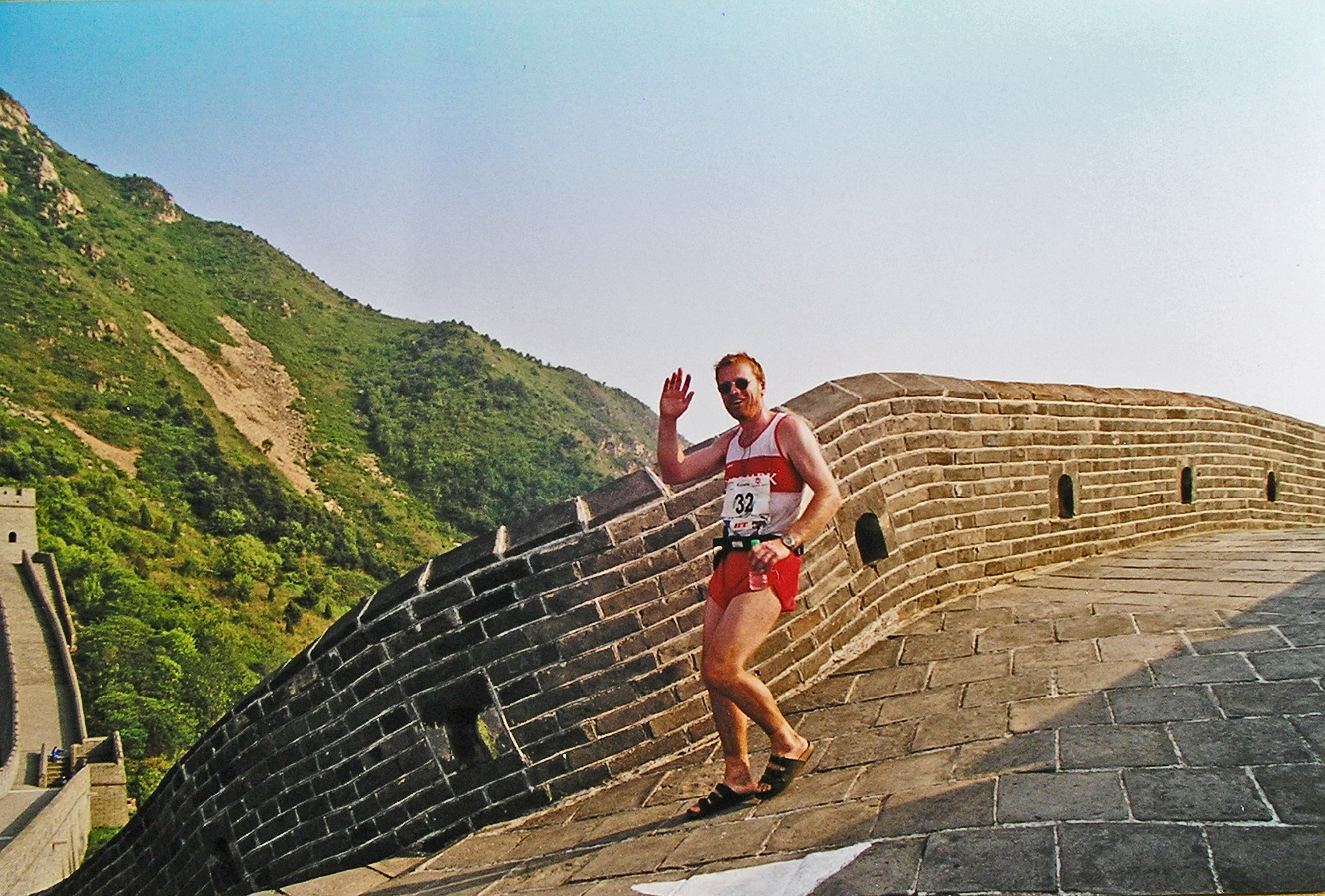
Of course running on the Wall wasn’t easy, but on the other hand I don’t remember it being particularly difficult that year. Maybe this was because I had conserved physical energy during half of the run. On the way over the Wall, I passed a good number of other runners, many of whom slipped past me again on the way down the mountain.
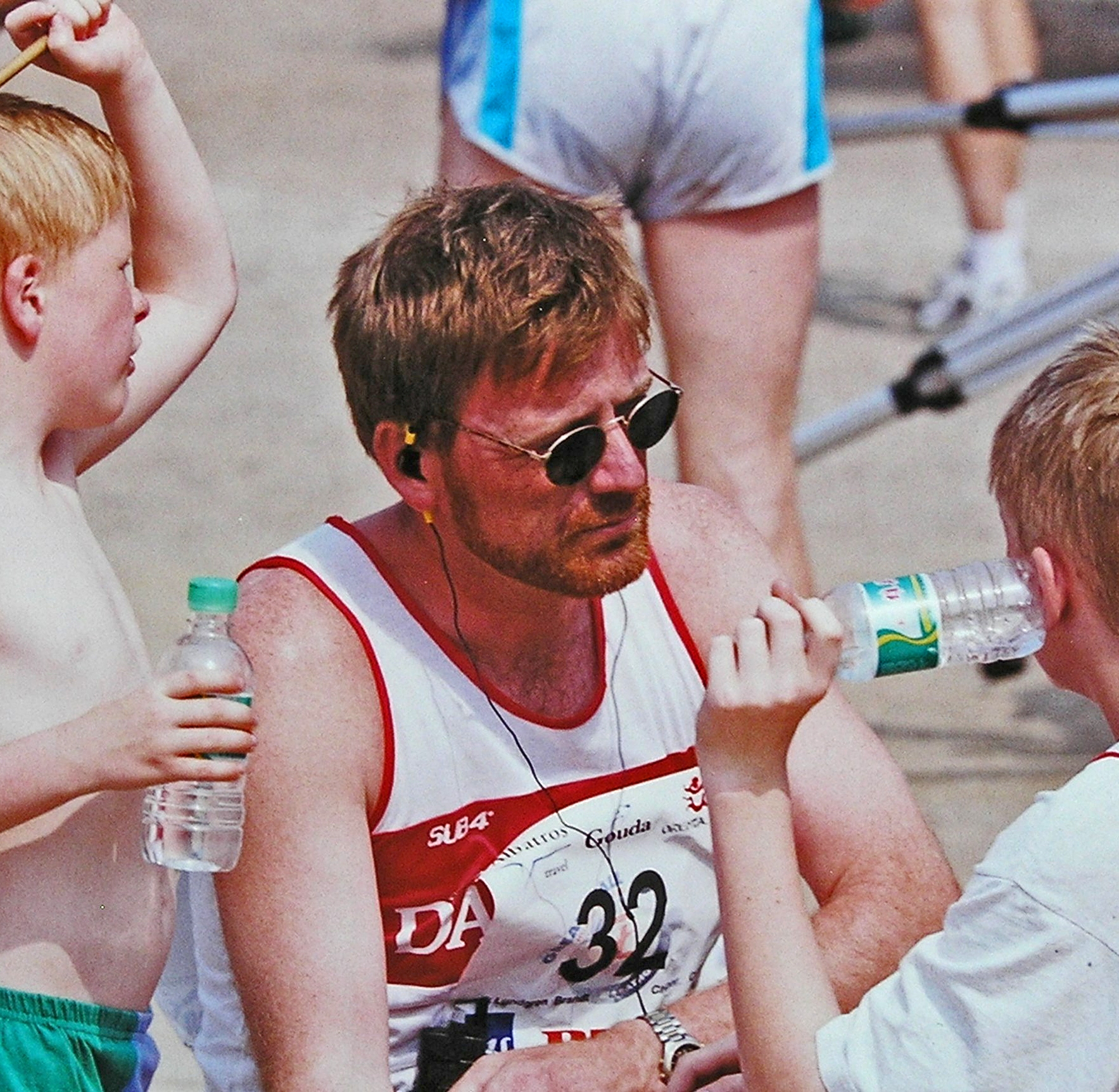
I came in as the seventh last man in the race, though with a time of 7:17:43 I was in good time compared to the official deadline. At the finish, I bent down and activated my chip. The tears flowed once again, but this time it was neither because of pain nor melancholy, but out of pure gladness at having succeeded in getting through the rigours of the day.
Medical treatment and a promise of a comeback
At the finish, I immediately received medical treatment from Mogens Rishøj, who punctured my blisters. This was not pleasant, but it had to be done. While I laid there receiving treatment, Søren Rasmussen came over and gave me some sympathy. Søren, the managing director of Albatros, had also just run his second Great Wall Marathon. Like me, he had made his debut as a marathon runner in this same place the previous year. I knew who Søren was, but this was the first time we spoke. The last thing I said to him was: “I’ll be back next year”. I think it was at this precise moment I actually wrote my long-term contract with the run.
A very special group
One group attracted particular attention that year. Fate had brought together some fast runners in that specific group, and they made their mark on the marathon top ten. Both the winner and number two were in the same group. Again in 2000, the Danish broadcaster DR had sent a team to cover the event, and I was later able to watch the formidable struggle between Martin Steinbach and Steen Habermann. The former came in first with a time of 4:11:29 while Steen crossed the line a minute and a half later. After his victory, Martin lay with a drip for several hours because he had not drunk enough fluid during the race.
The winning times in relief
The times are clear evidence of the fact that the race had become more difficult. Martin’s personal marathon record was 2:45:21. Compared to the winning time in 1999 (55 minutes faster) this rather puts things into relief. There was no doubt that the degree of difficulty had been enhanced.
The women’s 2000 record came from our group. With a time of 5:22:30, Ingelise Jensen was an hour and 27 minutes behind Kersti Jacobsen’s 1999 record.
Cupid on the Wall
The group’s guide was Merete Skov, and the cupids were particularly active during those days in China. Merete later assumed the name Habermann and she and Steen returned to run The Great Wall Marathon several times. In 2005, Merete completed the five-kilometre run with their nine week old daughter, Agnete, asleep in her sling. It’s incredible what a marathon can lead to.
A few statistics
Runners from nine different nations participated in the 2000 marathon. A total of 10 women and 66 men finished the run and 56 Danes received medals, so we were still in the majority. It was not to continue that way, though.
A total of 92 runners had assembled at the start, of whom 16 dropped out and half a dozen had withdrawn before the start of the run. Seven runners had to be put on drops, and worst affected was Kathy Loper with whom I ran during part of the race. She collapsed at the finish and spent two days in a hospital in Beijing. Lars Bom was among the ones who dropped out: Badly affected by the heat, which made him dizzy, he had had the sense to stop. Two of the runners who didn’t complete the 1999 marathon also had to abandon their attempt this time and returned home crestfallen.
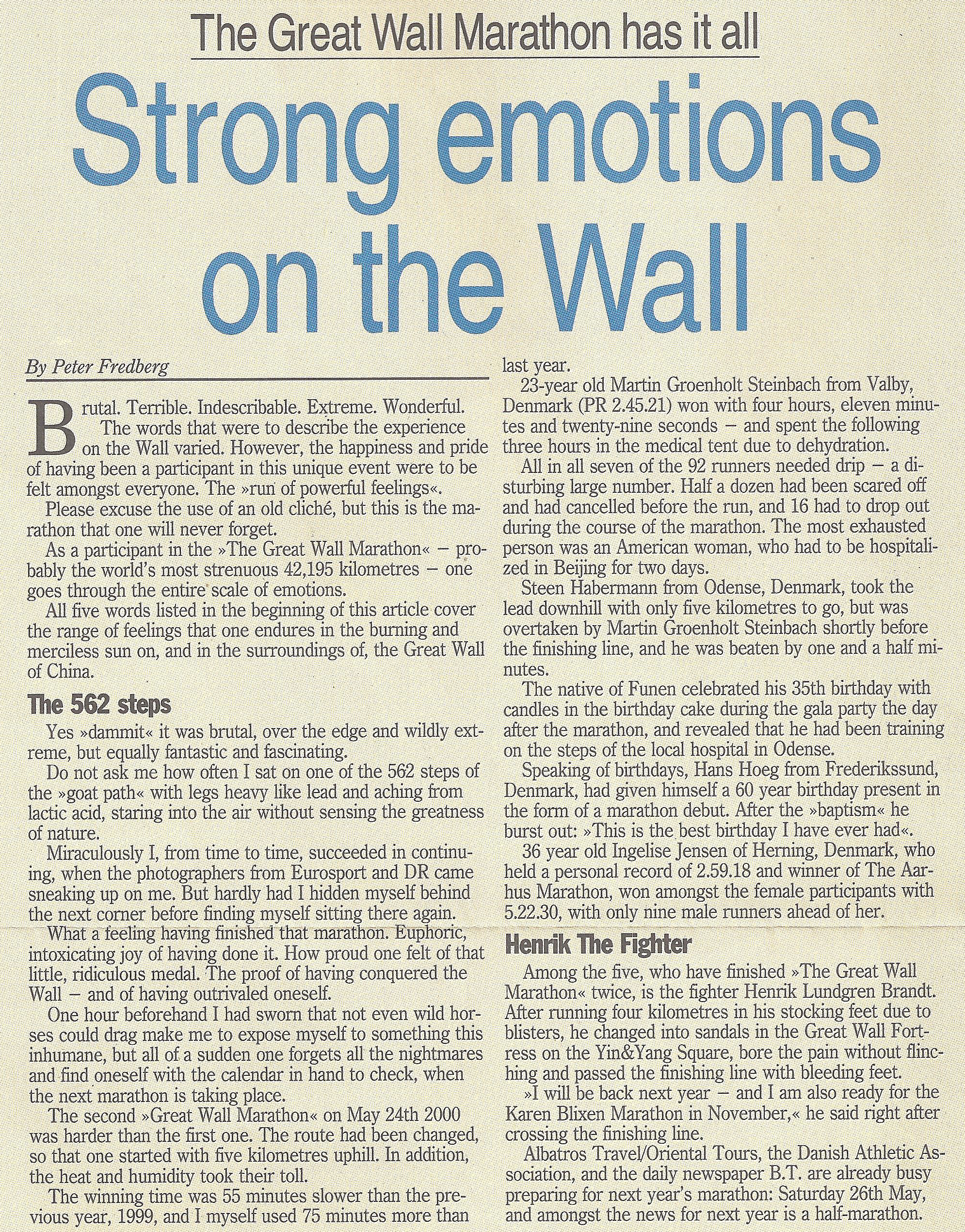
Once again, the tabloid BT did a good job covering the marathon, and this time the run newspaper was in English as well as Danish. In the paper, there was a piece about “Henrik the Fighter”. That was the story about my blisters and sandals.
Yet another splendid gala dinner
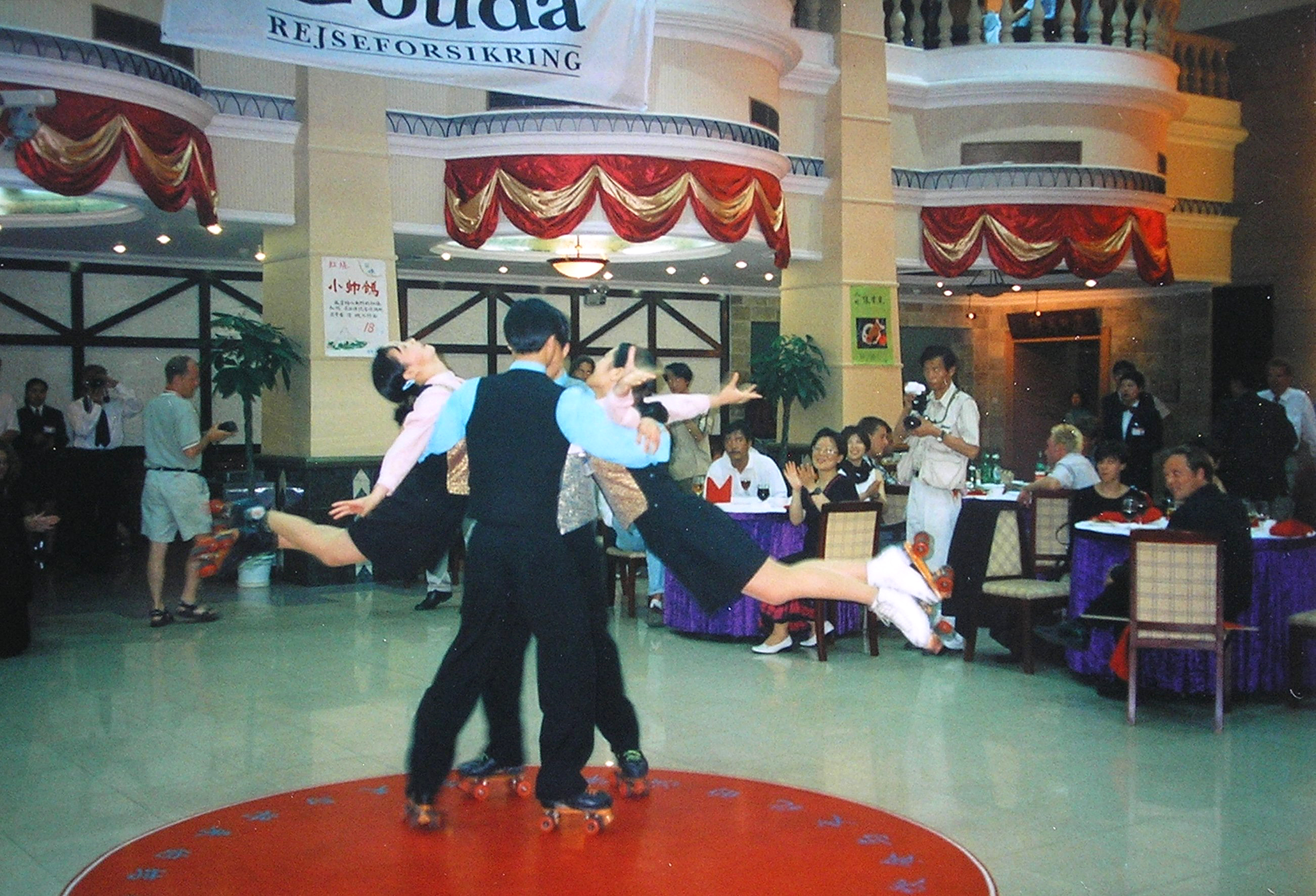
The gala dinner was as splendid as the past year. Because there were not as many participants, the party was held at a smaller venue. At the beginning of the event, a man from Bornholm went around distributing some small folders. When Ingvor got to us, I reached out for a folder. In his sonorous Bornholm accent, he said: “Oh, but that’s the last one I have”. I asked him whom he would otherwise give it to, and he gave me his last one. No-one knew at the time, but for him this was the only folder that paid a dividend.
Buy the book here.
