


Alternative to a cancellation
During my first years as a runner, people often asked: “You’ll have run the Copenhagen Marathon, then?” The answer was no, and I added that I probably never would. The Copenhagen Marathon and The Great Wall Marathon are very close to each other time-wise, in the second half of May. It was, therefore, not realistic for me to run both races. However, the SARS epidemic which had caused the cancellation of the Chinese race gave me the opportunity to run in my own capital.
The Copenhagen Marathon first saw the light of day in 1980 and has been organised down the years by the athletics club Sparta in collaboration with the daily newspaper Politiken. The marathon has grown over the years, and in 2003, there were some 5,500 runners.
Pacemakers
That year, the marathon was run on 18th May, and a few days earlier I had picked up my start number, T-shirt and marathon bag at Østerbro skating rink, where there was also a sports exhibition.
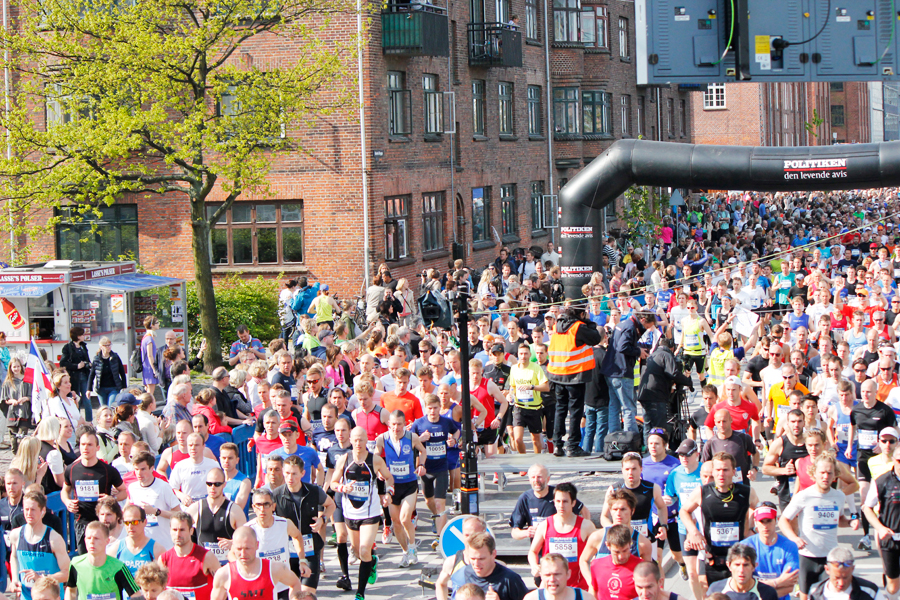
On the day of the run, I took the train to Copenhagen and walked to the start at Vester Voldgade in the city centre where the run was to begin at 9.30. Something new this year was pacemakers who were to ensure a stable pace throughout the run. With my previous experiences with reducing my time, I decided to follow the pacemakers and their orange balloons to achieve a time of four hours. However, I made the mistake of not joining the main group from the start, which meant the race was uphill from the first meter.
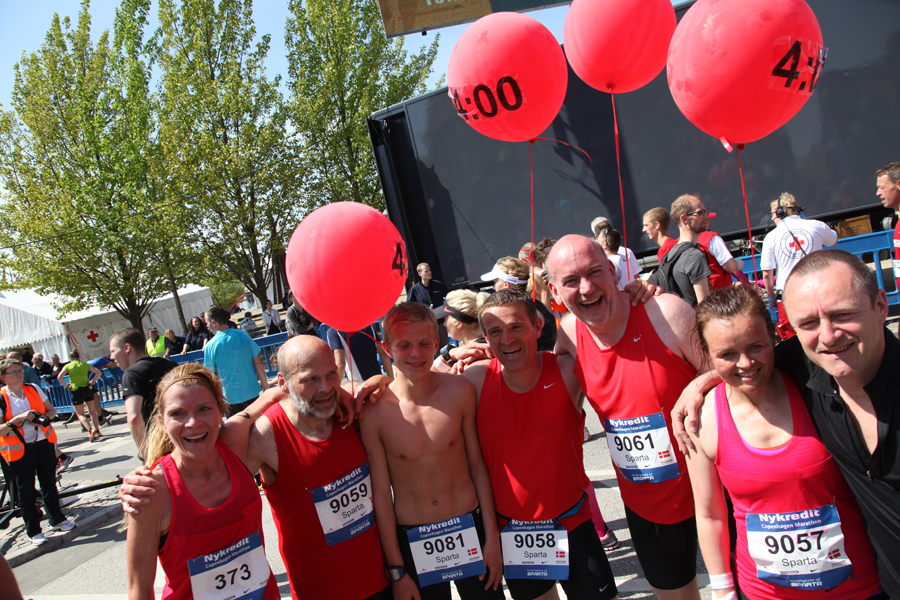
My aspiration to catch up with the orange balloons meant that I increased my pace from the start, and having to overtake a lot of runners to get there was stressful. This would also prove to be a bad technique.
It was not until half way through the run that I managed to catch up with the four-hour group, by which time I was completely shattered and could not keep up with the runners I had fought so hard to catch up with. It felt as though the air in my inner balloon was gradually seeping out as the orange balloons ever so gently disappeared over the horizon.
The route
The route went from Vester Voldgade, through Vesterbro and then to the southern harbour district, Sydhavnen, up towards Valby and along Kalvebod Brygge. From here we ran through Nørrebro to Østerbro, to Amaliehaven on the city harbourfront to Nyhavn, and then finally along Christiansbrygge to end up at Vester Voldgade and the finishing line.
Good weather
The weather was on our side all day. As far as I was concerned it could have been slightly cooler, although it could have been much worse. There was plenty to drink along the route, with 11 water stations which also provided energy drinks.
The heat and my pushing myself so hard at the start to catch up with the orange balloons had a negative effect on my performance during the second half of the run. I had to suffer the indignity of being overtaken by the white balloons which marked the runners expected to come in with a time of 4:15. This did, however, motivate me to use all I had in reserve towards the end so as not to be overtaken by the pink balloons for 4:30.
My time was 4:25:48. Although this was well short of my ambition, I was satisfied all the same with having completed my home country’s largest marathon.
The marathon was won by the Italian Mostafa Errebbah in 2:19:57.
Buy the book here.
