


The free trip
All my trips to China have been very special, but the special thing about this one was that Søren had promised me the trip for free. I sent off my registration paperwork and received confirmation and an invoice in return. As Thomas had said two years previously during the gala dinner: “Søren is an honourable man – you can count on his word”. And I could. The invoice ended with a row of zeros.
I was to set off on a nine-day trip on 20th May. As in 2001, I had chosen to join a group without guided tours, and as in 2000, we were to run on 24th May. Everything looked good. All the same, there was a factor that lurked in the background.
SARS
In the autumn of 2002, reports came in of a mysterious disease in the Chinese city of Guangdong. The disease could easily be confused with influenza, and its symptoms were fever, coughing, trouble breathing or shortness of breath. Nobody knew where the disease had come from or how it could be cured. From mid-November 2002 to the end of February 2003, there had been 792 cases in Guangdong, and 31 people had died.
The disease became known as SARS, an abbreviation of Severe Acute Respiratory Syndrome. SARS spread to large parts of Asia and was also reported in other parts of the world. Fewer than a thousand people died world-wide, but there was a real fear of an epidemic of disease of which no one knew the extent and for which no cure was known.
GWM – should we/shouldn’t we
Ultimately, people questioned whether The Great Wall Marathon 2003 should go ahead, and I was asked if I dared go. My attitude was clear. If the airline and the organiser were sending people to China, then my participation had to be defensible. I had also taken into consideration the fact that very few people had died from the disease and that everything you ever do involves a risk. So I wasn’t much more afraid of the disease than of so many of life’s other hazards.
Postponed
On 25th April 2003, Albatros Travel sent a letter saying that they had been keeping a close watch on developments and reported SARS infections in China, as well as constantly studying information from the World Health Organisation, WHO. They did not believe that travelling to Beijing and northern China constituted a risk and ascertained that only one person in 20,000 was affected by the disease in Beijing. At the global level, since the SARS mortality rate was one in 650,000, SARS was not considered to be more lethal than an “ordinary” influenza.
On the other hand, the media had, despite the realities, managed to create a general atmosphere of fear as far as travelling to China was concerned. Even though a highly qualified team of medics was attached to the marathon, and although they were sure that The Great Wall Marathon would be run as planned and under fully defensible circumstances, they found it best to postpone The Great Wall Marathon 2003.
New date – 1st November 2003
Instead of the planned run on 24th May, it was immediately announced that the marathon would instead be run on 1st November. They guaranteed that all travel arrangements in connection with the event would remain unchanged without any price increases; even though the departure dates were now well within the high season.
It was entirely up to the individual whether they wanted to participate on the new date or to cancel. Anyone could cancel their trip without it costing them anything at all.
Radio interview
I was not at all surprised by these developments, though I was rather disappointed. With Albatros Travel as an intermediary, I was interviewed on 6th May by the Danish Broadcasting Corporation, DR, on the morning programme. I made my opinion known though I fully accepted the decision.
Totally cancelled
On 27th June, yet another letter was sent by Albatros Travel. They had, unfortunately, ascertained that the vast majority of people who had signed up for the year’s marathon had decided to postpone their participation in the run on the Wall of China until 2004. Even though China had been declared SARS-free, they felt it was necessary to cancel the year’s marathon and to focus on next year’s run at the “right time” in May.
Curious merchandise
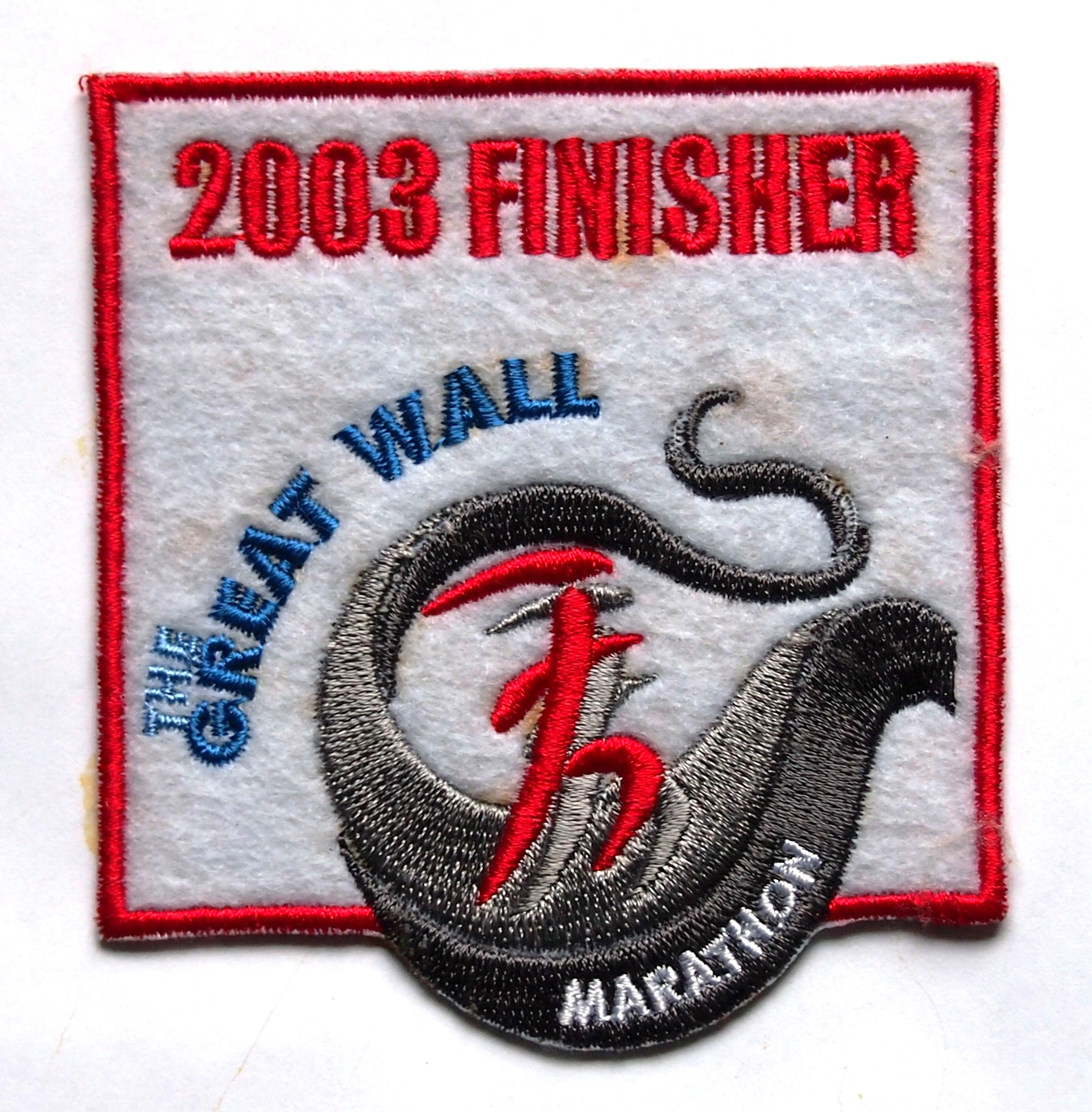
In 2004, during the gala dinner of The Great Wall Marathon, I was given a very special present by Albatros’s guide Merete Skov Habermann. Leading up to the cancelled Marathon in 2003 various kinds of merchandise had been made which later went to waste. Merete gave me a “finisher” cloth badge that no one would ever be entitled to wear. She felt that I was the right person to own it. I was moved by the gesture and would never dream of sewing the label on any of my clothing. But it is in my scrapbook for The Great Wall Marathon 2003, because I made one even though the marathon was never run.
Whatever became of SARS?
The SARS epidemic lasted 100 days, and the disease has apparently now been got rid of because they found a cure. Many people have now entirely forgotten SARS, which was obviously a parenthesis in history.
Some scientists believe the disease stemmed from the civet cat. Others maintain that other species spread the disease, bats being among those mentioned.
Buy the book here.
