


During journeys around the world, you get to meet a lot of people, and you make some good contacts, too. Once in a while you agree to meet again, but often nothing comes of it. Among the runners in The Karen Blixen Marathon in 2000 was a man called Rolf Bücking from Viborg. He had spoken warmly of the 24-hour run held earlier that year by Viborg Athletics and Fitness Association. The run was to be repeated every year from then on. Getting to know each other in Africa ultimately led to the idea of our going to Jutland to run with Rolf.
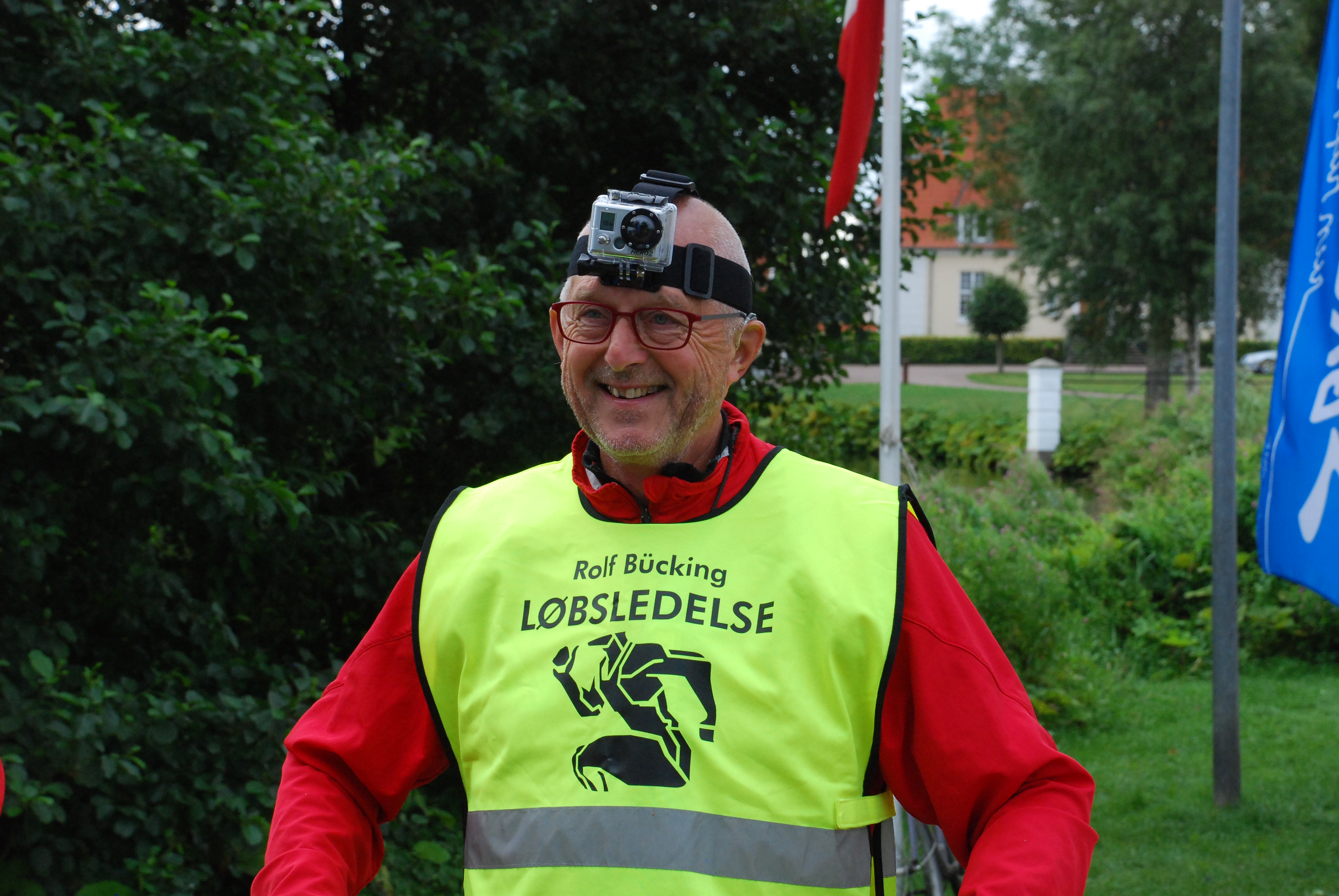
In the spring of 2001, I received a letter from Albatros Travel. They had taken the initiative of inviting runners from The Karen Blixen Marathon to form a relay team to run at 24-timer Viborg (24 hours Viborg). The team was given the name “Kenya Safari Team”. Albatros Travel would sponsor the team’s sign up fee and a T-shirt for the participants.
I thought it would be fun to meet the group again. I also felt it could be most agreeable to take part in a relay race because there would be plenty of time to relax and enjoy the company of the others when I was not running myself. But at the same time, I thought it was a bit too easy to be running a relay. Perhaps I’d become a bit cocky after several extreme marathons and a 100 kilometre run. I informed the others that I would have liked to have joined them, but wanted to run solo. I bought a good tent and three sleeping bags. Again this trip would be for the boys and me.
On Saturday 11th August, Kim Tang Veje and his girlfriend visited us for breakfast. We provided the coffee, and they brought the bread and pastries. After this, we set off together towards Jutland. Kim and Steffen were to run in the relay race, while Kim’s girlfriend and Emil would not be running.
The run was held at Sønæs, a drained green area on the south-western banks of Søndersø. The area covered around 7.5 hectares. Before they set about draining the area in the late 19th century, Sønæs had been a lake separated from Søndersø by a narrow tongue of land, along which the road Sønæsvej runs.
On arrival, we put up a tent, said hello to the others and generally charged up our batteries for what was about to take place while we had a good look at the place. Søndersø is the southernmost of the Viborg Lakes and lies to the east of the town. Water flowing out of the lake ends up via tributaries in Gudenåen, Denmark’s longest watercourse.
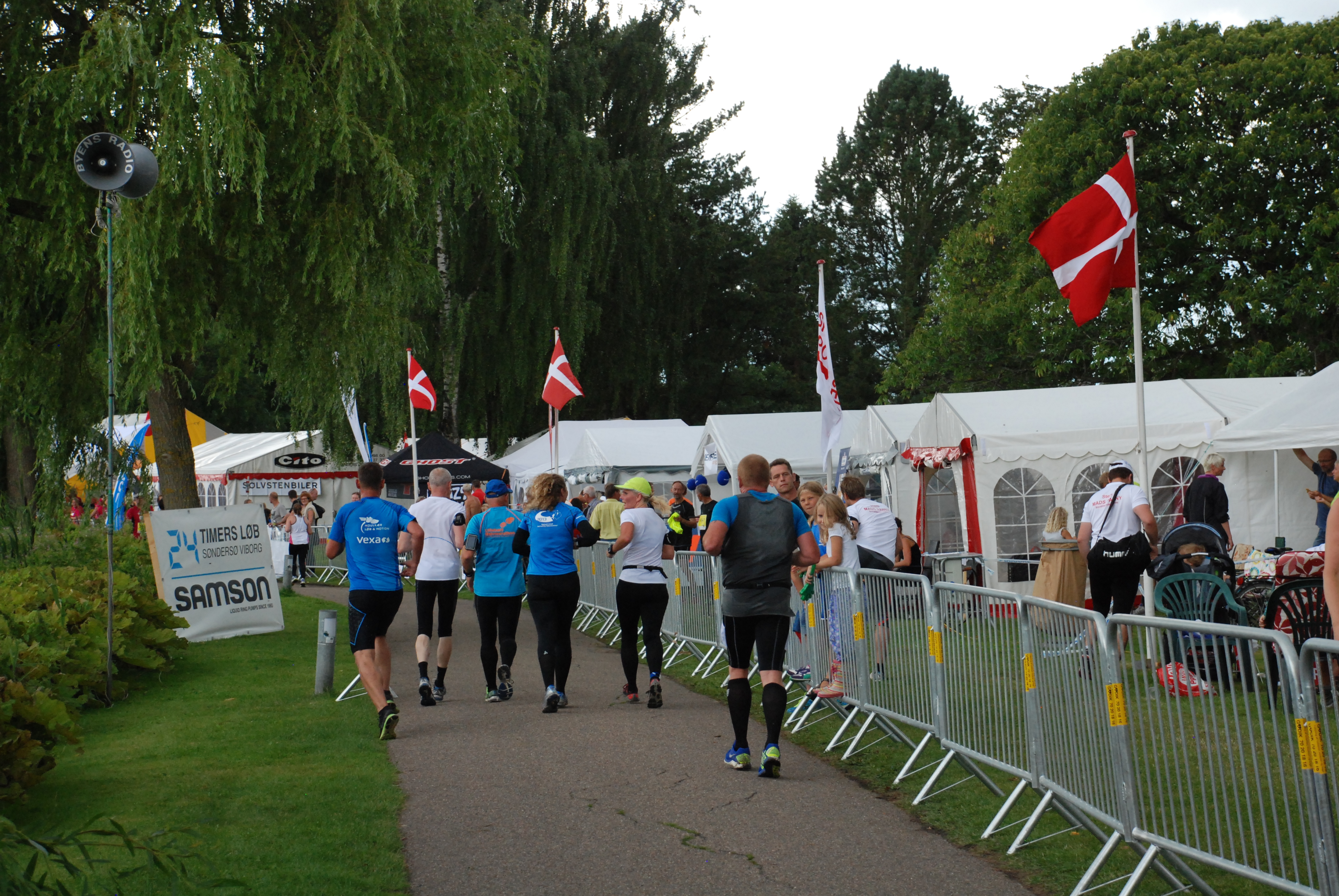
The run takes place on a 5.72 kilometre route around Viborg Søndersø. So the route is not particularly varied, and we had rich opportunity to study the town’s hospital and the towers of its famous cathedral.

The run was started at 12 noon by deputy mayor Klaus Keller. There were loads of activities that day. I didn’t get to enjoy any of it, but it was great for Emil and members of the relay team. There was beach volley, an exhibition of gliders and rowing boats, as well as rowing machines and other equipment; scouting activities, sport dance displays, line dance, square dance, aerobics, karate, parachuting and agility displays. Nobody had a moment spare to get bored. On the Saturday night there was a disco and Sunday morning, a jazz band provided musical entertainment.
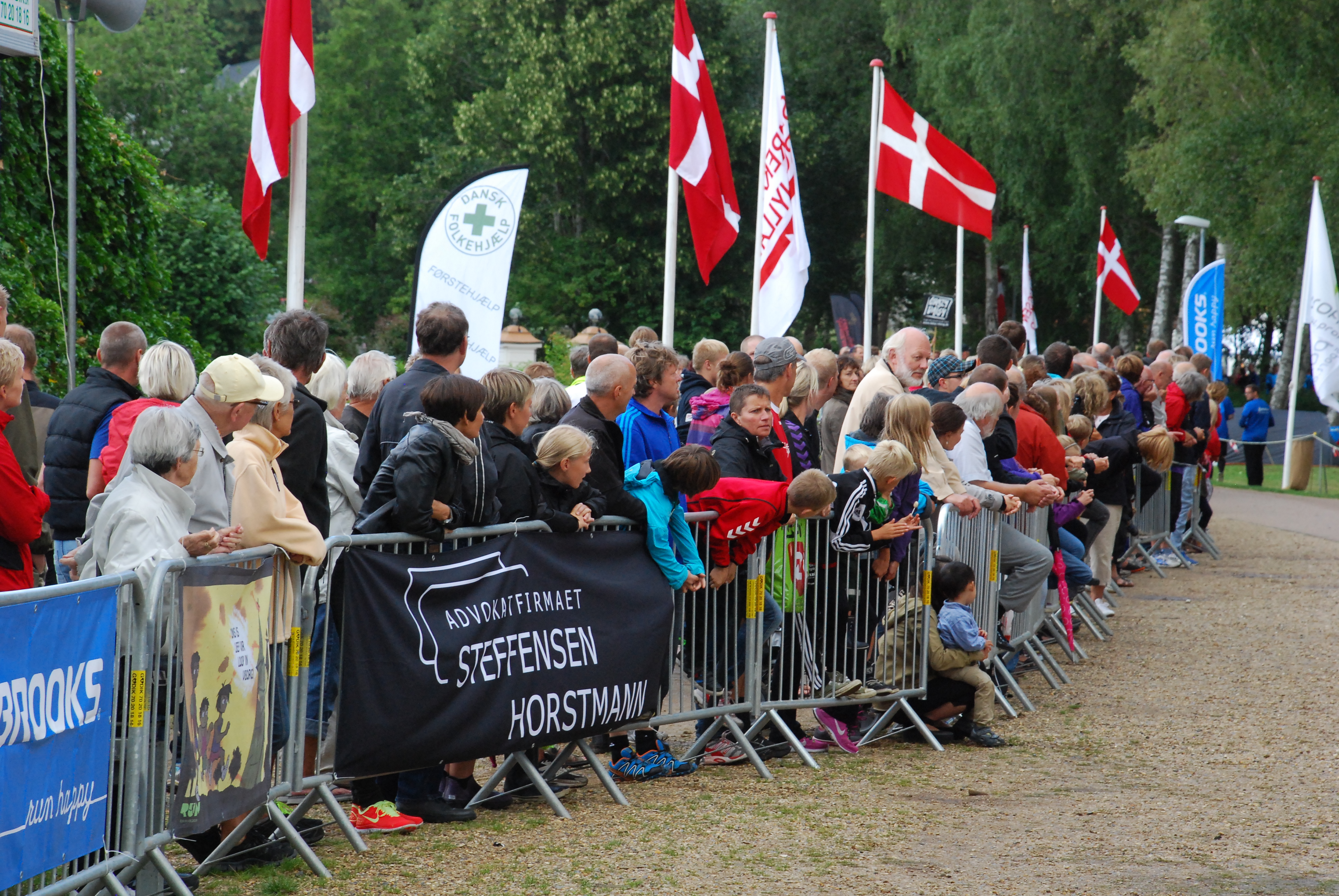
It was up to each runner and relay team how much they wanted or were able to run. To begin with, I kept Rolf company, although I ended up going solo at some stage.
At one point, 42.195 was written in chalk in the middle of the road. That’s the marathon distance, of course, but what was it doing here? I found out that it had been written especially for Tage Johansen, a doughty Jutlander from Frederiks, who had set himself the goal of running 130 marathons that year. Two of these were to be run in Viborg that weekend. He was to run one on the Saturday and another on the Sunday. So Tage was supposed to do seven rounds of the lake and then finish up at the point marked in chalk. Unfortunately, the Guinness Book of Records in London subsequently refused to recognise his record because his runs had not been official marathons as such. All Tage’s runs were on officially marked up routes, and he had officials at all the runs, but this was not good enough for the famous record book.
The weather on Saturday afternoon was good, and I enjoyed it all. I often passed the finish and our tent and was cheered heartily by my boys and the Kenya Safari Team people. The same also happened along the route when I was overtaken by the group’s runners, which, of course, happened quite a few times. Towards evening I was given food and massage in a tent after which I set off once more. As it began to get dark it wasn’t quite as pleasant, but I was still in good spirits. It had now started to rain, and the spectators gradually disappeared. But for a while yet, someone stood at the chip mat which was measuring our laps, and here there was water and food to be had as well. At one stage, when I was thoroughly saturated, I was given some hot bouillon. That was just what I needed.
After midnight, the finish was unmanned, although I was overtaken by others from time to time. Then we perhaps exchanged a “hi”, but running in the dark was otherwise pretty lonesome. And on parts of the route it was pitch dark. The organisers had lit garden torches in some places to light up the path, which we otherwise would never have been able to see.
In the middle of the night, I was in serious trouble. I was thoroughly soaked by the rain and had gradually become tired and exhausted. This meant that I lost my sense of direction and left the route on several occasions. Suddenly I would find myself standing there in the dark on a lawn in front of a bush, unable to go any further. I then had to look around and find my way back onto the path, and I found this to be rather concerning. The times I did this I left the path at the right hand side, but if I had left it on the other side, I might have ended up in the lake. I was aware of the fact that this could have been fatal at that time of the night and in my physical condition.
Then I suddenly realised that lamp-posts had been put up along the path where it was previously dark. I was bemused at first by the fact that somebody had put up lampposts early on a Sunday morning, but there was an explanation. When I got up close to a “lamp-post” it turned out to be one of the garden torches I had seen earlier in the evening. But then I caught sight of more “lamp-posts” on the horizon, and they also turned out to be garden torches. I now realised that I skated on thin ice although I still was aware that something was wrong and that it would be irresponsible to go on like this. Next time I arrived at the finish, I went to our tent and crawled into my sleeping bag. I set my mobile to wake me two hours later, then nudged Steffen and asked him to make sure that I got up.
When the two hours had gone by, my phone started emitting its irritating ringing tone. I turned over and crept further into the sleeping bag. Steffen jostled me and said I should get up. I didn’t want to. I could hear the rain drumming on the roof of the tent and had no desire to run at that time. But Steffen didn’t give up easily and in the end he kicked me and shouted, “You must get up Dad”. I was caught between a rock and a hard place. Was I to accept Steffen’s rough treatment or should I go out into the rain? I ended up doing the latter. I have since rejoiced at Steffen’s perseverance. Just think if I had snored away an entire morning in a tent on the banks of Søndersø where I was supposed to be participating in an ultra-run.
When I first got out of the tent, the rain wasn’t as bad as it had sounded inside. It was raining that was for sure, but then I had tried that so many times before. I put on dry running clothes and then things went marvellously. After several laps, I went to the food tent and got breakfast before continuing to run all morning.
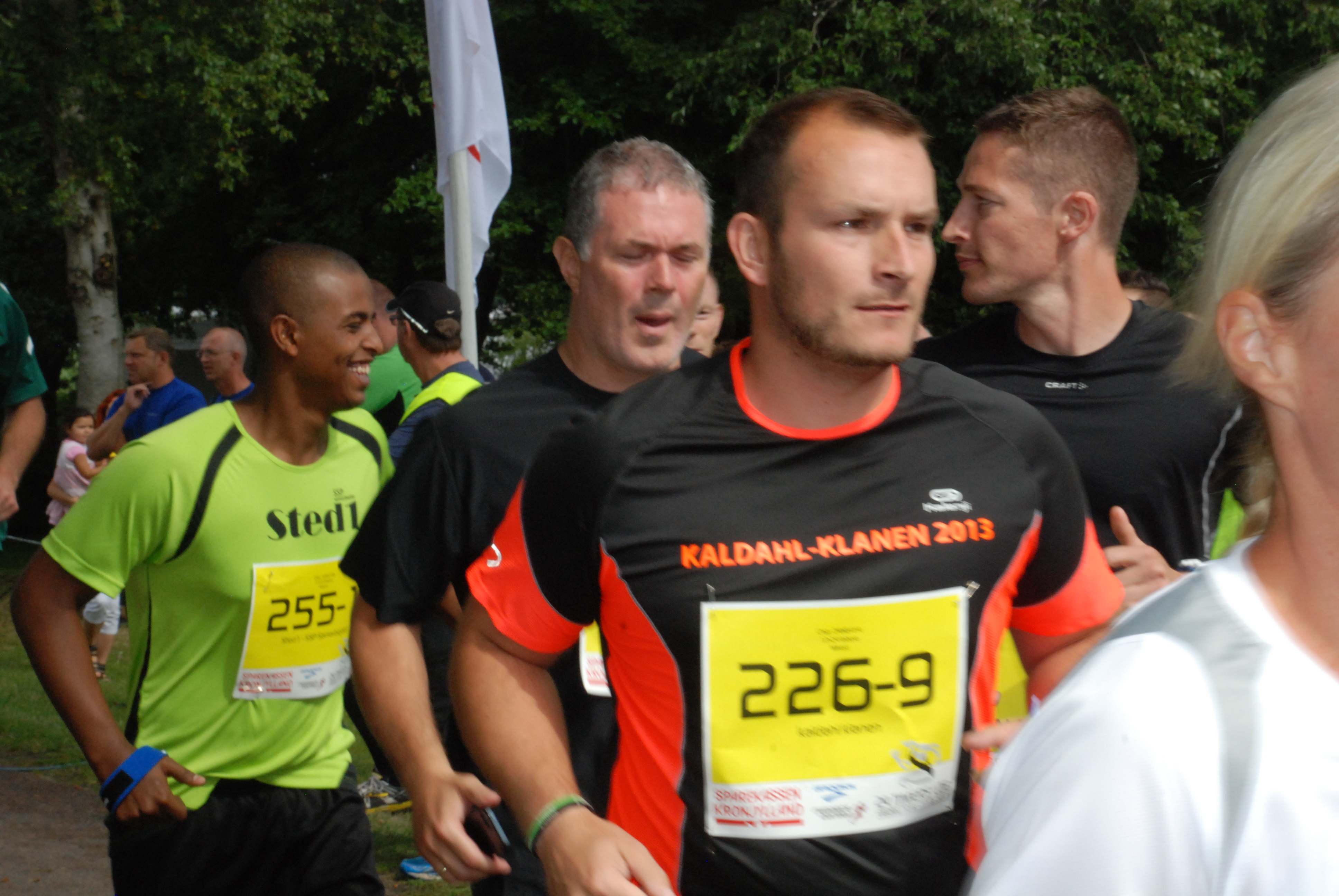
I had had no way of assessing how far I could run in 24 hours. I had thought that 24 laps would be just fine. That would have been the equivalent of about one lap every hour, but after 23:45:47 I crossed the finishing line for the 23rd time and had finished my run. The distance I had put behind me was 131.56 kilometres, equivalent to a bit more than three marathons. I was thrilled to bits by this performance which, by the way, was the same as Rolf’s. The Kenya Safari Team ran 49 laps, more than twice what I did. But with 16 participants in the group they were also able to start every lap on fresh legs.
I was completely drained of all energy and very tired, so I was not the one who should drive the car home. Fortunately we were together with Kim and his girlfriend, and as a relay runner he was not as used up as I was. So the experienced taxi driver drove the car while I slept my sweet and well-deserved sleep.
Buy the book here.
